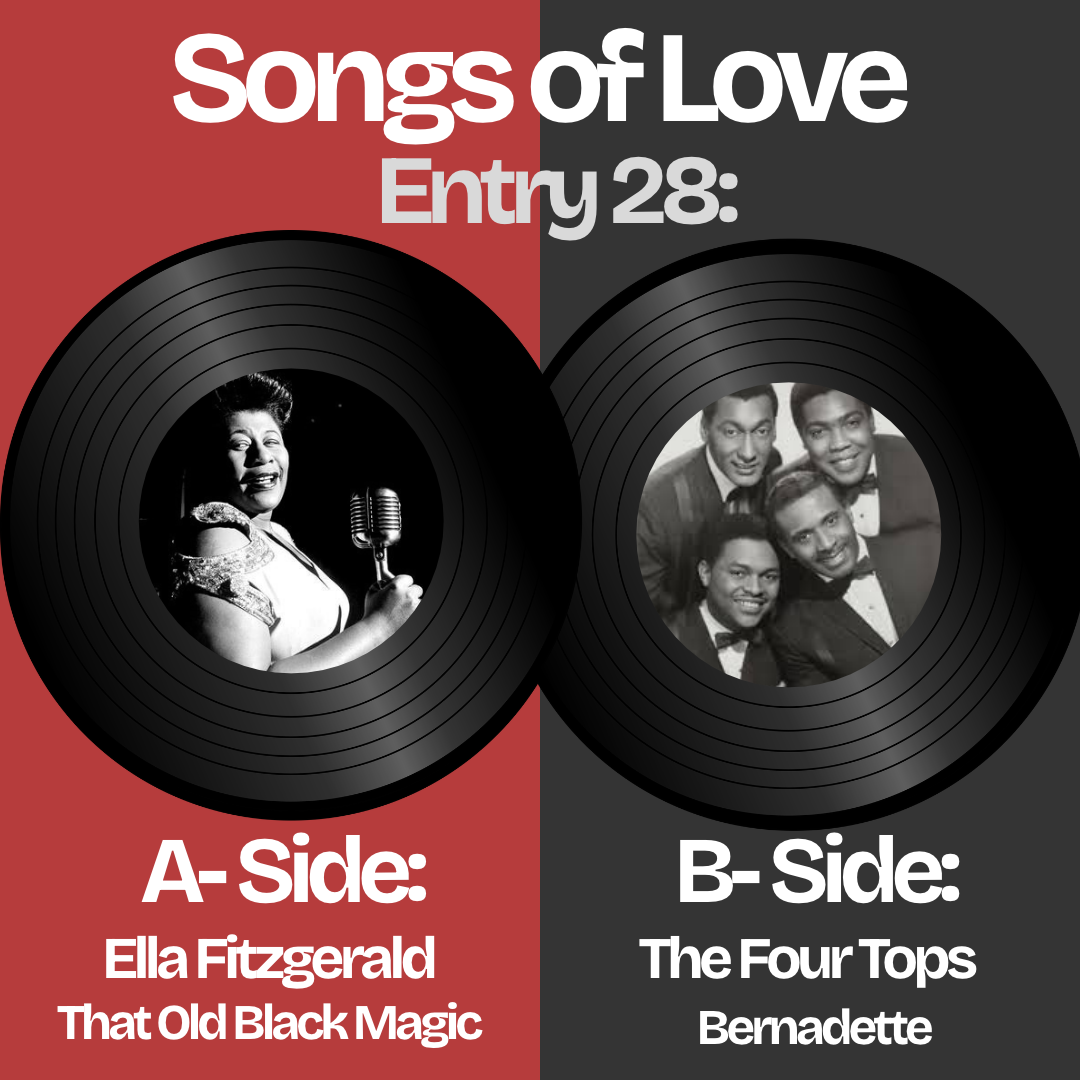
Songs of Love 28: Love as Magic
Love, perhaps more than any other element of human experience, seems to defy the rational. Perhaps that’s why so many love songs invoke ideas of destiny, or of the divine, or otherwise take on quasi-religious or spiritual modes. Being in love, and even falling out of love, seems to demand an explanation beyond the strictly material. Our A-Side this week takes that on in a very direct way, where our B-Side is closer to a kind of ritualistic invocation, as we’ll see. Either way, the everyday world seems to fall away, or even be a source of threat in the case of the latter, to be replaced by something unique and, in the strictest sense, awe-inspiring.
A-Side
Performed by Ella Fitzgerald
Written by Harold Arlen and Johnny Mercer
Released 1955 [1]
How often have you heard talk of the “chemistry” between two people? It might refer to two podcast hosts who have a nice repartee, or two people who click and become friends in a matter of minutes, but most often, we use it to refer to romantic relationships (or the appearance of one, as in a film). The “chemistry” between people stands in for all the little micro-reactions and interactions that we hardly even notice on a conscious level, but that add up to two people working very well together.
The thing is, talking about love as “chemistry” suggests something broadly scientific, something that can be measured and quantified. But that’s not really the experience of love or of relationships more generally. It’s feelings and impressions, things that operate on the level of the unconscious. There’s no love particles bouncing around to be tested, and as much as chemistry as a science deals in bonds, that’s no more than a fanciful metaphor.
No, love is most often far stranger and more irrational than that. So why not just think of it as magic?
We already draw on ideas of magic in thinking about connection at times – we speak of being “under someone’s spell,” for instance, or of being “charmed,” a term heavy with connotations. And it’s precisely those ideas that this song is drawing on, using terms like “magic” and “witchcraft” as a metaphor for that kind of powerful connection between people, and even gesturing towards fate as a guiding principle. We are very much in a world beyond the rational and the material here, which is just how love feels.
But there’s a curious note to that: why “black” magic specifically? After all, we think of black magic as something inherently dangerous or evil; “harmful or malevolent,” or involving “the invocation of evil spirits,” according to the OED. It seems to originate in early modern accounts of witchcraft and fey magic [2], where it often stands in for trafficking with devils. Not the sort of thing you would expect to be drawing on in a love story, as a general rule; or at least, not one with a happy ending.
Then again, it’s not too hard to see the connection. Something powerful, otherworldly, irresistible. Something that can neither be denied nor explained. And the fey connection brings us right back to that idea of charming, which is something that devils are also notoriously good at. There is something about the power of love that here feels dangerous, maybe even immoral, something to be resisted, as we’ve seen many times before – “I should stay away, but what can I do?” This is a “burning desire,” after all.
There is, however, another connotation to “black magic” that is particularly notable when the song is performed by Ella Fitzgerald – or indeed Sammy Davis Jr. or Nat King Cole or several others who have done versions. The idea of black magic is even now often associated with “primitive” cultures, often located in Africa, and attributed to some kind of shaman or other pseudo-religious figure – very often, animal or human sacrifice is involved. Like “voodoo,” it takes genuine religious or cultural practices and moves them into the realm of racial stereotype. And indeed more generally, “black” always carries the connotation of being evil and suspect, which then carries over into the people who bear it as a racial descriptor.
But this song embraces black magic. Here, it’s something inescapable, even pleasurable. At a stretch, we could see something counter-hegemonic in that, perhaps even a celebration of black pleasure. Implicit in that embrace is a revelling in the forbidden, the taboo, like an indirect take on ‘The Dark End of the Street.’ Love breaks down barriers and makes prejudices look silly. And here’s a black woman at the heart of the American entertainment industry in the 1950s reminding us of that. There’s something heartening in that message, if we choose to see it.
[1] Fitzgerald recorded several versions of the song, including quite a few live ones. I’ve linked the 1955 recording, originally from her album Sweet and Hot, but everything I say here applies to any of her versions.
[2] The earliest usage cited in the OED is in Book 3 of The Faerie Queene, from 1590.
B-Side
Performed by the Four Tops
Written by Lamont Dozier, Brian Holland and Eddie Holland
Released 1967
We’ve been here before, of course. Relatively early in this project, we looked at another Holland-Dozier-Holland Four Tops song, from the same album as this: the sublime ‘Reach Out I’ll Be There.’ And now we come to the flip side of that song [1], which I described as “matching the depths of despair into which the singer’s lover has fallen.” Here we have a song that, while not quite in those depths, seems to be teetering somewhere on the edge.
That might seem a surprising statement for a song that, on the face of it, centres on the singer boasting about his relationship with his beloved Bernie. But as with ‘Reach Out I’ll Be There,’ this is a song that reveals the limits of an overly logocentric lyric-based approach. The key here is Levi Stubbs’s vocal, which reveals what’s really at play here.
Like its cousin ‘You Keep Me Hangin’ On,’ ‘Bernadette’ begins with a repetitive riff, suggesting a Morse Code message – calling for help, or perhaps just searching for connection. Despite this, the opening lines centre on pride, not only in the lover, but in their relationship: “some go on searching their whole life through/And never find the love I found in you.” But that pride quickly turns into fear and insecurity. The singer is obsessed with the “envy in other men’s eyes” and the threat of them persuading Bernadette from his side, and so he pleads with her in increasingly extreme terms – “I need you to live.” The problem being, of course, that this kind of neediness is not especially appealing in itself, which doesn’t seem to bode well for the future.
And the singer seems to realise this. The song is written in a difficult key for Stubbs, and the strain in his voice comes across as wide-eyed desperation as he informs Bernadette that he’s the only one good enough for her, and also she belongs to him, and also he needs her in order to experience peace and joy, and also they’re meant to be together. Only in the bridge does he sound vaguely comfortable as he contemplates the peace of mind he experiences with Bernadette, but soon enough he’s back to contemplating the threat of other men.
More than anything, he just can’t seem to rest. Even as the song seems to be ending, as the band settle back, as we assume he’s said all that needs to be said, he forces it back into being with a jump-scare “BERNADETTE!” Her name becomes an invocation, a kind of ritual prayer, repeated at least thirteen times by Stubbs (not counting the backing vocals) across the song. Is he naming her in order to summon her, or trying to take control of her, like a malevolent fey, by taking possession over her name?
Either way, the name is at the core of the song. Chris O’Leary (still my one-stop shop for all things Tops) notes that it could have constituted the entire lyric, such is the singer’s obsession with it. There’s a relish in the act of singing it, luxuriating in the syllables. Like Nabokov’s Lolita, the very act of saying the name seems to become an erotic act, edged by danger (though here of a very different kind than that which Humbert Humbert represents, albeit jealousy is his ultimate undoing too). And like with Nabokov, we’re conspicuously lacking in Bernadette’s perspective. She’s a vaguely spectral, otherworldly singer, longed into being by the singer. And like him, we can’t quite shake the feeling that she’s somehow moving further away.
[1] Not literally; ‘Bernadette’ was a single in itself, sandwiched between the similarly gothic ‘Standing in the Shadows of Love’ and ‘7 Rooms of Gloom.’