The Games of (My) Life: 1996-2000
Around the age of 6 or 7, my relationship to gaming changed significantly, taking on more of a sense of ownership – literal ownership of consoles and hence games themselves, but also of franchises. Like with books or films, I was finding games that were mine, to which I had a relationship relatively separate from my siblings or even my parents. And from those games flowed franchises to which I’ve been in thrall ever since, chiefly Pokémon and Zelda. In the same way that Disney animation takes up root somewhere deep in children’s unconscious minds, these games wormed their way into mine, and they’ve stayed with me in all kinds of ways ever since. Not the least of which is that I’ve replayed some version of three of the five games to follow within the last five years, so they retain a fairly direct presence in my cultural diet.
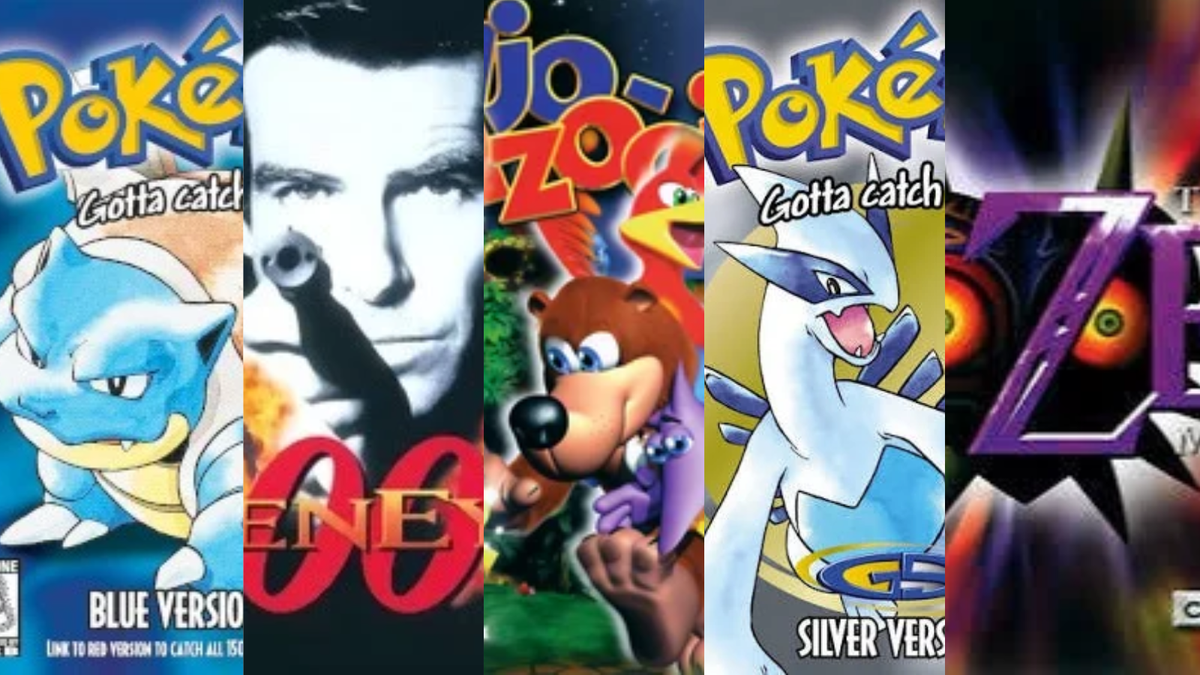
1996: Pokémon Blue
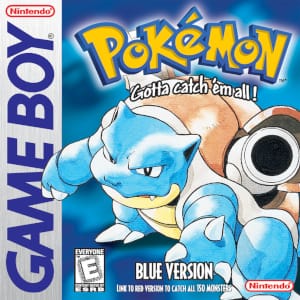
A couple of years ago, I saw a “what your favourite Pokémon game says about you” meme, where Pokémon Red/Blue being your favourite meant “you are approximately 35 years old,” Gold/Silver being your favourite meant “you are approximately 32 years old,” Ruby/Sapphire being your favourite meant “you are approximately 29 years old” and so forth. The point is obvious: the Pokémon game of which you have the fondest memories is your first one, the one that you played when you were a child. The thing is, that’s actually not true for me, as you’ll see a little further down this list. But it’s hard to argue with the idea that Blue, the iteration I had, was my most important Pokémon game.
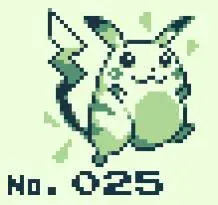
I started with the anime, as I imagine many others of my age did, and so the games were a slightly odd experience, with the Pokémon themselves looking relatively crude (Pikachu in particular is almost unrecognisable, far rounder than the more familiar version), and almost unrecognisable, stilted versions of beloved characters like Brock and Misty. But they also tapped into the desire inculcated by the anime: to become a Pokémon trainer myself. If not to catch them all (a feat I never achieved), at least to find my favourites, and journey with them.
And that desire has, oddly enough, stuck with me for almost three decades. To this day, every six months or so I’ll get a hankering to boot up a Pokémon game and play for 30 hours or so. It’s a tribute to the remarkably addictive gameplay loop, based on JRPG fundamentals. Battle, gain XP, win your way through a series of towns with different personalities, explore caves and dungeons. There are several other games and series on this list that could be described thus, but Pokémon was my first, and it left a very special impression. A mere glance at how many of my childhood toys were Pokémon-themed will tell you that. Much of my childhood was Pokémon and Harry Potter. And the former doesn’t directly fund a raging bigot, so that’s another point in its favour.
1997: Goldeneye
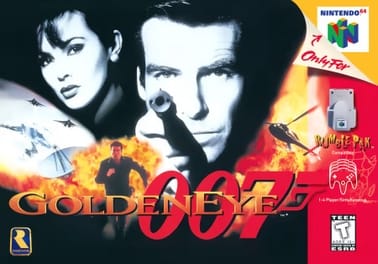
This is something of a throwback to the last entry, because Goldeneye was perhaps the defining game of my childhood that I never owned. Which stood out all the more strongly because it seemed like all of my friends did. I’m not sure whether I was actively not allowed to get the game (my parents were quite hot on age restrictions, so it’s very possible) or I just never tried, but while I played it many times at friends’ houses, I never once owned it.
And yet I was quite familiar with it. Even now I can remember the rough layout of several levels, such as the opening dam, or the St. Petersburg park. Given that I hadn’t seen the film (and still haven’t, oddly, despite having seen most of the other Bond films), I ended up with a distorted half-picture of its narrative. There were two women, who consisted largely of blocks, one of whom was some sort of hacker, and there was another 00 agent, who seemed to die early on but turned out to have survived and become the baddie. That was about the extent of my knowledge. Presumably Pierce Brosnan was in it, but we didn’t really see him from the first-person perspective, so I had to take that on faith.
And then, of course, there was the revolutionary split-screen multiplayer mode. Unusually, I think I played this less than the single-player, and my major memory is that Oddjob reined supreme thanks to his slightly smaller size and lethal hat. When I finally saw Goldfinger years later, it was a surreal experience to discover that he didn’t actually seem all that threatening.
Another thing that stands out in hindsight is that the game had a surprising amount of cultural presence. I can vividly remember a primary school teacher referring to the death animation, where blood comes down the screen. This is, of course, a reference to the opening of every Bond film, where the viewer is shot by Bond, thus making a terrible first impression, but I can distinctly remember that the teacher was referencing Goldeneye the game (I suspect not from direct experience, but who knows). In an era when for most people gaming was mostly just Mario and arcade games, perhaps it was the beginning of a minor cultural shift.
1998: Banjo-Kazooie
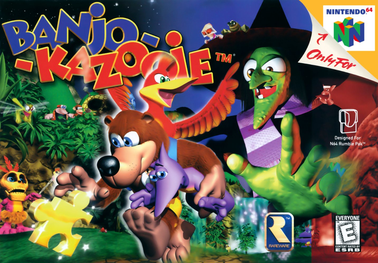
This was a difficult decision. I had a real internal debate over whether to choose this or Ocarina of Time, a huge touchstone for me and another game, like this one, that I played to death (not to mention a topic that would provide excellent SEO with the imminent remake). Ultimately, though, it came down to personal relationship: I adore OoT, but so do hundreds of thousands, at least, of other people my age. Whereas Banjo-Kazooie, though not really a deep cut, feels more mine, somehow.
I mentioned in the last batch my affiliation with platformers based around anthropomorphic animals and objects, and this is perhaps the king of them all. Practically everything in Banjo-Kazooie has eyes and a voice, from the rocks you can stomp at the beginning of the game through some of the pipes on the Rusty Bucket ship to the protagonists, a bipedal bear and the red bird who lives in his backpack, both named after the instruments they play in the game’s intro cutscene (and nowhere else). It’s a weird and wacky world, full of vibrant colours and bouncy sounds, all underpinned by Grant Kirkhope’s chirpy and inventive soundtrack. I’ve never taken any kind of hallucinogen, but if I did, I imagine what I’d see would look very much like Banjo-Kazooie.
I sometimes wonder how much its sense of humour affected me. As a reader of comics like the Beano, I was no stranger to meta commentary, where characters would comment on the medium in which they found themselves. And like those comics, there’s something fundamentally anarchic about Banjo-Kazooie’s odd world of transforming animals and a vaguely racially insensitive shaman[1], menaced by a witch who talks in rhyming couplets with perfect iambic tetrameter. It feels a little like how people who were around in the late 60s talk about Monty Python’s Flying Circus – just a fundamentally odd piece of media which cuts through all the more for that strangeness.
And despite, or perhaps because of, its numerous sequels which get exponentially more charmless as they go on, it still feels that there’s nothing quite like Banjo-Kazooie out there. Even its spiritual successor Yooka-Laylee, while retaining a hint of that charm, is far less intuitive to play. I still go back and play Banjo-Kazooie (and, to a lesser extent, Banjo-Tooie) every couple of years – in fact, I’m about overdue for a replay right now. Even now, returning to that world is still a lot of fun – not just for nostalgic value, but on its own merits. After almost 30 years, it still simply delights me.
1999: Pokémon Silver
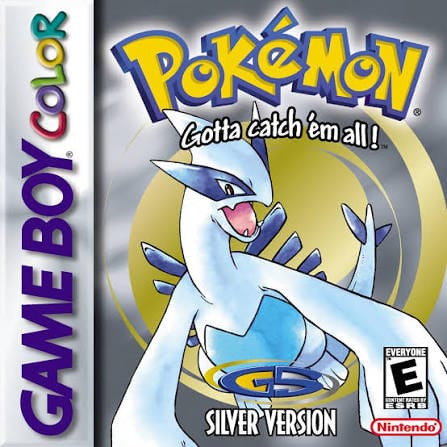
A matter of paragraphs ago, I mentioned that Pokémon Red/Blue, while my first Pokémon game, is not my favourite. Well, you need be tantalised no longer: Gold/Silver is my favourite iteration (or, more accurately now, the remakes Heart Gold and Soul Silver). I could give lots of reasons: the dual regions, the breadth of design, the introduction of several of my favourite Pokémon. But really, that meme from earlier wasn’t entirely wrong. Silver isn’t my favourite because it was the first Pokémon game I played. It’s my favourite because it was the second [2].
I spent what felt like months reading previews in games magazines, looking at every new Pokémon design and wondering what it was like, how rare it was, what its moveset might be. It was my first real experience of what we’d now call a hype cycle; the idea that you could get excited and enthusiastic about a game that you hadn’t yet played. Along with the very next entry on this list, it was an early exercise in anticipation, you might even say in dreaming.
Because, as a child and even as a teen, it’s fair to say that I actually played a relatively small proportion of the games that I read about. I was very far from being deprived, it should be said; it’s just that I read about games so voraciously that there was an inevitable mismatch between what I read about and what I could play. I’m quite glad Twitch and YouTube weren’t around at that time, otherwise who knows how many hours I’d have whiled away watching playthroughs (probably much the same as those I spent in similar fashion in my twenties, come to think of it). I can distinctly remember spending hours poring over a strategy guide for Hitman 2, a game I wouldn’t play until several years later, and imagining what it must be like to play.
Which sounds a bit sad, but really wasn’t. The game that exists in your head is perfect and pure, with no fiddly control schemes or bugs to let it down. Which is not to say that I was let down in this case: I devoured Pokémon Silver over untold hours. It’s the game I brought on holidays, that consoled me when my beloved crocodile pool float ripped. I even played an early fan translation before the game’s official English release. It has any number of childhood memories attached to it, and I also happen to think it’s the best and most rewarding of the main series games, with two regions and hence two sets of gyms, and a relatively slow level progression meaning no real difficulty spikes.
It also inaugurated an odd trend in my purchases of physical Pokémon games. I bought Pokémon Gold, and opened the box to find Silver within. A few years later, I bought Pokémon Ruby, and found Sapphire inside. A few years after that, I bought Pokémon Pearl, and found Diamond inside. I didn’t buy another physical edition until Pokémon Sun, and since then (across Sun, Sword and Scarlet) I’ve always found the right game within. Strangely, I feel a little melancholy about that. I miss the simple touch of an overworked employee reaching into a drawer and pulling out (very slightly) the wrong game to slot into your box (steady on there). It’s a reminder of the demise of brick and mortar game shops, and the concentration of the market into a small handful of online retailers.
Which is a bit depressing, so let’s cheer ourselves up with another nice, happy game from my childhood.
2000: The Legend of Zelda: Majora’s Mask
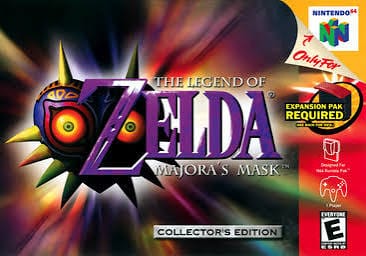
Oh. Oh well.
I’ve said a lot about Majora’s Mask and its profound effect on me already, and honestly don’t have a great deal to add to that. With the OoT remake on the horizon, I’m both excited and trepidatious about the idea of MM getting its own remake (which is not confirmed, but widely speculated). It could so easily go wrong, and undermine the uncanny atmosphere of the game, especially now, when the primitive-looking N64 graphics feel all the more haunting. As with the OoT remake, though, there’s no doubt that I’d play it. It’s too fundamental to who I am for me to avoid it.
One thing worth noting: to my slight surprise, this is not only the first Zelda game on the list, but also the last. I’ve enjoyed plenty of other games in the series, and considered a few for later entries, chiefly Wind Waker and Breath of the Wild. As much as I’ve loved those games and others for what they are, though, it does at times feel like I’m really just chasing the high of my childhood from the two N64 games (and possibly WW, which came out when I was 12 and was another game I anticipated for months before its actual release). It’s a further indication of how much taste is formed in these relatively early years, I suppose – on some level, maybe we’re always just chasing that kind of high.
[1] Though, while Mumbo Jumbo might just be ambiguous enough in his origin or ethnicity to get away with it, Banjo-Tooie introduces Humba Wumba, a Native American medicine woman straight out of a 19th-century cartoon.
[2] Well, ish. Realistically Yellow was the second game I played, but I count that as more an expansion of Red/Blue.