Songs of Love 13: Loving an Ideal
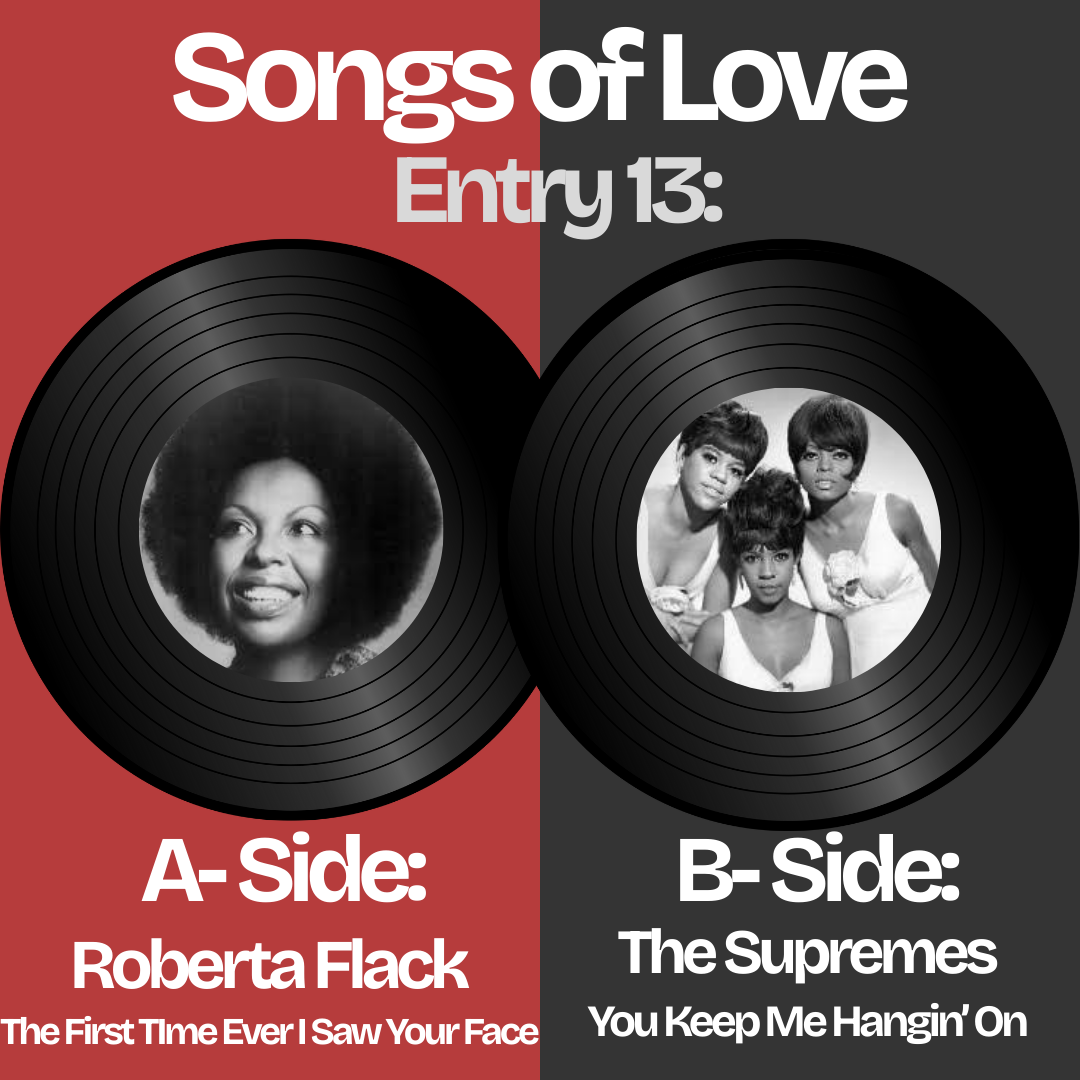
Well, 'tis the season of love. And as it happens, the playlists from which this project grew began life as a Valentine's Day project, growing out of a radio show a decade ago. So to mark the occasion, a double-helping of posts - number 13 today, on the 13th, and number 14 tomorrow, on the day itself (I'd love to claim that I planned this, but it's pure serendipity). And as it happens, it's two posts that I think go together particularly well.
Ideals, and idealisation, are so often at the heart of not only love songs, but how we think about love more generally. Being in love with someone has a way of flattening out their faults to become at best non-existent, at worst eminently excusable. Even love itself is idealised, in concepts of love at first sight, of soulmates, of perfect relationships that endure regardless of any setback. But ideals can be dangerous. An ideal is not a person, and treating one as the other sets us up for disappointment, even danger. Our B-Side this week is a perfect example of that. But that’s not to say we should cast ideals aside either. An ideal is something to aspire towards, something to live up to. Ideals can better us, just as long as we see them for what they are.
A-Side
The First Time Ever I Saw Your Face
Performed by Roberta Flack
Written by Ewan MacColl
Released 1969 (didn’t chart until rereleased in 1972)
We’ve touched before on the idea of love at first sight, of the moment where you see your lover’s face for the first time, bathed in heavenly light and with choirs of angels chanting Handel in your ear. It’s a familiar trope, not just from Hollywood, but in popular song; a quick search turns up plenty of songs with titles like ‘Since First I Saw Your Face’ from as far back as the 16th century[1]. In Middlemarch, the romantic artist Will Ladislaw hums a song called ‘When First I Saw Thy Face;’[2] later, he will trace his love for protagonist Dorothea Brooke back to their first meeting in Rome. This idea of the decisive, catalytic moment of change appeals to the romantic impulse to imagine a life changed utterly by another person, even to ideas of soulmates and predestination at times.
And here, unlike with previous entries, we have a song that plays this trope reasonably straight. The lover is associated with heavenly bodies, with nature (“the trembling heart of a captive bird”); they fill the sky and move the earth. It’s classic romantic hyperbole, of the kind we’ve seen here before – which is not to underplay its effectiveness. There’s a reason this kind of language recurs in so many love songs: because it really does capture the sense of a person filling your entire world. And even though this song is reflective rather than being of a particular moment, it’s a reflection that still keeps those moments alive.
The song has a neat structure to it; rather than sticking with that first decisive moment, it moves through three of them: first sight, first kiss, first time sleeping together. Flack was quoted as saying that, similar to our last A-Side, she liked the ambiguity of the song in terms of what kind of love it was about, suggesting that it could refer to a parent’s love for a child[3]. I don’t like to suggest that any interpretation of a song is invalid, least of all that by its most influential performer, but I’m not sure this really survives any kind of analysis of the lyrics. “The first time ever I lay with you” isn’t strictly sexual, true, but the aforementioned progression does seem to suggest that, and lying next to a baby for the first time is not really an experience that tends to be recorded in this way (then again, I’m not a parent, so perhaps I’m wrong about this).
There’s also, of course, the fact that the song was written by Ewan MacColl for his lover and later wife Peggy Seeger, which doesn’t disqualify other interpretations by any means, but does direct attention for sure. Both MacColl and Seeger disliked the Flack version, and many other versions, though Seeger claims to have come around to it since. It’s not hard to see why, in comparing it to Seeger’s version(s). In Seeger’s hands, the song is a straightforward statement; a romantic one, for sure, but one to be delivered sharply, one which will speak for itself without frills. Flack’s version, nearly two minutes longer, is almost all frill. Flack luxuriates in the sentiment, the delivery as significant as the message itself in its romantic overtones. It’s also not hard to see why Flack’s is the more enduring, for the same reasons. It’s a song that speaks directly to love in its own language. It sounds like what it’s like to fall in love, and to reflect on it at a distance. It doesn’t just describe the encounters; it re-enacts them. Sometimes the direct approach is best, but a song like this, that is so much about the experience of love, seems to demand grandeur.
[1] As so often with this sort of thing, the trope of looking on a face and feeling overwhelmed slides back and forth between devotional (‘Lord Jesus Christ We Seek Thy Face’) and romantic songs, often sharing language of worship and rapture. The kind of immediate love described in this paragraph has something of the Damascene conversion in it, for that matter.
[2] Clearly expected to be familiar to George Eliot’s audience, but I haven’t been able to find this song, unless it’s identical to one of the aforementioned songs with a bowdlerised or misremembered title.
[3]This is quoted (from a print source which I can’t track down) on the song’s Wikipedia page, which does strangely appear to be conflating two quotes from decades apart together, but provides sources for both.
B-Side
Performed by The Supremes
Written by Lamont Dozier, Brian Holland and Eddie Holland
Released 1966
A caddish man revels in the need a woman has for him, constantly playing with her affections. He doesn’t seem to value her particularly, but her love for him satisfies his ego, and so he strings her along at every turn, coming in and out of her life and never allowing her to move on. Even after they’ve broken up, he remains in her life, claiming to want to be friends. And she recognises all of this, seeing the coercive control playbook, pleading with him to stop at every turn, a plea which he evidently ignores[1].
It doesn’t sound like the stuff of a beloved pop classic. But as we’ve seen many times before, emotional extremity is very often what resonates with the record-buying public. Especially when it’s married to a driving Motown beat.
And that last point is in fact an important one. It’s easy to think, as Vanilla Fudge did upon hearing the song on the radio, that what this needs is to be a slowed down dirge, with the singer wallowing in their own despondency. In fairness, plenty of songs treat that emotional terrain well with that kind of arrangement, and the swampy Vanilla Fudge version is far from a disaster. But what it loses is the original’s sense of utter desperation. It’s precisely the bouncy energy of the song that gives it this sense, of a singer flailing about for stability, of dancing through the pain.
Everything about the song screams this desperation. Even the opening guitar riff, inspired by the breaking news alert on the radio, comes across as a Morse Code SOS, a cry for help. The desperation is so powerful that it leaks out of the song itself and extends to its paratext – the song’s B-side, another Holland-Dozier-Holland composition, is called ‘Remove This Doubt,’[2] which comes across as an addendum to ‘You Keep Me Hangin’ On.’ The cover of the US single even makes the former look like a subtitle or subheading to the latter:
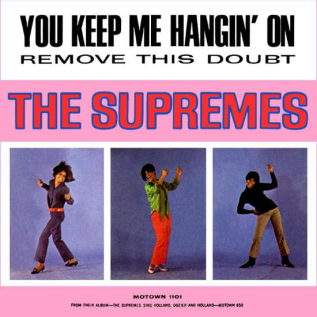
And this sense of need has come across to other artists. Apart from those who’ve covered the song down the years, there’s Lou Reed, who repurposes the phrase “you just keep me hangin’ on” to refer to an addictive relationship with heroin[3]. It’s one thing to liken a toxic love affair to addiction, but to do it the other way around, at least implicitly, is something we see far less often. It’s proof in itself of the resonance of this song; of how that wide-eyed desperation comes across.
[1]Even though this is a song that can be and has been covered by men, and even though men are of course also subject to abusive and controlling relationships, interpreting it as being about a woman subject to a man’s power seems to add an extra frisson to it, and so I’m foregoing my usual gender-neutral policy here.
[2]‘Remove This Doubt’ is in lyrical terms almost an opposite to ‘You Keep Me Hangin’ On’ in that it depicts a singer hoping that their love is requited, as opposed to that of the A-side, who knows well that hers isn’t.
[3]Reed disavowed this interpretation of the song, preferring to see it as a romantic statement, but I tend to think that the use of this particular phrase places the song into a more intense register than that, especially given Reed’s thin, pining delivery.