Songs of Love 15: Love on the Borderline
It's been a busy couple of months, so this project has fallen by the wayside a little, but here it is, back up on the road, with an entry I've been looking forward to for some time, no less.
Love is, to some degree, inherently counter-hegemonic. As a lover, it’s easy to consider oneself an outsider – something of a theme for the next few entries, in fact. Being in love puts you at odds with the world and society, if only in the sense of what (and who) it is that you value (yet another way in which it’s similar to religious devotion, in fact). And indeed, there’s a long history of love itself being criminalised or otherwise legislated against, whether in terms of queer or interracial relationships. The A-Side this week is very much playing in that kind of familiar territory: a love affair that is seen as morally wrong or at least taboo by wider society. But the B-Side is something different: a song that is well aware of its own sin, that wallows in that very sense of wrongness to a degree that seems almost parodic. It’s a reminder that being opposed to societal ethics doesn’t necessarily put you on the side of good.
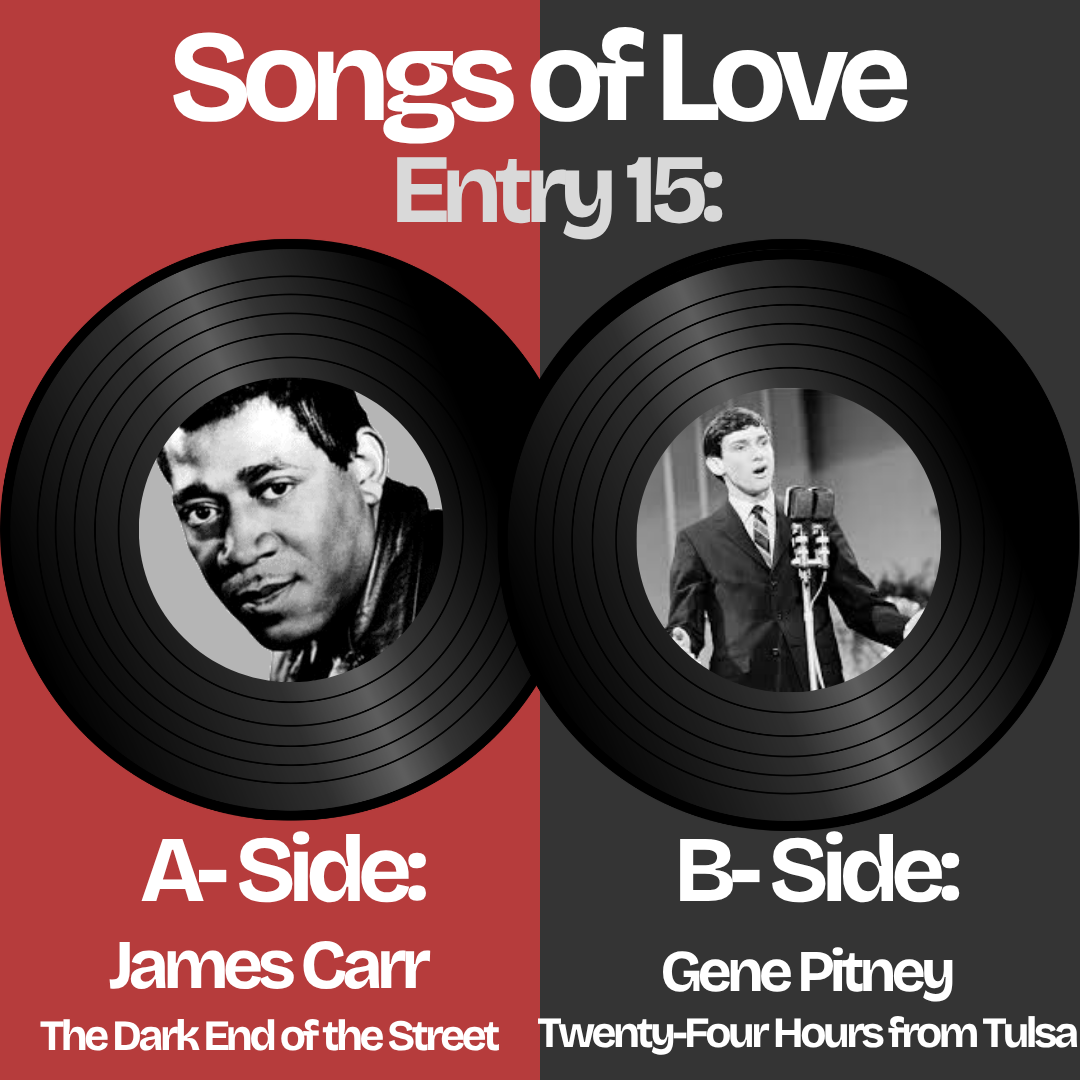
A-Side
Performed by James Carr
Written by Dan Penn and Chips Moman
Released 1967
At the risk of stating the obvious, not every love affair is open and obvious to the world. Some need to be hidden. There could be any number of reasons why – parental disapproval, societal taboo, simple embarrassment, or, of course, adultery (which is where today’s B-Side comes in, but we’ll get to that). Those reasons are, of course, quite distinctive from each other, and might prompt a range of different reactions from us, but in effect, they may be quite similar.
We have no idea what’s going on in this song, why the love affair needs to be hidden “in shadows.” All that we know is that the singer believes there to be something wrong (a word that recurs twice) about their love – “it’s a sin.”[1] Whether they actually believe that, or they’re ironically reflecting the judgement of others is something we can only guess at. What’s clear is that sense of judgement, expressed most clearly in the song’s bridge, with the phrase “they’re gonna find us” repeated three times, an expression of paranoia or of resignation to the inevitable. The love itself has been “stole[n],” suggesting a sense of defying fate – at some point, it’ll all come crashing down.
Perhaps the most tempting reading of this particular version, given the song’s origins in the mid-60s and Carr’s identity as a black man, is that the relationship in question crosses racial lines, and hence is taboo. But there are other possibilities: perhaps, as already noted in a footnote, it’s a queer relationship. Or it defies some other societal boundaries; the Commitments’ version might lead us to think it could be a cross-class relationship, for instance[2]. The song won’t tell us, as if adhering to secrecy even from the listener, and it’s that openness to interpretation that makes it so endlessly appealing.
This all seems quite dark and pessimistic, and there’s certainly that element to the song. But what makes it an A-Side is the sense of a love that’s irresistible, that acts as a refuge from the pressures and fears of daily reality, whatever those might be. For me, it’s the final verse that really elevates this song to the level of a masterpiece. The two lovers encounter each other in the city, in broad daylight, and don’t interact, each nursing the secret knowledge that they will be able to meet in darkness that night. It’s a beautifully romantic image, and also one with a real sexual frisson, given that air of the forbidden. At least in the short term, no sense of judgement or forbiddance will keep these lovers apart.
[1] A phrase which, in its echo of the Pet Shop Boys song, makes a queer reading of this song very tempting indeed.
[2] A scraggly, wrong side of the tracks youth from Ballymun meets a well-heeled private school-educated one from Ballsbridge. It writes itself, really.
B-Side
Performed by Gene Pitney
Written by Burt Bacharach and Hal David
Released 1963
There are a lot of love songs that talk about destiny, about the idea of being drawn inexorably towards someone across time. It’s a comforting idea, and a relatable one when you’re in the throes of love; that you were meant to be together. But there’s also a sizeable subgenre of songs in which destiny figures as a kind of antagonist which brought a relationship to an end. Think of ‘Idiot Wind’ – “it was gravity which pulled us down/And destiny which broke us apart.” That’s also relatable, in its way; the idea that even the end of the relationship was prefigured, that the events of your life are part of a grand tapestry (and, by implication, that there’s something to come beyond this ending, something that is right for you). And it’s also comforting, not only for those reasons, but because it’s an abdication of responsibility. After all, if the relationship was destined to end, then you didn’t really do anything wrong, did you?
Then there’s this song, which stretches that to, and possibly beyond, its breaking point. Because it’s one thing saying that kind of thing of a relationship where two people gradually grow apart. It’s quite another when a relationship ends because of a sudden act of infidelity.
The song is structured as a letter – an epistolary song, if you will (I will) – a familiar enough conceit. Think of Leonard Cohen’s ‘Famous Blue Raincoat’ (laid out like a letter in Cohen’s collected lyrics) or Olly Murs’ ‘Dear Darlin’’ (a song I find unaccountably moving, despite having heard it several times a day while working in a supermarket a decade ago). But where both of those seem to have as their aim, stated or otherwise, some kind of reconciliation with the letter’s recipient, there’s nothing of the sort at play here. The singer here is telling their lover that they “won’t be home anymore;” that’s the whole purpose of the letter. Well, that and to explain why, in rather more depth than the recipient would like, you’d imagine.
Because really, that’s the heart of this song. It’s the account of someone who knows they’ve done something absolutely awful – just listen to the glum self-pity in Pitney’s voice as he sings the final lines - and yet they’re obsessed with the idea of explaining it in detail, justifying it. If their lover can hear about how beautiful this woman they met was, the instant attraction between them, the details of their experiences dancing together, then they’ll understand. And then the singer won’t have to feel guilty about it all. It’s a delusion, obviously, but a powerful and oddly compelling one.
Ultimately, the singer wants to be seen as a victim of what’s happened, perversely. But the details of what’s happened betray them. At every turn, they are not only complicit, but active:
And so I walked up to her
Asked where I could get something to eat
I asked her if she would stay
There’s a touch of unreliability to the narrative too; the couple go from eating together to “dancing closely” without any intervening steps. All we get is the beautifully filmic transitional detail of the jukebox turning on and the morning light creeping in. Again, it’s as if there’s something inevitable about what’s happened here, as with the vaguely cosmic “welcoming light” that guides the singer to his new lover, like a star of Bethlehem for adulterers. And then there’s this:
All of a sudden I lost control as I held her charms
And I caressed her, kissed her
Told her I’d die before I would let her out of my arms
The affair’s beginning, or consummation, is portrayed here as a sudden attack of madness, the singer “los[ing] control” and coming on extremely strong to someone they’ve known only a few hours[1]. But this sense of madness actually feeds their self-portrayal as a victim. Once again, they want their former lover to believe that they lacked agency in all of this. It was the passage of time, it was a moment of madness. Over and over, in the chorus, they lament the fact that they were so close to home, as if sighing over the dramatic irony. As if this geographical nearness to their partner doesn’t actually make the betrayal worse.
The final chorus just nails home this faux-helplessness:
I hate to do this to you
But I love somebody new
What can I do
This one is a line longer than the other choruses, as if the excuse is here finally being stretched beyond breaking point. It’s all enraging, the kind of thing that prompts you (well, me) to shout at the radio – you don’t “hate this” enough not to do it though, do you? As for what you can do, well you could start by driving back to Tulsa and your partner rather than, by inference, abandoning your entire life on a whim. After all, they do tell us they can “never go home again,” so there’s no question of an extended moving out or separation period – this is a complete abandonment, this letter the only communication the singer’s erstwhile partner will ever receive about the matter.
And, of course, the perversity of all of this is utterly brilliant. Hal David has created a psychological profile of the kind of unhappy narcissist who lies to themselves and others to disguise the behaviour they know to be wrong. And Burt Bacharach has married it to one of his most arresting melodies, one which seems to promise romance and adventure at every turn (as does Pitney’s hip-shimmying delivery), such that the poison seeping through is all the more arresting. This is another of the songs I started this project for, like ‘Idiot Wind’ or ‘Glad to Be Unhappy’ (there are some A-Sides too, I promise), because it simply expresses something I’ve never seen explored so well in any other art or media. Not a bad day’s work for all concerned, then.
[1] The idea of love as madness, something which inhibits rational thought and judgement, is an old trope; Shakespeare plays with it throughout a number of plays, most notably A Midsummer Night’s Dream. Here, though, I think there’s something more cynical at play.