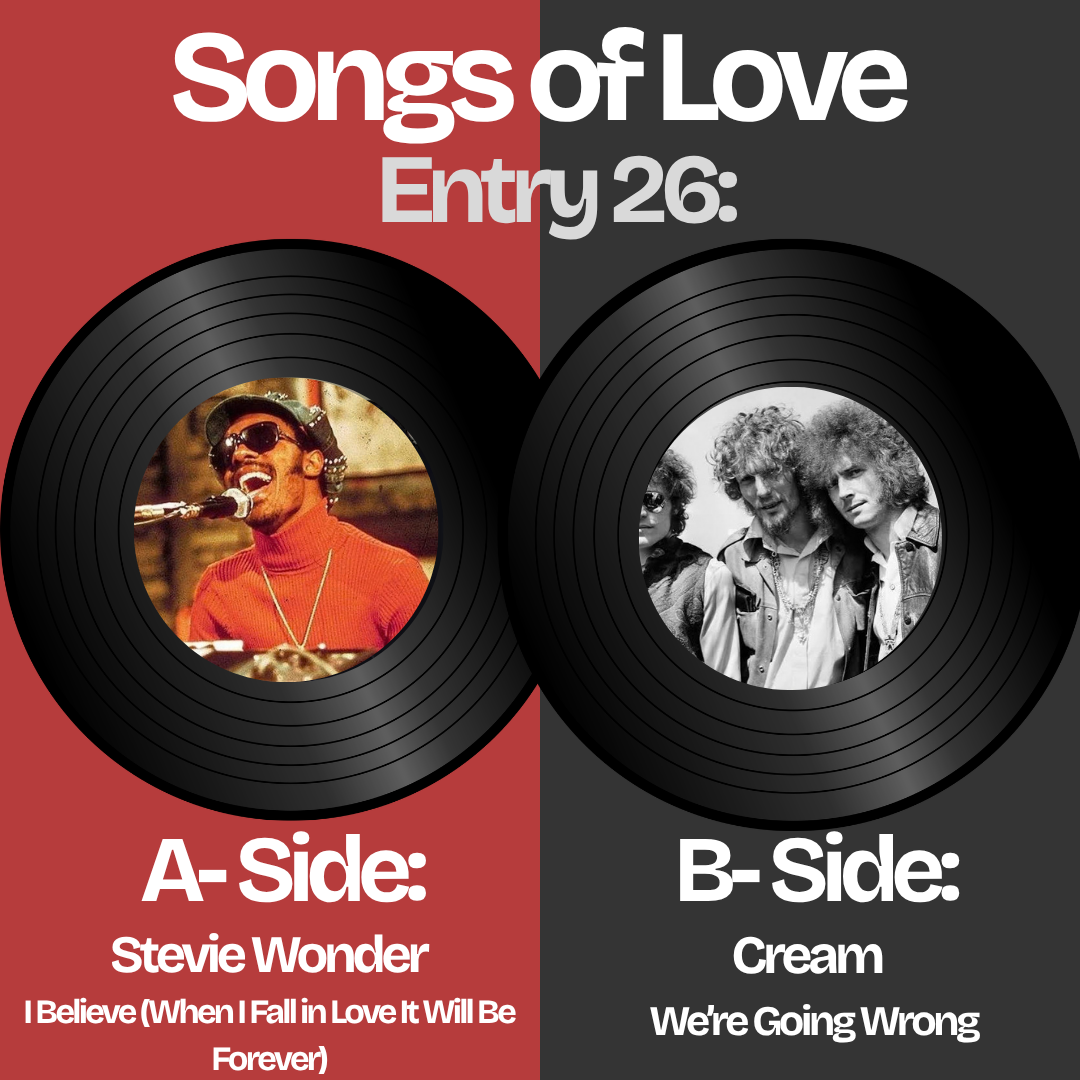
Songs of Love 26: Delaying Love
There’s an immediacy to many of the songs we’ve looked at in this project so far, and to many love songs in general. Very often, they’re about decisive moments, whether they’re “set” in the present, where that moment is happening right now in the course of the song, or looking back on it. More rarely, they may be anticipating the crucial moment, seeing it in the future. There’s something of that last in the songs in this entry, for sure, but they’re also doing something quite different. These are, in different ways and for very different reasons, songs of delay, of deferment, where change is put on the long finger. It’s an easy sentiment to relate to, at least at times; many of us fear change. But that kind of procrastination is unsustainable; the very art form, in this instance, mitigates against it, as we see particularly in the B-side. Music is about repetition, but also about progression, and there is no song ever written that fails to come to an conclusion.
A-Side
I Believe (When I Fall In Love It Will Be Forever)
Performed by Stevie Wonder
Written by Stevie Wonder and Yvonne Wright
Released 1972
Something we find quite frequently in love songs of all kinds is a sense of “before” and “after.” In a break-up song, that could mean that the world has been drained of all meaning, rendered grey and empty – something like ‘Melancholia’ is an easy example. But we also see the opposite, where the advent of the lover or the relationship brings meaning and light to the world. As in many things, A-sides and B-sides share more than you would expect in this regard – in both cases, the lover is associated with light and meaning.
And here is yet another example of that kind of crossover, albeit with a few twists of its own. The verses paint a vivid picture of a life of “despair,” devoid of all meaning. “Shattered dreams, worthless years” is the kind of opening line you expect of Robert Smith or his arch-enemy Morrissey far more than Stevie Wonder. But here the focus is on the contrast, on the advent of love which forms a kind of revelation, bringing enlightenment.
So we’re back, again, to a world of revelation and divinity, a running theme of several entries now. And like last time, we’re dealing with a love that is vaguely messianic, in a Biblical sense, foretold and prophesied in obscure but meaningful ways. Even the very title – “when I fall in love” – treats that love as an inevitability, an article of faith, we might say.
But there’s something odd in that. Unlike last time, the lover isn’t a theoretical future construct, but a real and present person. There’s a sense that they and the singer are together, sharing “sights” and “sounds,” their hearts in the process of “merging.” It seems very much as though they are, in fact, falling in love. So why does the chorus defer the time of falling in love to a future “when?” Why isn’t it happening now?
It’s an even more pressing question because the key [1] to this song is precisely that it’s addressed to a specific person, who is kept in mind throughout. The chorus has a distinct and significant difference from the title – where the latter seems to invoke an abstracted future event, falling in love in general, the song itself is far more specific and directed – “when I fall in love with you it will be forever.” It’s as if the addressee is being slotted into a pre-existing fantasy, the face in the imagined wedding photo filled in at last. In keeping with a running theme of recent entries, the dream and reality are beginning to merge.
And there’s another running theme that emerges as the song goes on. From the very beginning of this project, we’ve been seeing interplay between the love song and the devotional song, or hymn. Earthly, romantic love is frequently conflated with, or ascribed to, the divine. And, of course, central to this song is the concept of belief. At first, that belief seems to be abstracted, rather than involving any kind of divine presence, acting as an expectation as much as an article of faith – in the same way that I believe I will go to the shop after writing this, the singer believes that their love will be forever.
But that changes with the second iteration of the chorus, which sees the emergence of a vocal countermelody, what we might interpret as a second voice, or at least a supplementary sentiment. Here the concept of belief is first focused on the prospective lover - “I’m so glad that I found someone to believe in” [2] – in line with that idea of the abstract taking form; the belief has found a locus. But then there’s a shift – that same voice proclaims that their prayers have been answered. So there’s a direct appeal to the divine here, making the song itself into a kind of prayer. It even veers into the evangelical: “God always will answer your prayers,” they assure us, followed by a cry of “Thank you, God,” which has the air of a charismatic prayer meeting, but is so casual that it slightly implies the divine presence may be leaning on an amp just off-stage, flashing Wonder a thumbs-up in recognition of the shout-out.
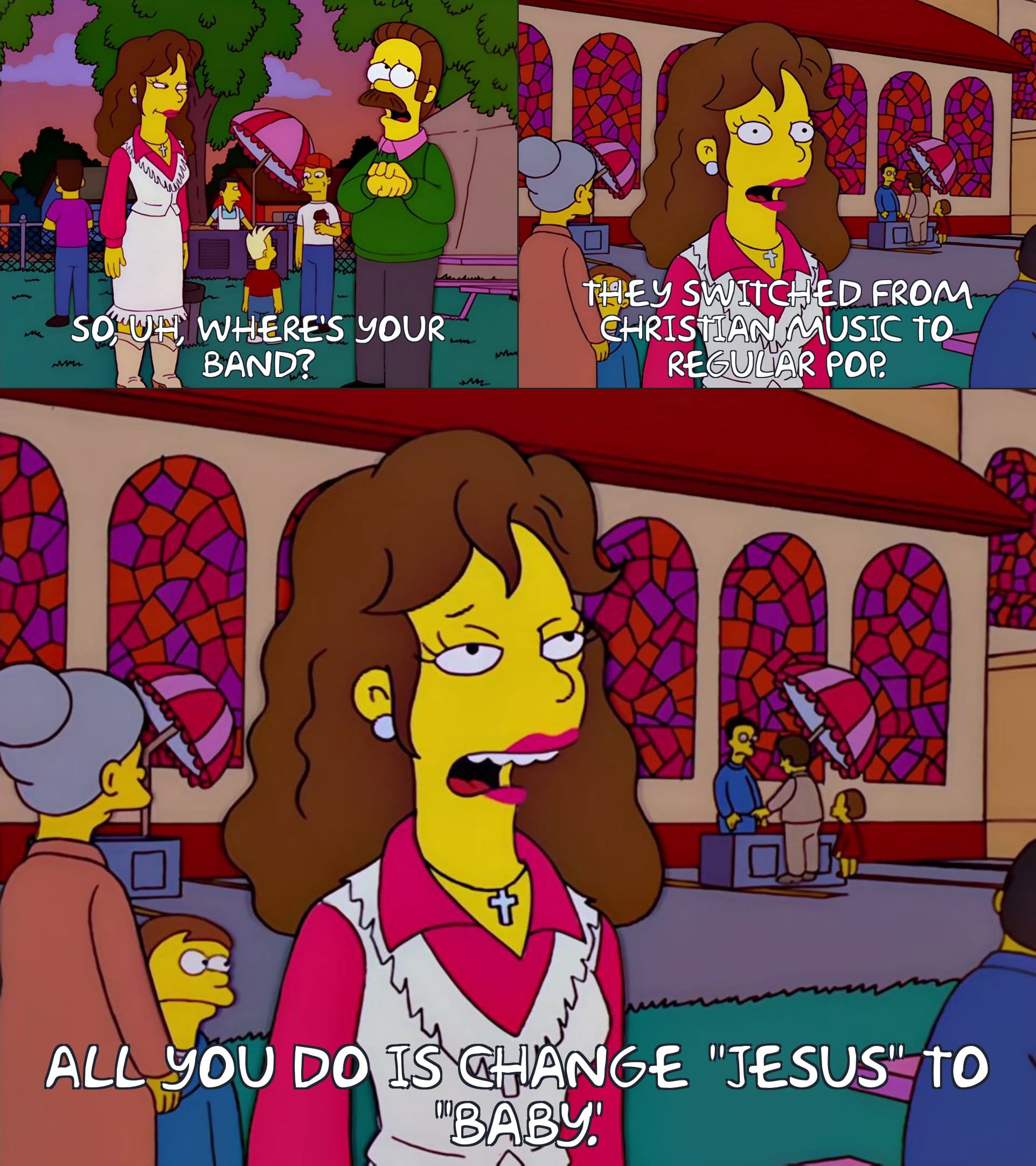
All of which is significant in itself, as it alters the character of the song and is yet more evidence that the devotional song and the love song are very close cousins; the telltale sign being whether the singer says “baby” or “Jesus” [3]. But it also proffers a potential answer to that question from earlier: why is the falling in love deferred into the future? And that answer brings us back to our new best friend from recent entries: apocalypse.
In religious traditions of various kinds, apocalypse is not only (and not always) the end of the world. It is the definitive moment of enlightenment, which shapes history by its presence. We could point to something like the Norse idea of Ragnarok, but in fact the easiest and most fitting example is the Christian concept of the second coming of Jesus. That is, in religious terms, the moment that makes everything right, where the earthly world is brought into harmony with the divine. And it is, by its nature, always anticipated, always looked to in the future.
So we return to the idea of the messianic. In this song, love and the prospective lover constitute the saving grace, explicitly located in the divine, that makes the world right and rescues the singer from a bleak life of despair. Which is quite a standard for her to live up to, it must be said.
[1] There’s a Songs in the Key of Life pun in here somewhere, I’m sure.
[2] It’s not easy to hear this bit, which is buried somewhat in the mix, but it starts around the 2.54 mark in the video linked at the top of this entry.
[3] Yes, I have robbed this joke from The Simpsons, like at least 50% of my sense of humour.
There’s a serious theological point to be made here as to whether this kind of interplay reifies romantic love to the status of divine, and whether that forms a kind of heresy (Kierkegaard thought so, but then again Kierkegaard wasn’t big on fun), or whether romantic love is in fact a way of experiencing the divine. A footnote to a Stevie Wonder song, directly below a Simpsons quote, is perhaps not the place to have that argument out, though.
B-Side
Performed by Cream
Written by Jack Bruce
Released 1967
If ‘I Believe…’ is a song about everything being made right, this one… well, the title tells you everything. And sticking with the apocalyptic theme, this is a song where the moment of enlightenment has already arrived, has in fact just passed (“I found out today”), and has torn the world apart. This is a song of decay, of entropy, of things falling apart.
And yet what’s most striking about the song is the degree to which, while claiming on the face of it to be about seeing and conveying the unvarnished truth, it seems to be trying desperately to do anything but. Once again the wording of the title is vital; it’s not called “we’ve gone wrong.” The implication is that the process is ongoing, and hence that it could potentially be altered or reversed. This song is about trying to arrest momentum, to stop the runaway train from careering off the cliff.
Or so we might think from the title and the basic premise, but listening to the song tells us otherwise pretty quickly. This is the sound of doom, Jack Bruce keening [1] for a relationship that, like the woman from ‘Point Blank,’ is simultaneously dying and dead. For most of the song, Eric Clapton’s guitar and Bruce’s bass paint in broad strokes – a single, drawn-out chord or note – and Bruce’s vocal does much the same, squeezing every syllable to death, especially on the chorus (for a three-and-a-half-minute song, there are actually very few lyrics). The song as a whole feels lethargic, like it’s trying as hard as possible not to get somewhere. The implication seems to be that a break-up is imminent, but the singer refuses to reach that conclusion.
The counterpoint is provided by Ginger Baker’s typically hyperactive drum fills, suggesting a rapid, irregular heartbeat. As the song progresses, this energy starts to infect first the bass, on the choruses, and then the guitar, with Clapton in the second verse moving from chords to far more elaborate fills. There’s a sense of building to a climax, as the song finally concludes with what sounds very much like a collapse. Only Bruce’s vocal resists stubbornly, hanging on the words “we’re going wrong” over and over for the last quarter of the song and refusing to let go of them. The sense is of a building reality that isn’t being faced.
As to what that reality is, the song is deliberately short on details, which is where it derives a good deal of its power, but there are hints to be found. It’s framed as a plea to the lover “Please open your eyes,” “please open your mind.” The plea is for understanding, for seeing the truth, and that the lovers could come together to repair the relationship. But hidden in this plea is an accusation; that the lover doesn’t already have an open mind/eyes, that they are wilfully blind or perhaps even ignorant. So there’s a barb hidden beneath what first appears an attempt at connection. Even while pleading, the singer is subtly laying blame.
And that is why the title is, ultimately, a lie. Perhaps it’s an inadvertent one, perhaps it’s the singer who needs to open their own eyes really. But it seems clear that the damage is already done. This is not a relationship that’s going wrong, it’s one that’s already irreparably damaged. And the singer’s misguided attempts to hold on to it, even to salvage it, are only doing further harm.
[1] In this (very good) BBC version, Bruce performs the chorus as a howl of anguish, but on the recorded version his voice is high and thin, more like a lament. Watch out also for Clapton in this video, who appears to be cosplaying as Frank Zappa.