Songs of Love 25: Love as Passive
Many love stories are a mixture of passivity and activity. The chance meet-cute at the café or university library is counter-balanced by the airport rush at the end, a testament to the love bursting forth uncontrollably. In reality, some of us go out seeking love – on dating apps, at events, or simply by chatting up strangers – while others have it come to them – a chance meeting, a friendship that blossoms into something else, a developing work flirtation. But even where it’s the latter, there has to be some degree of activity – somebody has to make the first move. Here, though, we have two songs dedicated to utter passivity as a mode of being. In the case of the B-side, it’s really a kind of helplessness, but for the A-side, it’s a conscious way forward, a devotion to destiny. In both cases, we might regard that kind of passivity as an unworldliness, something unrealistic in many senses. But then we often experience love as something outside of, if not opposed to, the mundane world.
A-Side
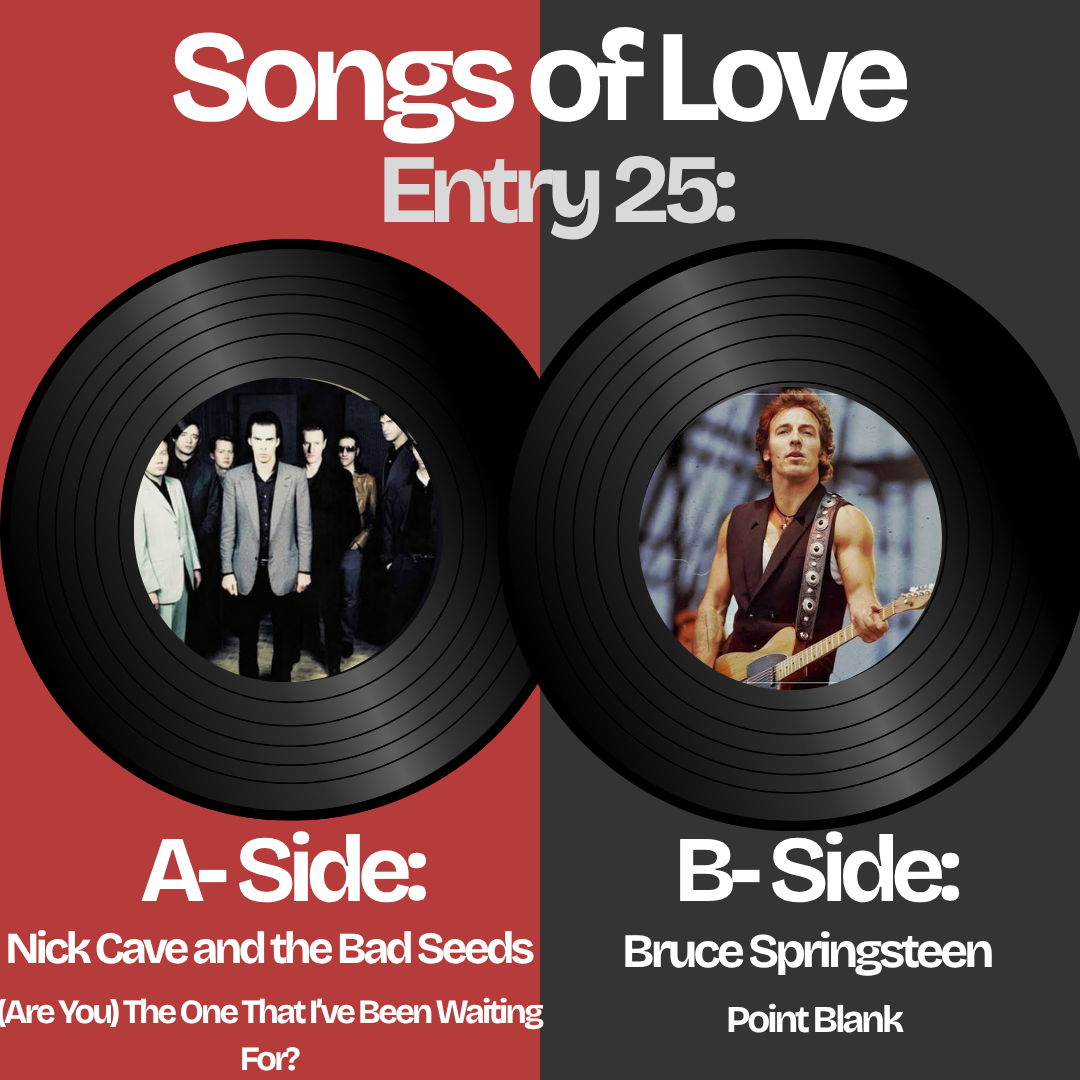
(Are You) The One That I’ve Been Waiting For?
Performed by Nick Cave and the Bad Seeds
Written by Nick Cave
Released 1997
Well, he’s been a long time coming, appropriately enough for the song in question. Nick Cave has made little cameos here and there in various entries, sneaking through from previous work I’ve done, but has yet to receive the kind of sustained attention he seems to demand. Demand not only because he’s a fascinating songwriter, but because he is himself profoundly interested in the love song. His lecture “The Secret Life of the Love Song” has been a regular source for me over the course of writing this project, not so much of information as of inspiration. Cave is somebody who thinks very deeply about his art, as is easy enough to tell from reading just about any interview with him, or his curated Q&A with fans The Red Hand Files. And indeed it helps that for most of his career he’s been a regular writer of profound, moving love songs too.
Indeed, this song comes from Exhibit A in that facet of his career: 1997’s The Boatman’s Call, often compared to Dylan’s Blood on the Tracks both for its quality and its predominant subject matter. And like that album, while much of it is concerned with break-ups, it’s far less of a “divorce album” than its reputation would suggest. Rather, it’s about the vicissitudes and aspects of love – all of them, or at least as many as will fit in 52 minutes or so of music.
Perhaps the clearest example of this is ‘Far From Me,’ a song which Cave claims was written across the course of a relationship [1], and thus chronicles its heady beginnings followed by its decline. In this, it’s not unlike ‘Idiot Wind,’ which follows the range of emotions felt and expressed in the wake of a contentious break-up, but there’s an immediacy to ‘Far From Me’ that sets it apart. Where ‘Idiot Wind’ is starting to rise above and move beyond the catastrophe by the end, ‘Far From Me’ remains “suspended in your bleak and fishless sea.” There’s no way forward from here [2].
And then there’s ‘(Are You) The One…,’ a single which, together with its well-beloved cousin ‘Into My Arms,’ signalled to the record-buying public the advent of a kinder, gentler Cave – or at least, one rather less concerned with murder ballads. That impression didn’t entirely last, but certainly here we’re lulled in with a sedate organ melody; not a single Blixa Bargeld pterodactyl scream to be heard[3]. There’s a warmth to the song, with even Cave’s vocal proceeding mostly in hushed tones, as though there’s something delicate here that he fears to disturb. The only exception is the bridge (“Oh, we will know, won’t we”), where it rises in exultation, Cave first calling upon the heavens (the author, in fact) before rejecting them, his voice dwindling again on the words “then they die.”
We’ve come upon the idea of destiny many times before in this project, two lovers being drawn inexorably together, or apart, in songs like ‘Something Changed’ or ‘Black Star.’ In the former, it was something to question and speculate about; in the latter, a scapegoat. But here, that idea is taken to something of an extreme. There’s a sense here of a soulmate, who is “[drawing] near,” “moving surely toward me,” whom “every little thing anticipates.” The implication is that the singer’s whole life leads up to and frames this lover. Moreover, much as he claims to have “longed you here,” we’re left very much with the impression that the lover’s arrival was inevitable, requiring no effort from the singer. All they need to do is wait patiently.
Religious echoes are never far away with Cave (certainly not for someone who did a PhD on the theology of his work), and there’s a couple of things going on in this idea. The lover’s arrival is framed here as a form of apocalypse (which comes originally from the Greek for “revelation”), something that shapes an entire life and serves as a movement into a new kind of life. And just as Jesus advises the apostles to wait for the coming of a new world, so too the singer awaits a lover who seems to be oddly both present and absent within the song, told to “lay your head upon my shoulder” in one verse but still “in motion” in the next. Here too there’s a faintly Christian sense of God as both omnipresent and distant.
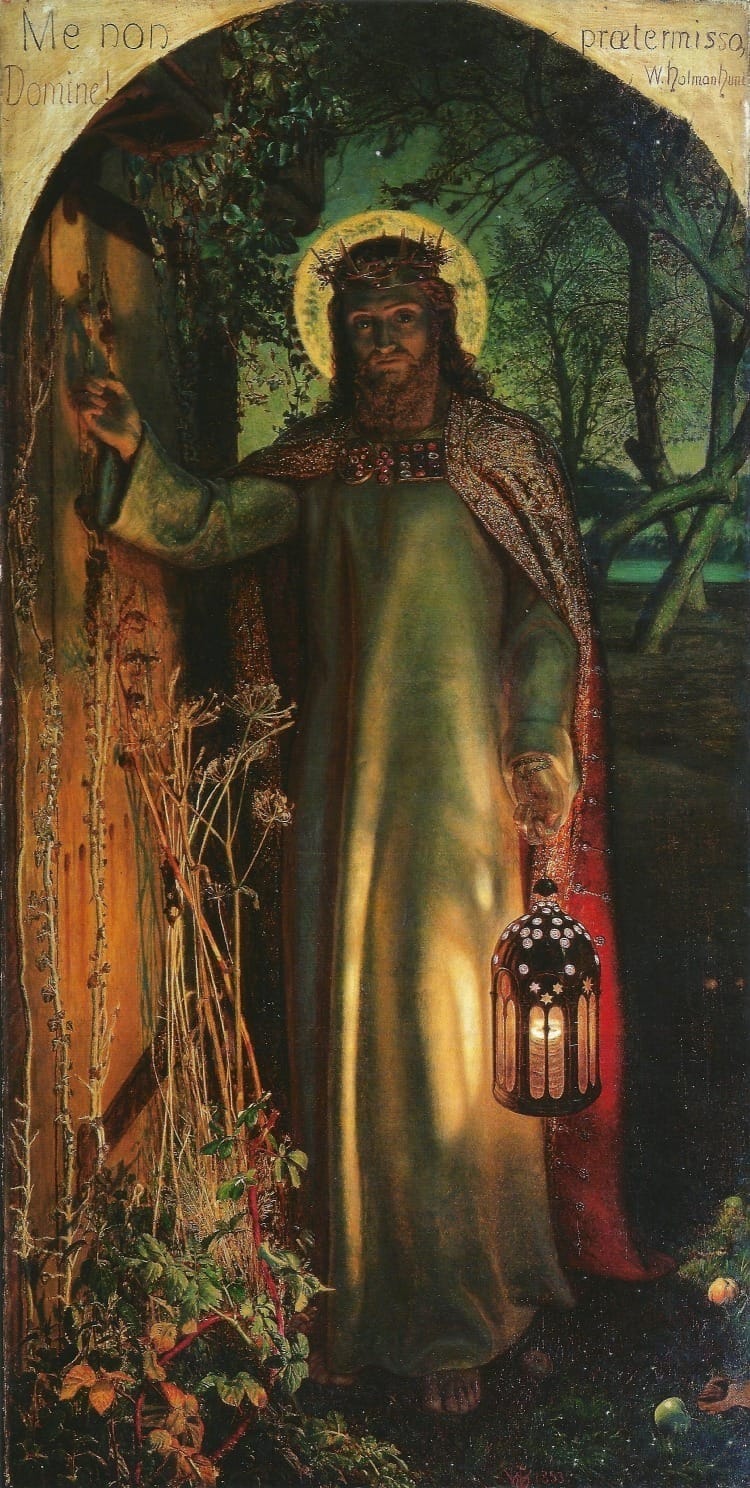
The other theological idea at play here is the Calvinist concept of election: essentially, that some people are “elect,” and hence are already saved, an extreme version of Luther’s idea of salvation by faith alone. This one is, I’ll grant you, a bit more niche, but Cave’s hyper-individualist theology actually has a surprising degree of commonality with the notion of the elect. Here Cave’s singer is already subject to love, moving inevitably towards it, without any apparent need for action – already saved, in a sense. He even applies the Sermon on the Mount: “There’s a man who spoke wonders though I’ve never met him/He said, ‘He who seeks finds and who knocks will be let in.” [4] Seeking implies a degree of active search, but that doesn’t seem to be what’s happening here. Rather, the singer here is like the figure of Jesus in the Holman Hunt painting The Light of the World (referenced by Cave in his 1998 introduction to the Gospel of Mark), waiting patiently to be allowed access.
But all this talk of theology and the divine shouldn’t distract us from the fact that this is all occurring on a very human level. This is not a song about God, but about earthly love, albeit the two are inevitably intertwined in Cave’s work. But there’s also a rejection of the cosmic at play here. In the bridge, Cave raises the possibility that the arrival of the lover will be marked by some great heavenly event: “The stars will explode in the sky,” but immediately rejects this: “But they don’t, do they?” The question may be rhetorical, but it raises the possibility that this is a conversation, albeit a one-sided one with a theoretical individual. Moreover, it’s the singer’s “heart” that “will reward me,” not heavenly intervention. The apocalyptic (in the sense of catastrophe) energy that animated so much of Cave’s work is here rejected in favour of the mundane. It’ll be back, but actually this movement towards the celebration of the mundane characterises much of his later work, such as ‘Gates to the Garden’ (“God is in this hand that I hold”) or ‘Get Ready for Love’ (“I was just hanging around, doing nothing and looked up to see/His face burned in the retina of your eyes”).
And yet despite this focus on the human and the ordinary, this is still very much a song of ideals and abstracts. The lover is somehow out of focus, a Platonic ideal rather than a flesh-and-blood person, at least for now. And while we could poke all sorts of philosophical and even ethical holes in the idea of treating a person as an abstract, I think that’s the source of this song’s power and beauty. We all want to think of love as something that exists above the mundane, in a rarefied idealised space, whether that’s our actual experience of it or simply a longing. We’ve seen, and will continue to see, so many songs that revolve around some conflict between the ideal and the mundane – in fact, you can scroll down a bit for a very good example. And so often, the mundane seems to either win out or at least compromise the ideal. So there’s something very pleasing about a song that is so thoroughly on the side of love as something that transcends the ordinary sensory experience. A song, in fact, that believes in love.
[1] Most likely his short-lived relationship with PJ Harvey, which attracted a good deal of press attention around the release of the album, as a couple of the songs describe figures who very much seem to resemble Harvey.
[2] I’ve actually long thought that the album should end with ‘Far From Me,’ partly because I like this as a sentiment to finish on, but mainly because I think the actual closer, ‘Green Eyes,’ is by far the weakest song on the album and it would actually be stronger for that song’s loss.
[3] Bargeld looks positively bored in the video for this song, standing at the side of the stage and not playing his guitar at all. Having been a founding member of the Bad Seeds, he would only stay with them for two more albums (on which his presence is barely felt) before returning to his true calling of making weird noises with Einstürzende Neubauten.
[4] Matthew 7:7: “Ask, and it shall be given you; seek, and ye shall find; knock, and it shall be opened unto you.” Luke 11:9 has very similar phrasing. I quote the King James version here advisedly; it’s Cave’s favoured source, as it has been for innumerable writers in English down the centuries.
B-Side
Performed by Bruce Springsteen
Written by Bruce Springsteen
Released 1980
For someone who’s released a pretty substantial range of music in his 55-year career, and experimented in a variety of modes and genres, it’s not that hard to come up with a stereotypical Bruce Springsteen song. It deals with the difficulties of working-class life, and the distance between fantasy and reality. The people in the song feel trapped, hemmed in by compromise and unable to escape, much as they might dream of it. There’s probably some reference to cars or driving as the mechanism for that escape. And while there are no cars to be seen here, it might be one of the strongest reckonings with the double-edged power of dreaming in Springsteen’s canon, rivalled perhaps only by the title track of the album from which it’s drawn (which does in fact feature a car).
And like ‘The River,’ this song is centred around a romantic relationship[1]. Unlike in that song, where the dream seems to be failed for both the singer and Mary in tandem, here we have two people whose relationship has fallen apart, who represent opposite sides of the fantasy/reality conflict. The singer here still seems to hold out some kind of fantasy or hope for the future, or so we might gather by contrast at least. Their ex-lover, though, has lost all belief, lost even the ability to pray for a better tomorrow, and has become resigned to a grey, mundane world. The realities of money (and not much of that) have replaced fantasy; “that welfare check” explicitly contrasted with belief in Romeos and “pretty little things” [2]. There’s no fantasy of a better life left, whether that better life be a pure belief in love, or even a fantasy of more and better material things. All that’s left is drudgery and compromise.
The singer’s attitude to all of this wavers over the course of the song. At times, there’s a palpable bitterness, the lover referred to as a “fool” who can’t see what’s truly important. But there’s also a sympathy there, especially in the verses, for someone whose idealism has crumbled away, who tells themselves “little white lies to ease the pain.” There’s a sense that she’s a victim of a system personified in a nebulous “they” who made unjust demands, whose empty “promises” of a better life are the only fantasy left to her – and one which never comes to fruition. As in much of Springsteen’s work, the dream at play is the American dream of self-sufficiency and financial success, which has proven hollow.
All of which builds to the song’s extraordinary third verse, which seems to build and build with the air of a drama coming to its climax. The singer dreams of what seems to be somewhere between a memory and a purely imagined fantasy of the couple dancing together, the slow dance belying real heat and passion: “you pulled my jacket off as the drummer counted four,” “as I pulled you tighter I swore I’d never left you go.” Springsteen pushes through the long lines like an eruption of emotion, the words spilling forth as though they’ve been building for a long time. And then all at once, the dream erupts suddenly into reality: “Well I saw you last night down on the avenue/Your face was in the shadows but I knew that it was you.” All at once, there’s a tension, a stand-off mirroring the recurring imagery of shooting, as the singer attempts to reach out to his ex. And the high drama comes down, not to the drawing of a gun, but a simple action of turning away, a denial of recognition as devastating as St. Peter’s, if more subtle. The implication is of the lover choosing her fate, or else already being resigned to it.
And that fate, as suggested by all the imagery of dark alleys and shadows in those lines, is death. Throughout the song, it’s made very clear that the loss of love suffered by the woman at its heart is a kind of death. She has lost all faith and hope in the future, and so that future has ceased to exist. So, in a sense, she’s already dead, her sense of self snuffed out in a moment, like being shot. But in another sense, she’s being poisoned, her life dwindling away slowly: “You wake up and you’re dying/You don’t even know what from.” There’s a fine balance going on between these ideas of dying and already dead throughout the song, even to the final verse’s tentative suggestion of reconciliation, which is shot down.
So naturally, there are a lot of suggestions that the song is about an inevitable decline, a slow journey towards death. Jeffrey Symynkywicz describes it as being about “an inexorable decline that is carved at the heart of life,” while for Rob Kirkpatrick, the theme is “you’re born dying.” [3] Cheery stuff. But that’s not quite how I see it. Yes, the song is about a kind of spiritual decline and death, as we’ve seen. But those things aren’t inevitable. Rather, the singer sees them as something to be actively resisted. They show a combination of disdain and compassion for the woman who has succumbed to the cares of the world, but as part of that, they insist that some kind of idealism can still exist; indeed, that it’s vital. Not for nothing does the heart of the song take place in a dream.
Which leaves us with a question. It’s not hard to see ‘Point Blank’ as a sort of character sketch, similar to so many other Springsteen songs from ‘4th of July Asbury Park (Sandy)’ to ‘Highway Patrolman.’ But what character is being sketched here? Is it the woman who has found herself dragged down by reality, who has lost all sense of the future she imagined for herself, and seemingly all human connection? Or is it the man who is fixated on a dream, and obsessed with extending that dream to her?
[1] Which is far from unusual for Springsteen, of course – ‘Thunder Road’ and ‘Born to Run,’ to take the most obvious examples, revolve around shared fantasies of escape, while something like ‘Darkness on the Edge of Town,’ similar to this song, is premised on a failed relationship that contrasts with the singer’s extant fantasies.
[2] We’re told that she “grew up where young girls they grow up fast,” and yet the singer still refers to her as “little girl” in the chorus. Does this indicate the singer’s belief that there’s some remnant of that “young girl” left, or is it indicative of a paternalistic attitude on his part? Referring to the lover as “little girl” or similar is not exactly uncommon in the rock tradition (and probably shouldn’t pass without comment as often as it does), but given the song’s focus on coming to terms with reality, there may be an extra sting here.
[3] Symynkywicz, J.B., The Gospel According to Bruce Springsteen, 2008, p. 66; Kirkpatrick, Rob, The Words and Music of Bruce Springsteen, 2007, p. 73.