The Games of (My) Life: 2001-2005
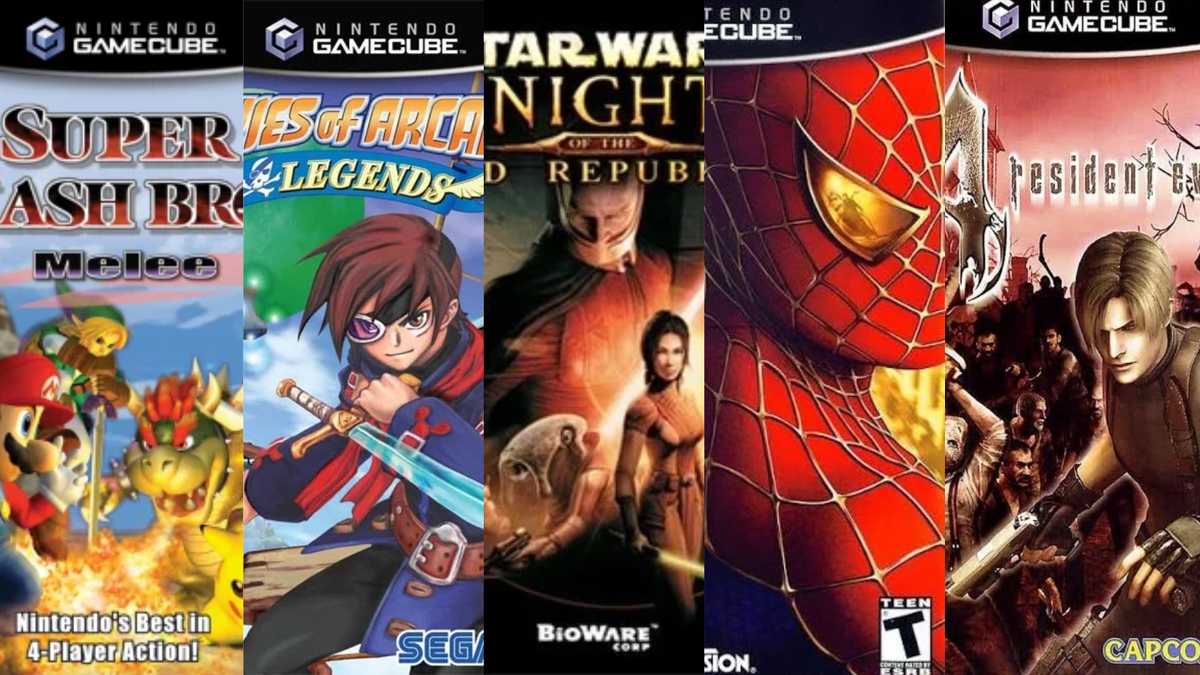
These were perhaps the golden years for really forming my taste. As I moved into my early teens, games magazines took on less significance, and recommendations from my peers took on greater. In secondary school, I quickly found a group of friends who were committed gamers, and we all shared stories, tips, and indeed games themselves. Two of these five games I played by borrowing them from friends, and while I subsequently bought copies, I still associate them with that sense of a shared experience.
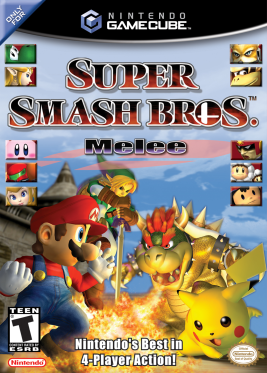
2001: Super Smash Bros Melee
For me, I think the Super Smash Bros games had much the same kind of impact as a young comics fan finding out about big team-ups like the Justice League or the Avengers (I only got into comics later, when such things had less impact). Here were Mario, Link, Kirby et al all together and battling each other, in ways that felt entirely true to the experience of their own games [1]. It was, to my young eyes, as if the Simpsons family and the Rugrats had turned up in an episode of Pokémon, and somehow fit in seamlessly. It felt remarkable to me that such crossing of borders was possible.
And as much as I actually played and enjoyed the Smash games, and Melee in particular, as fighting games down the years, it’s that experience of a combination of characters and worlds that I think is the most significant element of it for me. It’s a sort of odd mash-up, especially when it comes to Wii entry Brawl’s adventure mode, where Kirby’s nemesis Meta Knight teams up with Fire Emblem protagonists Marth and Ike, for instance. At times, it resembles nothing so much as an officially sanctioned form of fanfic.
Which is especially significant, because my first ever fanfic, written at the age of 11, before I was even aware of the concept, was a Super Smash Bros one. I don’t recall the plot at all, but I know that it involved Smash’s specific roster of characters. Something about that strange mish-mash clearly spoke to me; perhaps it was the lack of an overall organising principle or plot in the source material, but more likely it was simply the incongruity of the crossover.
If so, it’s a baton I very much took up. I’m not the most prolific writer of fanfic – what I’ve written over the last couple of decades probably totals somewhere around a mid-length novel, at a guess – but all of what I’ve written has been based on game universes, chiefly Fire Emblem and Persona. The only one that isn’t entirely based on a game is an Ace Attorney/A Song of Ice and Fire crossover, which itself indicates my love of peculiar crossovers, the genre in which I’ve written my longest and most involved fics. Something in me just loves plonking two characters from totally different worlds down next to each other and seeing what happens, and I really do think I get a lot of that from Smash originally.
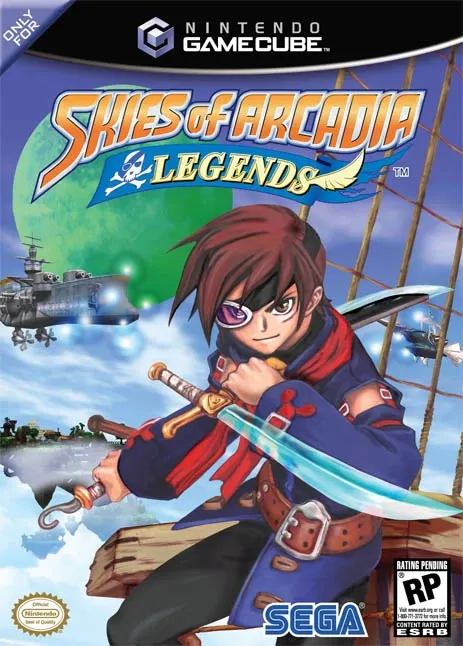
2002: Skies of Arcadia Legends
Now this was a crowded year. Wind Waker, Mario Sunshine, Metroid Prime and Kingdom Hearts all vied for position here, each with their various merits and fond memories attached. But as with Banjo-Kazooie, this is a personal list, and this right here is a game for which I think I’m likely in the top 10%, if not 1%, of fans.
The thing is, in some ways Skies of Arcadia is not the most original game ever invented. It’s got a very cool aesthetic and world of floating islands and sky pirates, and its turn-based ship battle system remains quite novel. But looking back, having played lots of other games in the genre, I can see all the inspiration taken from the likes of Final Fantasy and Dragon Quest, especially FF6. Crucially, though, I played this before any of those games; even more crucially, SoA has a charm that is all its own.
The story mostly follows classic JRPG tropes: main character Vyse initially sets out to save his father from the clutches of the domineering Valuan empire, and ends up on a quest to collect crystal MacGuffins and save the world. There are twists along the way, and lots of memorable characters, but nothing much to haunt the memory (unless you’ve played it a dozen or so times, as I have, and before all those other games to which it’s similar). The worldbuilding is clever and efficient, with the world divided broadly into six parts each governed by an elemental moon, but leans heavily on tropes (and at times ethnic stereotypes) in defining the disparate continents and cultures.
But perhaps the thing that sticks in my memory most about SoA is a single moment [2]. The game’s manual tells you that at some point the player (or Vyse) will gain their own ship to outfit and crew. But that doesn’t happen for some twenty hours or so of gameplay, somewhere between a third and halfway through the game, which seemed an age when I was 12 or 13. And when, unexpectedly, it does happen – Vyse is given the Valuan flagship by the empire’s prince, who despairs of the path his country is taking, after a prison break – I found myself genuinely moved.
Wandering the corridors of the ship – or rather the two corridors and four rooms that make it up – I found myself marvelling at the fact that this was mine, my own little part of this world, to do with as I please. I’ve never been able to pin down how that feeling was evoked, other than the degree to which I’d bought into the world, but it’s something I’ve been trying to kindle and recapture, both in my own play and in TTRPGs that I’ve run, ever since.
And speaking of TTRPGs...
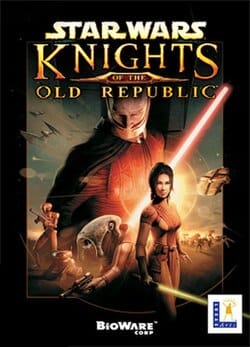
2003: Knights of the Old Republic
It’s hard to recall, now that my enthusiasm for the series has been quashed by endless bland TV series, but I used to be a huge Star Wars fan. I was just the right age for the prequels to play a significant part in my childhood and young adolescence, and I had siblings who had grown up with the original trilogy. I was the kind of person who read spin-off novels, and had I been into TTRPGs at that time, I would certainly have been playing Star Wars-themed ones.
What I did have, though, was KOTOR. Which, as it happens, was my first exposure to a D20 system, which I entirely failed to master until years later, when I returned to the game after having played some D&D. But that didn’t stop me from enjoying KOTOR as a whole, even if I found the combat frustrating at times – not because it was poorly designed, but because I just couldn’t figure out what a will save was.
But more appealing to me was the overall story. I was a sucker for a moral choice system (still am, honestly), and Star Wars’s built-in dark side/light side binary was clearly perfect for such a system. Much as I admire KOTOR 2’s attempts to flesh out a morally grey take on Force ideology, it’s very much swimming upstream, which likely accounts for why I do admire that game rather than love it (plus the fact that it’s compromised and broadly unfinished, which is an enormous shame).
And in fact, KOTOR is a good example of how that kind of broad dualism doesn’t necessarily stand in the way of good, even complex storytelling. Characters in both KOTOR games are often caught between ideologies, unsure how to proceed, and this is clearest in the character of Revan (big spoilers for a 23-year-old game ahead). Revan was once a notorious Sith Lord who terrorised the galaxy, but was captured and had their memory wiped, becoming the main character. Which means that your choices inadvertently push a particular philosophy of mind. Perhaps Revan was always evil, and their fall was inevitable. Or perhaps they’re capable of redemption, albeit through the most extreme means possible. Are people capable of inherent good, no matter what they’ve done? Is there a moral core to a person that will shine through in a tabula rasa situation? Can someone who’s brought death and misery truly be redeemed? Well, that’s up to you. Heavy stuff for a game about swinging lightsabers around.
As a postscript, I wrote some of this entry in the week when Bioware’s closure was announced, and it served as a timely reminder of the way the games industry chews up creative talent at a constant churn. Booooooo.
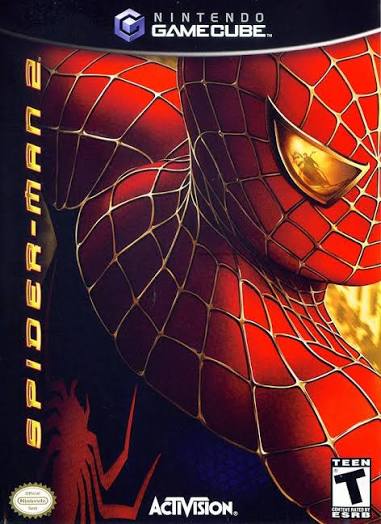
2004: Spider-Man 2
As I’ve mentioned previously, film tie-ins don’t have the best record. Especially in this period, they were frequently lazy and rushed, spending half their allocated budgets to get the actors in for an afternoon and forgetting to have them do anything interesting in the process. Some of the better ones were playable, but rarely did they capture anything of the feel of the film itself.
Spider-Man 2 was, in various ways, exceptional. It had at its heart a fundamental guiding philosophy: what would it feel like to be Spider-Man? And every element of the game proceeded clearly and logically from that principle.
The core of the game is rooted in perhaps the predominant image of Spider-Man: swinging around the streets of Manhattan. The game is almost like some of the best platformers in that the experience of traversing the world, swinging and web-crawling, is instantly appealing and intuitive. I haven’t played this game in at least a decade and a half, but I can still call to mind what it feels like to dive off a building and swing.
Part of that, of course, is that it has spiritual successors in the Insomniac Spider-Man games, which I’ve played and enjoyed very much in their own right, but which also feel to me like a throwback to this game. Perhaps that’s partly because Spider-Man 2 was one of my first experiences of a big open world based on a real-life location (in this case Manhattan) reconstructed fairly accurately. I hadn’t yet been to New York, but I somehow felt like I had after playing the game. It’s oddly like one of those train simulator games that takes you across Europe or similar; digital tourism by proxy.
As you would expect from its being based on arguably the best Spider-Man film, the story is pretty decent. It expands on the film’s plot to add in lots more villains, to pad out the running time and make Peter Parker’s life even more hectic, and naturally enough glosses over the film’s “Spider-Man no more” plotline, which would be exceptionally boring to play. In the process, it was actually my first exposure to some of the major Spider-Man characters like Black Cat and Mysterio.
And it’s worth a word on the latter, because I still love this take on him. I enjoy a good Mysterio, whether the SFX guru of Spider-Man: Far From Home or the five-person mystic of the recent Ultimate Spider-Man, but mostly I like a Mysterio who’s just a bit of a spoofer, all illusion. Which is summed up beautifully by the final battle with him in this game, where he stands in the centre of the arena in his cape and fishbowl helmet, conjuring illusions and grandstanding. And then, once you make it to him and land your first punch – he immediately falls over and the battle ends, because he is in fact just a normal man (if not an innocent one). It’s a lovely subversion of expectations, and still a defining take on a major character for me. Not bad for a game that was presumably only ended as a quick and easy tie-in to a successful film.
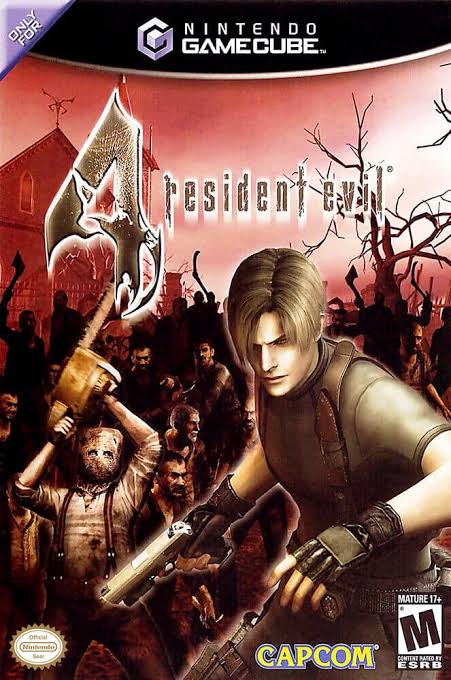
2005: Resident Evil 4
I’ve never been the biggest horror fan. There are horror films I love and admire, but I’m too much of a wimp to opt into being scared on a regular basis. And that goes doubly for games. I’ve watched playthroughs of and video essays about several Silent Hill games, for instance, but never quite brought myself to play one myself. There are exceptions – Lovecraft-derived Eternal Darkness or Junji Ito-inspired World of Horror – but for the most part, I prefer to remain unspooked.
I have, though, played several Resident Evil games. I suspect they appeal to me because they live on the edge between horror and action. Yes, there are spooky things, but crucially, I can shoot them in the face. And notably, I’ve tended towards the more action-oriented entries in the series. I haven’t played Texas Chainsaw Massacre tribute act Resident Evil 7, for instance, but I have played its direct sequel Resident Evil Village (and didn’t quite realise how lost that would make me until partway through the game).
And so it’s no surprise that Village’s spiritual predecessor would be far and away my favourite of the series. Resident Evil 4 is, essentially, a playable action movie with horror trappings – not just in that it’s more focused on gunplay than on survival mechanics, but primarily in its big, silly tone. When the village elder turns into an eldritch monstrosity with extendo-limbs, Leon Kennedy doesn’t cower or run; instead, he responds with a quip, as he does over and over throughout the game whenever anything objectively unpleasant occurs in front of him, whether it be a man running at him with a chainsaw or a chained-up prisoner growing claws and charging him (lots of people run towards Leon in this game).
Which was ideal for me as a teenager who loved Die Hard and similar loud action films. RE4 is cheesy as all hell, and refuses to take itself seriously. Take the merchant, who’s become a meme. Who is he? How does he keep getting everywhere ahead of Leon? Why does he have a massive arsenal of weapons, and what exactly is his business model here? The game doesn’t care a bit, and the implication is that neither should you. This is a game where a recurring antagonist sits in a dark room wearing sunglasses while looking at a computer screen, and that’s just fine.
Now, of course, I’m older. I have a PhD. I like Captain Beefheart and The Fall. I’ve read and somewhat understood Finnegans Wake. And I still love cheesy, silly action films. And indeed, I still love RE4, and have played through the excellent and faithful remake several times (and for that matter, it’s not the last action film-style game that’ll show up on this list). It hasn’t had a profound effect on who I am or how I think, but it is enormous fun, and has been every single time.
[1] Exhaustively so, in fact. I highly recommend Smash director Masahiro Sakurai’s videos on game development, not just on their own merits, but for the insights they give into the sheer level of detail involved in designing character movesets etc. for the Smash games.
[2] I talked about this moment in a video I made years ago about using SoA as inspiration for a D&D game.