Songs of Love 17: Loving Outsiders
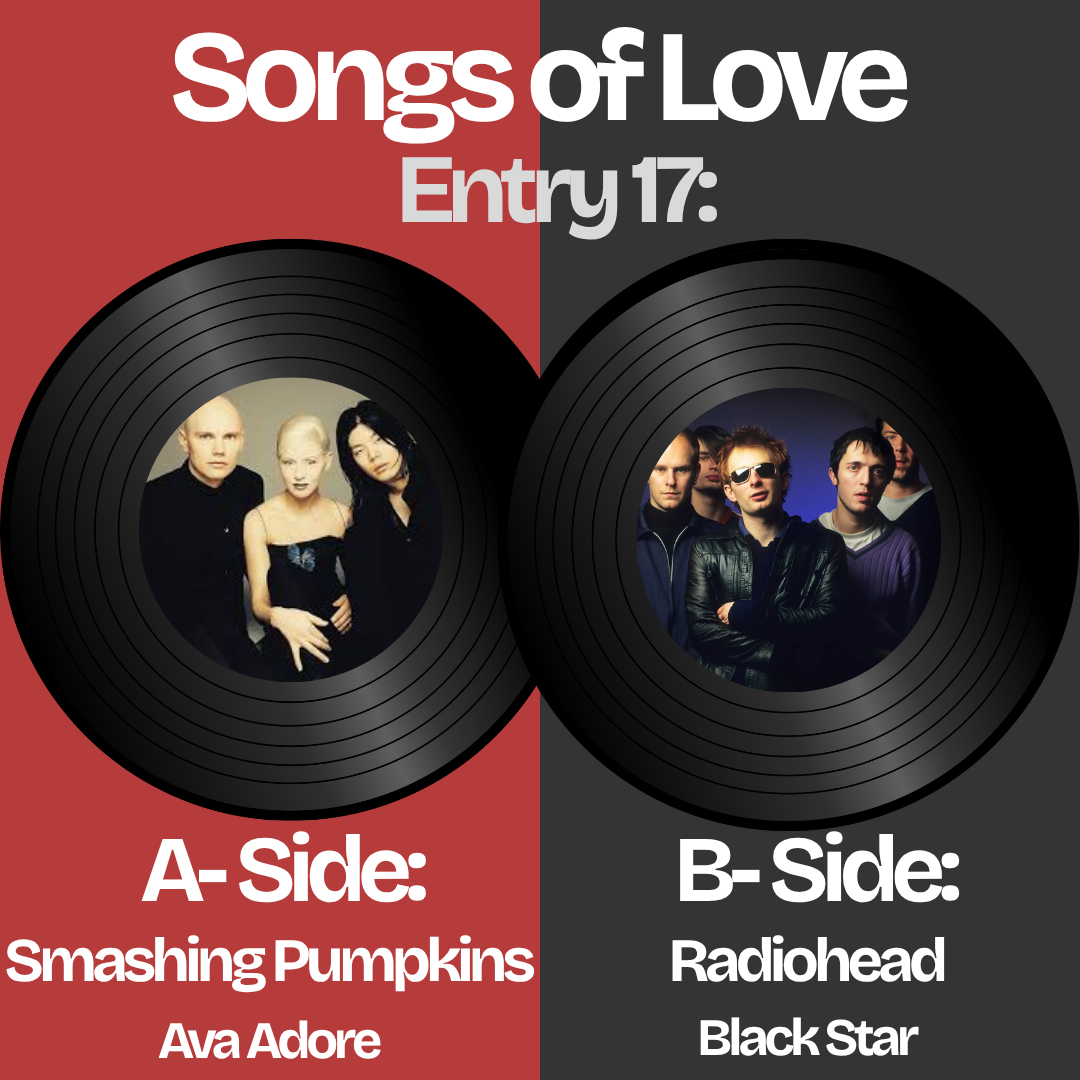
Last time, we touched on the idea that to be in love makes it feel like you’re separated from the world. A corollary to that is that there’s no shortage of love songs catering to people who already feel like they’re outside of the norm in one way or another, whether those be people who belong to marginalised groups, or simply what my dear friends Half Man Half Biscuit characterise as sensitive outsiders. And this time, we’re very much in the latter camp with both these songs, with two bands who’ve made a career out of outsiderdom. And yet, if anything, our B-side is about an unusually normal situation. Because being in love, and falling out of love, are in fact everyday occurrences as well, lest we forget.
A-Side
Performed by the Smashing Pumpkins
Written by Billy Corgan
Released 1998
This is not, in fact, the Smashing Pumpkins song I was originally planning to cover here. When I set out on this project, I thought I might at some point do an A-Side entry on ‘Stand Inside Your Love’ - not the most complex song in its sentiments, but one that I actually find quite moving for its sincerity and lyrical simplicity. Instead, though, I’ve been drawn into this much weirder and murkier number. Which makes sense, I suppose. For all that Billy Corgan’s lyrics tend to wear their heart on their sleeve, it would be hard to get around his and the band’s general presentation of being, to use the sociological jargon, complete weirdos [1].
Whether it’s a pose with any correlation to their real personalities is both beyond the scope of this analysis and also, I think, utterly unimportant. Like many artists, they’ve realised the significant artistic (and, it must be said, commercial) power of identifying with the outsider – the creep, to quote our B-Side band, who have a similar approach, if a little less overt. It’s a powerful social statement, and one that often flatters the listener. They are, by implication, cleverer and deeper and just generally better than the facile sheep who surround them. Usually, that idea is harmless, and you either grow out of it or adopt it as a relatively minor part of your self-conception. Sometimes, it makes you go and shoot John Lennon. That instance is, by necessity, an outlier, but it always does to be a little sceptical in an age of incels and other manosphere types whose social failings can be blamed on nebulous Others.
That said, not every appeal to outsiderdom has that kind of destructive and insular power. In fact, another obvious way for it to go is a celebration of queerness, whether in a broad or specific sense. That’s the outsiderdom of the X-Men, of David Bowie assuring his audience that “you’re not alone.” That’s an appeal to the outsider out of which communities and even movements can be made.
But anyway. Back to the Smashing Pumpkins, who perhaps have just a tad of both the queer rebel and (being rather harsh, and not especially apparent in this song) the incel to much of their work. One look at the video for this song, with Billy Corgan haunting the frame like a Nosferatu whose lack of reflection has caused him to apply far too much eye shadow in error, can tell you that. But the video also suggests a playfulness, drawing attention to its own artifice, with the camera turning back to show us both its own dolly track and the sets through which we’ve been moving. There’s an artifice there that works nicely with the very Gothic excess of the song.
As for the song itself, it certainly starts strong: “it’s you that I adore/You’ll always be my whore,” a phrasing which is quoted in surprisingly few wedding vows. Already, then, there’s a smile playing about the lips of the song, as if undercutting itself. That said, maybe this kind of degradation is part of the relationship dynamic. Certainly the idea of kink is all over the video, which is perhaps a hint as to how the song should be read. And especially when the verse continues “you’ll be a mother to my child/And a child to my heart,” there’s a curious sort of tenderness going along with it.
In fact, this is a song that’s obsessed with placing the lover in specific roles. In the next verse she’ll “be a lover in my bed/And a gun to my head.” This time, the roles are oppositional – first we’re back to that tenderness, with a distinct sexual element this time, then to an underlying violence. The idea that sex and violence are in some way interconnected is a common one, but so too is the idea that to be in love is to make oneself inherently vulnerable [2]. In other words, that there’s an inherent threat at the heart of a love affair, that every lover is a potential femme fatale who could plot your downfall. It’s a slightly worrying worldview (maybe we’re not actually so far from the incel dynamic here), but then again embracing that vulnerability could also be the key to a really healthy and open relationship.
Not that healthy dynamics are entirely on the agenda. That second verse begins “And I’ll pull your crooked teeth/You’ll be perfect just like me.” Again, the underlying violence is clear, but so too the sense of, well, strangeness – though not, crucially, estrangement. A kind of “perfection” through physical imperfection is being sought here, but more importantly, a desire for the lover to be exactly like the singer. This is a song that seeks to pull the two together as closely as possible. As the refrain says over and over, “we must never be apart,” a relationship of extreme co-dependence. She is both “the beauty in my world” and “the murder in my heart.” There’s an embracing here of not only violence, but also the grotesque, a refusal to fit conventional narratives of what a love affair should look like. A queering, in fact.
Either the singer or the lover, or both (the phrasing is unclear), are “drinking mercury.” Mercury is, of course, potentially poisonous, but it’s also a potent symbol of changeability, of adaptation. And for that matter, Mercury is also Hermes, the trickster, sometimes a trans or intersex symbol. So again, there’s a sense that the two lovers are to be blended together, particularly if we take the singer to be male (we can quite easily infer the lover to be female from some of the roles and images already cited). By this stage, then, we’ve left healthy dynamics far behind us, to a degree that might seem to align more with a B-Side. But the thing is, this is art. As much as I might talk about real relationship dynamics sometimes in these entries, these songs are not therapeutic manuals for how to conduct a love affair or relate to another human being, nor should they be. They may be cathartic outpourings, or they may be intended only for the listener to relate to. Either way, it’s all about authentic emotion, or at least the appearance thereof. And that’s not always pretty. In fact, it frequently isn’t.
In short, sometimes love looks like Billy Corgan sliding into frame, a hungry look on his face, like the goth alien he is. And it’s important to celebrate that, I think.
[1] The most entertaining aspect of this self-presentation (to me at least) is the near-total absence of drummer Jimmy Chamberlin from most promotional material, Chamberlin being by some margin the most normal-looking member of the band, certainly in this era. Most of the promo pictures I went through when putting this post together look very much like Corgan, James Iha and D’arcy Wretzky are assessing the viewer’s application to join their polycule.
[2] In fact, this is the core of the Smashing Pumpkins song that I’m intending to cover as a B-side at some point. I’ve referenced it before, so eagle-eyed readers (who know their Pumpkins) may already know what song it is.
B-Side
Performed by Radiohead
Written by Radiohead
Released 1995
Radiohead are a band who primarily, almost exclusively, deal in big emotions and especially in abstracts. Their lyrics can be cryptic, and are often divorced from the minutiae of everyday experience. They’re not a band particularly interested in the material world, as a general rule. And, much as I like a great deal of their output, I think that’s why I find this relatively low-key song quite moving. This is not a song about a futile attempt to find meaning in existence. It doesn’t revolve around obscure images of floating down the Liffey. It’s just a sad depiction of a relationship grinding to a halt.
They’re also not a band who are frequently associated with love songs, but there are actually a few examples from this relatively early stage of their career. Here again, though, I think Black Star stands up against its contemporaries in its mundanity. Compare it to something like ‘Punchdrunk Lovesick Singalong,’ with its refrain “a beautiful girl can turn your world into dust,” a line and sentiment which I found extremely moving as a teenager, and now find eminently punchable in its self-pity. Even outside of the refrain, that’s a song full of images of destruction, a doomed love affair against a backdrop of conflict (shades of ‘Heroes,’ perhaps). Everything is grand and overwhelming; love on an operatic scale.
Here, though, we’re dealing with something very different indeed, as the first line shows us:
I get home from work
And you’re still standing in your dressing gown
Well what am I to do?
The impression here is of inertia, even of sloth, in the image of the lover still in their dressing gown in the evening. There’s more than a hint of mental illness there, likely a depressive fugue state, which is borne out over the course of the song, but that idea of inertia also stands in for the relationship as a whole, which seems to have reached a stopping point beyond which it can’t progress. More than that, though, it’s a very everyday, domestic image. Especially when married to the reference to travelling by train later on, there’s a sense that this is a song built around someone who works a 9 to 5 job (what a way to make a living), something very foreign to many Radiohead songs.
Even the recurring idea of battling depression is framed in a very mundane way. This is not a grand conflict, but an everyday internal struggle of a kind that can only be glimpsed, and not fully understood, perhaps not even by the singer. They may claim to know “all the things around your head/And what they do to you,” but there’s a fundamental distance at the heart of the song which belies that. The song is rooted in helplessness, in the frustration and the dislocation of knowing that your lover is in distress or pain, but being utterly unable to help them. While I think the first verse conveys this more strongly than the second, whose “troubled words of a troubled mind” veers close to cliché, it pervades the whole song. The singer is left confused, able only to question – “what are we coming to?/What are we gonna do?” – and bereft of answers.
And perhaps it’s for that very reason that they feel compelled to blame this downfall on something external, on a black star controlling their fate. The idea of destiny as ruling over love is something we’ve encountered before, on a positive level with something like ‘Something Changed,’ but also as a scapegoat in ‘Twenty-Four Hours from Tulsa.’ In all cases, destiny comes with an idea of passivity; that love is something that is going to happen, regardless of any human action, and hence that its end is also inevitable. That could be a comfort, in a case like this where love seems to remain but the relationship itself is stretched. But there’s also a slight hint of a sardonic edge. The chorus offers three things to be blamed: a black star (suggesting an inverted or negative destiny), the falling sky (an image of disaster), and “the satellite/That beams me home.” All three are broadly sky-based images, conveying the image of the singer gazing upward in appeal or despair. But the third is something different. It implies that the singer is an alien, not at home in human society (perhaps prefiguring the next album’s ‘Subterranean Homesick Alien’). This comes out of the singer being unsure how to deal with their lover’s illness, we might assume, perhaps even a hint of neurodivergence [1]. But the idea that this alien nature is to be blamed comes with the suggestion that it’s something of a pose. It’s little more than cosplay, an excuse to avoid having to deal with the difficulties of human connection.
And perhaps further proof for this comes in the song’s final verse. This is one of those songs where time passes in the course of it. In between the second and third verses, the relationship comes to an unseen end, with the singer left alone. But that sense of helplessness doesn’t leave with their lover. Indeed, the figure of the lover haunts them – “I keep falling over, I keep passing out/When I see a face like you.” It’s a kind of grief, but perhaps also a kind of guilt. The uncertainty and difficulty of the relationship has been subsumed, and has become an entirely internal matter – the final refrain moves to “what am I coming to.” The collapse of the relationship has changed into a kind of personal collapse, and the excuses of destiny and alienation won’t fly any more.
Why, we might ask, the sense of guilt? It’s a natural enough reaction to the end of a relationship, especially in difficult circumstances. We don’t know exactly what happened here, so it may not be as simple as the singer walking out on their lover, unable anymore to cope with their mental illness. But there have been hints that their feelings to their lover contained a certain amount of frustration. Consider the second verse:
I try to stay awake
But it’s fifty-eight hours
Since that I last slept with you
How to interpret these lines depends entirely on what you take the phrase “slept with you” to mean. It could be literal, and so the fifty-eight hours suggest a distance between the lovers, with the singer’s fatigue suggesting that they are on some level unable to sleep without their lover. But a darker possibility emerges if you take “slept with you” to be a euphemistic reference to sex. In that case, the singer is mourning the lack of sexual contact. Without that, they find it difficult to stay awake – difficult to be there for their lover, perhaps even to care. And maybe this accounts for the guilt. Maybe, after all, they just weren’t a very good partner.
[1] The idea of being an alien who is vaguely out-of-place in human society is a common, even fairly clichéd, way for neurodivergent people to describe their experiences. I have no data to back this up, but anecdotally I rather suspect that Radiohead are one of those bands who appeal disproportionately to neurodivergent people.