Odysseus, Destroyer of Worlds
[The following contains spoilers for Memento, The Prestige, The Dark Knight Rises, Inception, Oppenheimer and, especially, The Odyssey.]
In the last week or so, there has been an awful lot of discourse out there about The Odyssey – proof of its cultural impact, if nothing else[1]. Some of this discourse is, predictably, the cynical whining of far-right ideologues for whom the presence of black and trans people in the ancient world upsets their precious theories about how the world should be. Some discourse, from a combination of trained classicists and people with a vague understanding of the poem’s Wikipedia page, complains about deviations from Homer’s text, as with any adaptation, to (to my mind) varying degrees of salience. And some takes the film to task for being the story of a brilliant but complicated man struggling to live with what he has done, regarding the film as essentially Oppenheimer Part 2. I find this particular strand vaguely amusing, not because it’s wrong by any means – if anything, the film is really not subtle about telling you this, especially in its third act – but because it’s so unsurprising, almost to the point of being extremely obvious. Have these people not seen a Christopher Nolan film before?
Nolan has a number of preoccupations – nested narratives, shenanigans with time, IMAX cameras – but perhaps the most notable recurring feature of his films is that they tend to revolve around talented men, often mavericks, who are haunted by the consequences of their actions (whether they know this or not), and caught up in a spiral that will, left unchecked, ultimately destroy them. Some of them ultimately manage to escape the spiral (Bruce Wayne (Christian Bale)), while others are either destroyed (Rupert Angier (Hugh Jackman) in The Prestige), ground down irreparably (Oppenheimer (Cillian Murphy)), or interminably trapped in the cycle (Leonard Shelby (Guy Pearce) in Memento). As if to prove this duality, in The Prestige, one of the Borden twins survives to raise his daughter, while the other is hanged for apparently killing Angier. Likewise, Dom Cobb’s fate in Inception is left pointedly unclear, leaving the audience to judge for themselves – does this man deserve forgiveness and the ability to move on? So it comes as no surprise that Odysseus (Matt Damon) fits into this pattern, his near-decade of wandering here framed as a futile attempt to escape from what he has brought into the world, followed by years of unconsciously sought amnesia with Calypso (Charlize Theron) as an attempt to suppress memories he can’t live with.
Sometimes, as in the aforementioned Instagram discourse, I see these kinds of recurring preoccupations used as a stick with which to beat a writer or director, which to my mind is nonsense. Artists are almost inevitably drawn back to the same ideas and material over and over from different angles. No artwork is definitive, making the final statement on a subject, and so if that subject means anything to an artist, of course they’ll return to it. This is true as much aesthetically as thematically or ideologically; artists have signature styles by which they can be recognised. And Nolan loves a tortured male protagonist as much as he loves a blaring horn sound or a claustrophobic action sequence.
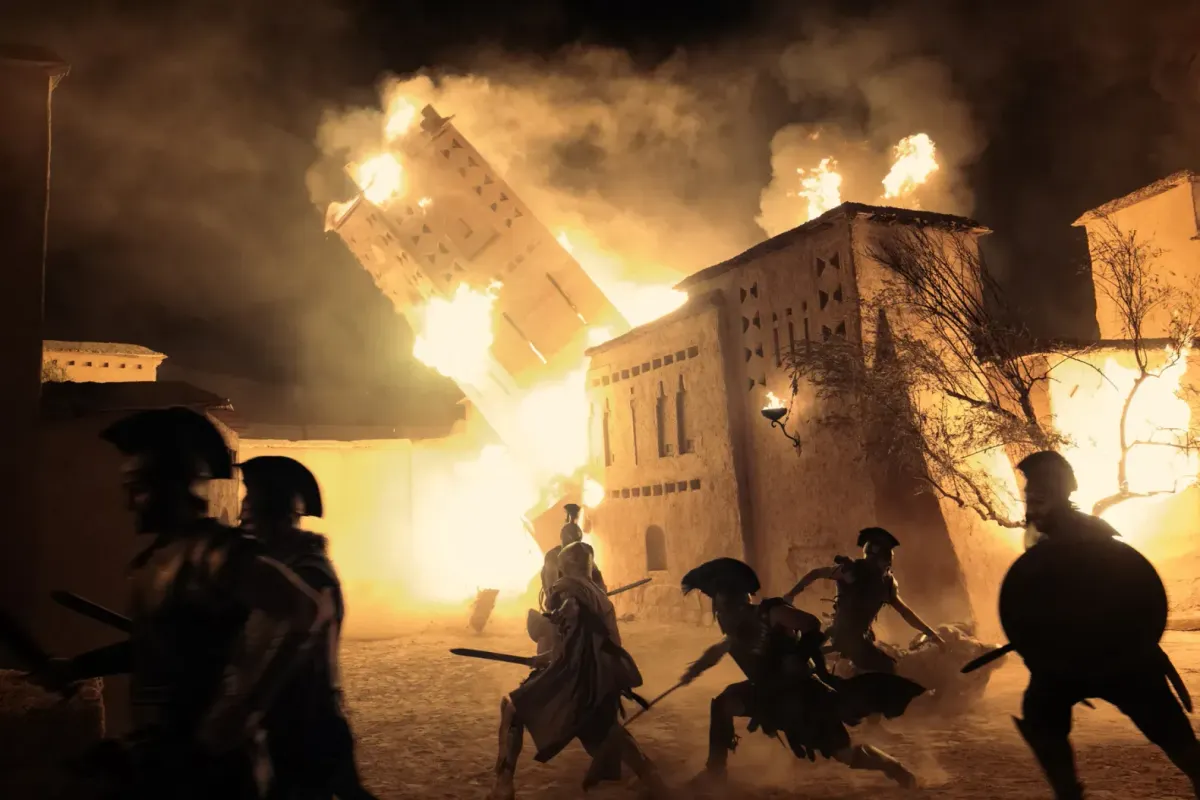
The Odyssey is, in a broad sense, a war film, or perhaps more accurately, it’s a film about war, and the breakdown of civil society that it entails. The sack of Troy is depicted gradually in flashback over the course of the film: first in fleeting images; then from the perspective of Menelaus (Jon Bernthal), who revels in the victory; then finally and most fully from Odysseus’s own viewpoint, as he witnesses the slaughter that he has unleashed on the city. Indeed, the Trojan war is framed as an imperial venture, reclaiming Helen (Lupita Nyong’o) after her abduction (which itself reduces a woman to her husband’s property, at least in some interpretations) no more than a pretext for Agamemnon’s attempt to control trade routes (which for my generation will elicit memories of the 2003 invasion of Iraq, but in fact recalls many similar excuses for American “interventions” across the world [2]). The Odysseus who lives with Calypso before returning home is haunted by the loss of his men, and particularly Sinon (Elliott Page), whom he deceived, but he is haunted as much by their actions as by their deaths.
We see Odysseus’s men participating in the wholesale slaughter and (implied) rape of the sack of Troy as part of Agamemnon’s (Benny Safdie) wider army, but even when separated from that army, they are explicitly shown pillaging a village (though Odysseus himself is kept away from the worst of all of this, and shown to be horrified by the former at least). Even their fateful slaughter of the sun god’s cattle is an act of pillaging, albeit one driven by desperation. The film makes a great deal of the threat posed to the city-states from the rumoured “people from the sea,” a loose adaptation of actual archaeological theories around the end of the Bronze Age (too loose for many archaeologists that I’ve seen). But as Odysseus recognises, the rumour that has spread actually refers to him and his men. They are the true threat to civilisation (which is also a neat inversion of Tiresias’s prophecy, in Homer, that death would come for Odysseus from the sea, a prophecy not fulfilled in the actual poem).
The nature of what these men are, or have become, is at the heart of one of the film’s most remarkable sequences: the encounter with Circe (Samantha Morton, singled out by a number of critics as one of the film’s highlights). The film’s shift for this sequence into outright body horror is incredibly effective in itself, but Circe herself, in conversation with both the men and Odysseus, frames the horrific transformation of them into pigs as no more than an externalisation of the horrors they have already wrought. For Circe, the pigs are what these men really are, driven by their appetites, and she refers to their human forms as “disguises.” She implies heavily to Odysseus that the men would have raped her, and whether or not she’s correct is for the audience to decide – I’ve seen some people argue that she’s framed as irrational, and it is true that the men approach her in apparent peace, but it’s also true that we’ve seen them do similar things already, and that Odysseus ultimately gets the better of her using force as much as guile. At the very least, it seems as if the film wants us to take Circe’s critique very seriously.
As many commentators have noted, Nolan has zeroed in on one of the key elements of the poem, a concept that recurs throughout much of Greek myth: the law of xenia, or hospitality, and its abuse. But Nolan widens this out such that xenia stands in for the whole of the social contract. Central to the poem, and a big part of the film too, is the idea that the suitors are abusing the hospitality of Odysseus’s house by staying there feasting constantly, and the significance of Odysseus’s return and slaughter of them is that it restores this order and avenges the slight. But the film suggests that the original transgression was the sack of Troy, with the Trojan horse – here redefined from a classic symbol of lateral thinking to a war crime – an abuse of the Trojans’ piety. As Odysseus and his men attempt to return home, they repeatedly either intrude on and abuse the hospitality of others by taking their property (the village, the sun god’s cattle, possibly Circe) or they are denied hospitality (the Cyclops, the Laestrygonians) – in fact, in a direct inversion of the law, rather than being provided with food, they become food for both the Cyclops and Scylla.
Xenia is the clearest illustration of the social order, but there are others. A recurring feature in the film is Odysseus’s inability or refusal to bury or properly honour his dead men, generally for practical reasons, which horrifies his remaining men and remains as a stain on his conscience. At the end of the film, he must sail to the west to honour all those whom he could not, but even as he does so, he knows that it is isn’t wholly sufficient. The societal breakdown that he has helped trigger is already taking its course, and Ithaca as it is will not survive.
Beyond this sense of civilisational collapse, there is another system in which Odysseus is caught, which again will be familiar to anyone who knows their Greek mythology: he is subject to the will of the gods. Nolan’s Odysseus struggles with this, questioning Athena [3] directly about how the gods speak to mortals, and attempting to defy what he knows to be his fate. Zeus and Poseidon in particular haunt the film through their apparent actions; Odysseus’s maritime misfortunes are attributed to the latter primarily, while the law of xenia is referred to throughout as “Zeus’s law,” its violation incurring an ominous roll of thunder.
But Odysseus is not a wholly passive subject in this system. His tragedy, such as it is, results from his hubris [4], his attempts to defy the gods and his fate, believing that he can steer a middle course between Scylla and Charybdis, or stop his men from eating the sun god’s cattle. Before this, though, his original violation looms over the film; the sack of Troy, and the abuse of the gods’ temples and priests that occurred there. There’s a sense that the world is now out of joint as a direct result of that violation. In the film’s third act, a gang of the suitors’ men infiltrate a temple of Athena, killing her priests, in an attempt to ambush Telemachus (Tom Holland), thus mirroring what the Greek [5] soldiers did in Troy.
Through all of this, though, the film treats the gods with a very modern ambiguity. It’s very possible to view them as being no more than a projection of Odysseus’s guilt, and by inference that he sees his random misfortune as the punishment he deserves. Unlike in Homer, there is no suggestion that Calypso or Circe are divine, nor that Helen has divine lineage; Nolan’s gods are far less present in the world, at least directly, than we might expect of much Greek myth.
It’s also worth noting some of the things that the film doesn’t depict. It’s quite a broad picture of the Trojan war, focusing mostly on its ending, though we do also see Odysseus’s initial departure from Ithaca [6] and (briefly) Agamemnon’s sacrifice of Iphigenia. Achilles is mentioned only once, and none of the major Trojan figures are named. There is some fighting in the course of the sack, but the only Greek casualty we see is Sinon. Perhaps most notably, there is no sustained reference to Helen’s abduction by Paris, which in mythology is both the original violation of the law of hospitality (and hence of the social order), and entirely the result of divine meddling, in this case by Aphrodite (and, indirectly, Eris). What this means is that the culpability of Odysseus and the Greeks is emphasised further. They become inarguably the aggressors, with little to no mitigation.
In most accounts of Greek mythology, the Trojan war and its aftermath marks the end of the age of heroes. This is partly because so many heroes and notables die in the war – Achilles, Hector, Priam, Penthesilea – or shortly afterwards – Agamemnon, Cassandra, Ajax – that the war is to the pantheon of heroes much as the First World War was to the generation of young men born between 1890 and 1905. But Nolan’s Odyssey picks up on hints in Homer and elsewhere that there’s more to it – that what we’re seeing is the end not only of an age of heroes, but of the Myceanean civilisation of the second millennium BCE. And furthermore, that that catastrophe has been brought about by the civilisation itself, that the Greek city-states are doomed by the savagery that they’ve unleashed, and the rules that they’ve broken; that once the social order has been torn down, it cannot be repaired. Despite the film’s relatively optimistic ending, in which Odysseus and Penelope (Anne Hathaway) sail west, Odysseus shows himself to be aware of that, speaking of the end of “our age of bronze” (in possibly the film’s clunkiest line). And even if he’s, for the moment, escaped the doom that found Agamemnon and may yet be coming for Menelaus, there’s still a sense of an inevitable end coming. Like so many of Nolan’s protagonists, things have been set in motion that Odysseus cannot control, and Ithaca may be just as doomed as Troy.
[1] As I’m starting by referencing a bit of a straw-man unsourced argument, I should also mention some of the sources that have informed my thinking in the couple of days since seeing the film: notably, Darren Mooney’s excellent video essay on the film and its relation to older swords-and-sandals epics; Mark Kermode’s review (really an extended conversation with Ben Bailey Smith), which is thoughtful, nuanced and not entirely positive; also Clarisse Loughrey, who considers the film to be the peak of Nolan’s career so far, which is quite some praise (this one’s behind a paywall).
[2] One of many salient insights in the Mooney video referenced in the note above is that Matt Damon’s characters in Interstellar and Oppenheimer could also be taken as avatars of American exceptionalism in different ways, suggesting that Damon himself is a sort of thematic thread through Nolan’s filmography, which has obvious implications for how we read Odysseus.
[3] Athena (Zendaya, strikingly ethereal) is the only god to actually appear in the film, and there’s plenty of scope to interpret that she’s no more than Odysseus’s hallucination of a young woman he saw killed in Troy in a temple to the goddess, thus forging a connection between the two in his own mind (this wouldn’t be my interpretation, as I’d tend to think it actually is Athena taking on that form, but it’s a perfectly valid one). There’s a wider debate to be had about how much the gods actually exist and influence the events in the film, and how much it’s just belief in them that shapes how people act and react (notably the opening caption refers to this as an age of “apparent magic”), but I think the effect for what I’m arguing in this paragraph is much the same regardless of whether you think the laws being transgressed are divine or human.
[4] In the Kermode review mentioned in note 1, Bailey Smith uses the phrase “imperial hubris” to describe the film, which is about the neatest encapsulation of what it’s about that I can imagine.
[5] I’ve followed the film’s lead in using the word “Greek” here in place of Homer’s “Achaeans” and others, simply for the sake of comprehensibility.
[6] Though without the mythological story (not in Homer) of Odysseus’s trick to try to get out of the war by pretending to be busy ploughing his fields – indeed, Odysseus is generally presented as less of a trickster and more of a soldier here than in Homer. Removing this emphasises Odysseus’s initial loyalty to Agamemnon, of whom we later see him ambivalent and wary after the sack.