The Two Towers Revisited
“Do we walk in legends or on the green earth in the daylight?" "A man may do both," said Aragorn. ‘For not we but those who come after will make the legends of our time. The green earth, say you? That is a mighty matter of legend, though you tread it under the light of day!” (33)
As mentioned last time, The Two Towers is my favourite of the Peter Jackson films; I think it has all the quasi-mythic grandeur you’d expect of a Tolkien adaptation, while also being an at times harrowing insight into the costs and nature of war as well as an eminently enjoyable popcorn epic, anchored by some all-time great acting performances. So I was a little surprised that I enjoyed the book version less than its predecessor. It’s still a phenomenal read, pacier than I expected and magnificently written, but this is, unsurprisingly, the one where the arbitrary separation of the book into three volumes feels most wearing, leaving it with two cliffhangers, one of which comes midway through. And while the oft-cited criticism of the book overall as being primarily about walking obviously overlooks Tolkien’s deep interest in landscape and its embedded history, the early chapters of Book Four in particular felt like something of a slog.
That said, there’s plenty to enjoy about this one specifically: the introduction of some of Tolkien’s most enduring characters, such as Éowyn, Treebeard and Faramir (the latter two of whom even manage to get more than a handful of appearances on the page); as well as locations like Fangorn and Cirith Ungol, not to mention Rohan and our first tentative foray into Gondor, which will dominate the third book. If the first book was overshadowed by Elves, this one very much takes us into the world of Men for the first time, and thus represents the passing of the torch in Middle-Earth.
As before, all page numbers are references to the 1999 Harper Collins edition; the search engine Search Tolkien has also been an invaluable resource.
So Far to Go
I talked last time about how the landscape in LotR is almost invariably strange and unknowable, with few maps available (except to the reader). Despite this, though, Tolkien is surprisingly exact about distances. Sometimes this comes through a character’s voice, as when Éomer tells Aragorn, Legolas and Gimli how far they have come in pursuing the Uruk-hai. More often, though, it’s the narrative voice that tells us exactly how many leagues the characters are travelling. For all the mythic wonder of the setting, he’s very concerned that it feel real, as is also clear in the lengthy descriptions of exactly what vegetation is growing, even in the shadow of Mordor:
For the most part [the land] was covered with a thick growth of gorse and whortleberry, and low tough thorns, though here and there clearings opened, the scars of recent fires. The gorse-bushes became more frequent as they got nearer the top; very old and tall they were, gaunt and leggy below but thick above, and already putting out yellow flowers that glimmered in the gloom and gave a faint sweet scent. (382)
In this instance, of course, there’s a character point to be made – perhaps this is Sam looking around with his gardener’s eye, seeing the details of the world in a very different way to Frodo.
Nonetheless, this information of how far the characters have travelled, or even where they are, is often hidden from them. As with FotR, this book is concerned at times with characters struggling to find their way. When we meet Frodo and Sam at the beginning of Book Four, they are utterly lost, ultimately requiring a guide to find the rest of their way (more on him later, as you might expect). Even Aragorn struggles to keep the trail of the Uruk-hai. Tolkien is invested in the details and process of moving through the wilderness. But unlike the characters, the readers have full information. Not only do we have access to the handy (if not especially detailed) maps at the back of the book, but the narrative voice likes to tell us exactly where the characters are, and what the significance of it is:
[Frodo and Sam] did not know, and could not guess in that misty light, that they were in fact only just within the northern borders of the marshes, the main expanse of which lay south of them. They could, if they had known the lands, with some delay have retraced their steps a little, and then turning east have come round over hard roads to the bare plain of Dagorlad, the field of the ancient battle before the gates of Mordor. (285)
Its name was Cirith Ungol, a name of dreadful rumour. Aragorn could perhaps have told them that name and its significance; Gandalf would have warned them. But they were alone, and Aragorn was far away, and Gandalf stood amid the ruin of Isengard and strove with Saruman, delayed by treason. (309)
What stands out here is not only the exactitude, and in the latter case the ominous foreshadowing (which continues right up until the hobbits set foot in Shelob’s lair), but the emphasis on not knowing. This is particularly significant in the case of Frodo and Sam, not only because (as I noted in talking about FotR) the wilderness is inherently unknowable for Tolkien, but also because it helps to underscore their heroism. They don’t know where they are or what they’re walking into, but they keep going nonetheless.
Nature Red in Root and Claw
There are a number of locations that could be argued to be the thematic heart of LotR, to embody something of what it’s fundamentally about: The Shire, Rivendell, Lothlórien, Minas Tirith, even Mordor (or possibly Isengard) in a sort of inverted way. There’s something to all of those, and certainly I devoted some attention to Lothlórien in the last entry, but I think the location that speaks most to Tolkien’s interests is Fangorn.
Fangorn is fundamentally unknowable, even sinister. It’s already been foreshadowed, in the Old Forest in Book One, where the hobbits were nearly eaten by a tree; Aragorn makes the connection between the two explicit (despite the fact that he’s talking to Legolas and Gimli, who’ve never been there). It’s ancient even by the reckoning of Elves, and with that comes a sense of mystery. Even knowledgeable people like Elrond and Celeborn have warned the Fellowship about it. It’s well-documented that Fangorn and the Ents’ revenge on Isengard is inspired by Tolkien’s disappointment that Birnam Wood didn’t literally attack Macbeth’s castle, but into this early modern influence he infuses a fundamentally medieval sense of landscape, where anything at all could be lurking in the forest. The wood that eats the orcs who flee from Helm’s Deep is the same wood whose water causes Merry and Pippin to grow. No wonder Legolas is fascinated by the place.
And the embodiment of all of this is, of course, Treebeard, who is also called Fangorn – twice in the book, Gandalf literally says “Treebeard is Fangorn” (119, 197), and Legolas recognises the name “Treebeard” as a rendering of the word “Fangorn” into the Common Speech [1]. Which suggests that, though he only appears in a handful of chapters, Treebeard could be regarded as the central character of the story – not, obviously, the main character by any means, but the one who embodies many of Tolkien’s key concerns.
Most obviously and fundamentally, he is nature. Like the forest that bears his name (presumably not coincidentally), he is deeply strange, a creature of legend barely recognised by most people, who provokes almost universal amazement when encountered. And, despite his kindly demeanour towards Merry and Pippin, he is dangerous when roused, as Saruman discovers. He and the other Ents are likened to Trolls numerous times, and indeed he claims that Trolls are Sauron’s (or Morgoth’s) “counterfeit” version of Ents (101), which helps to underline their potential for destructive power.
And he is old; unprecedently old. He is claimed numerous times in the book to be the oldest living thing in Middle-Earth – there’s an argument to be had about whether the likes of Gandalf or Sauron are older, in spirit form, but that kind of Top Trumps angels-on-pinheads nerdery feels to me antithetical to Tolkien’s interest in the nature of things over and above the details. What is clear, though, is that Treebeard lives partly in the past. He and the other Ents are in the process of passing out of the world, though they seem to recognise that fact less than the Elves do. What Treebeard does understand, though, is that the world has changed, and is changing, which accounts for his deep melancholy. He is not shut off from new things – he seems positively delighted to encounter Hobbits for the first time – but he is concerned primarily with the old.
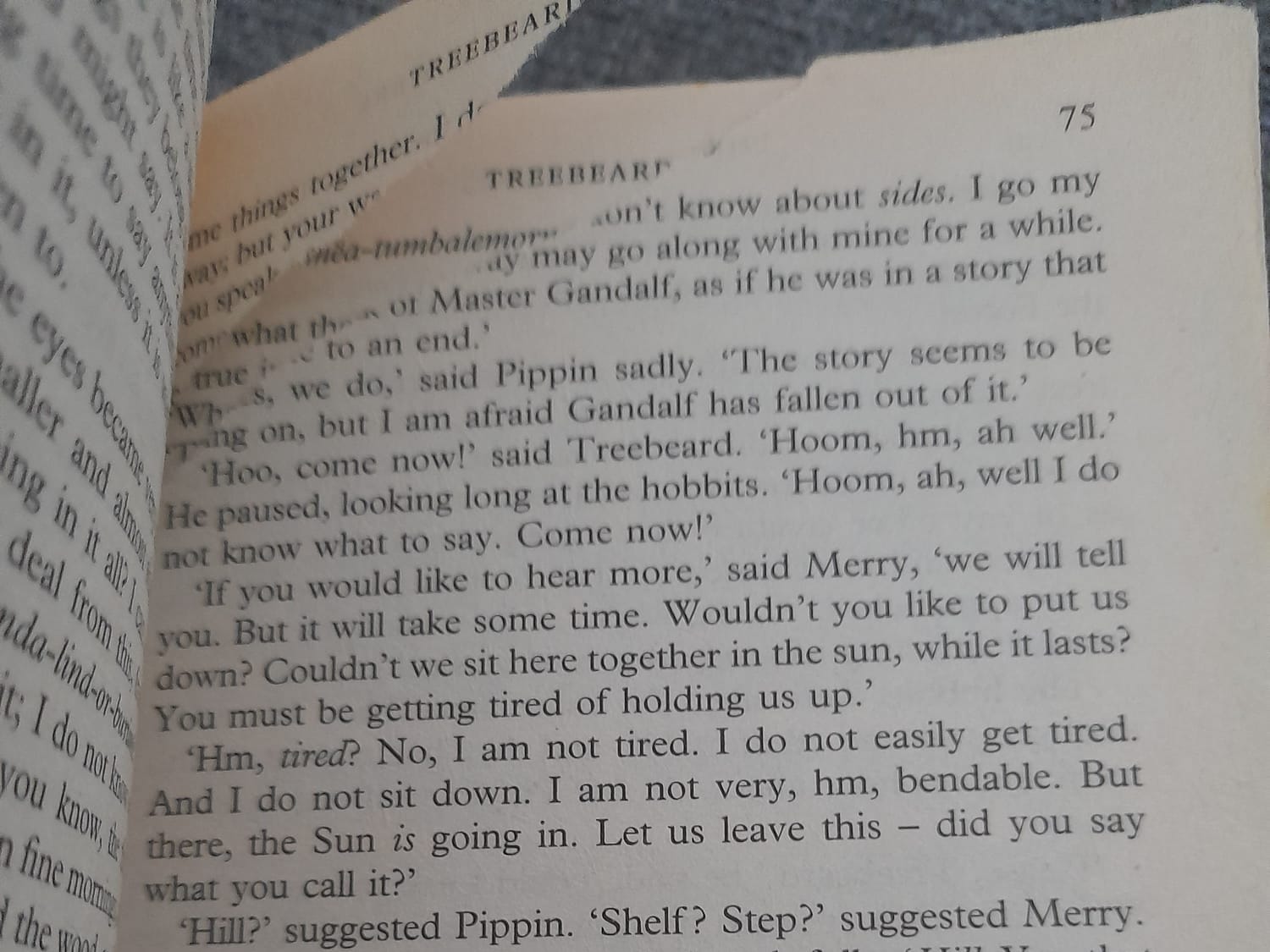
In this, he resembles Tolkien himself, as well as his fellow Oxford medievalist CS Lewis, on whom Treebeard is often said to have been based. And as if to strengthen the resemblance further, he is, perhaps more than any other LotR character, interested in language. Not just learning languages and translation, but the fundamental characteristics of different languages. Names in Old Entish “tell you the story of the things they belong to” (74), and for Treebeard signifiers and signified should be closely entwined; later in the same conversation he laments that “hill” is “a hasty word for a thing that has stood there ever since this part of the world was shaped” (75). For someone as interested in the creation of languages, and the way in which even their phonetics speak to aspects of the people who created them, as Tolkien, it seems almost like a self-portrait (albeit a mildly satirical one, as Treebeard is in part a comic character, with his constant exhortations not to be “hasty”).
The character Treebeard resembles most is of course Tom Bombadil, who likewise has some control over the unruly trees and acts as a kind of avatar of the natural world. Unlike Bombadil, Treebeard is directly relevant to the plot, but the long chapter that bears his name is rife with tangents. The most striking of these is his story about the Entwives, who make for a thematic contrast with the Ents, being concerned with agriculture and gardens, and hence with “order, and plenty, and peace (by which they meant that things should remain where they had set them” (87), as opposed to the Ents’ interest in unruly, unregulated nature. It’s reminiscent of the early 19th-century battle between classical order and Romantic chaos, played out in gardens of stately homes across Britain. And the other striking thing about the Entwives is that nowhere in all of Tolkien’s writing is the mystery of their disappearance definitively answered (though Tolkien did speculate in letters – the fact that he saw this kind of theorising about his own story in these terms (as speculation rather than authorial authority) speaks volumes about how he viewed it). It’s one of the clearest and strongest examples in the whole story of Tolkien’s enduring interest in mystery, and disinterest in unambiguous answers.
Creatures of Darkness
Let’s talk about Orcs, then. It’s impossible to get away from ideas of race in discussing them, nor should we want to do so – Tolkien was brought up at the height of the British Empire, and spent his formative years in either academia or the army, two different mechanisms by which racialised worldviews were inculcated and enforced. Of course the work he produced is inevitably infected by such worldviews. He designed Middle-Earth as Europe, with the Shire roughly corresponding to Britain (presumably making Ireland the Grey Havens, which I’ll take) and Gondor calling to mind imperial Rome, while Mordor sits somewhere around Turkey, and hence recalls that bugbear of the British imperial imagination, the Ottoman Empire. Throughout the book (and The Hobbit, to a lesser extent), east is equivalent to evil, danger, everything shadowy and sinister [2]. And the Orcs are no exception to this.
James Mendez Hodes has written convincingly about how Tolkien’s Orcs seem to be based on European descriptions of Central and South Asian peoples in particular. Beyond Tolkien, orcs have often drawn on the kind of “martial race” stereotypes Hodes explores, whether drawn from Polynesian, Central American or (most especially) African peoples. Fundamentally, they are a violent race bred for war, regularly referred to as “dark” or “swarthy,” (the latter word used also for the “Easterling” men who fight with Sauron) while Saruman’s Uruk-hai refer to the people of Rohan as “Whiteskins,” as if to make life difficult for progressively-minded casting directors. At times, the Uruk-hai commander Uglúk speaks in a declarative manner that sounds like the kind of remarks attributed to 19th-century Native American commanders in both actual historical record and popular media: “We are the fighting Uruk-hai! We slew the great warrior. We took the prisoners. […] I am Uglúk. I have spoken” (49).
And even if one were somehow inclined to write off all of this racialised description, Tolkien insists on drawing us back to the idea of race over and over in the text. This is most obviously true in the various scattered peoples of Middle-Earth – Elves, Dwarves etc. – but there’s an unsettling subtext of cross-breeding among the evil folk (and almost never among the good, Beren and Luthien aside). A “goblin-like” man turns up in Bree in FotR, attempting to spread fear and misinformation like a poorly-vetted Reform by-election candidate, and Merry and Pippin note several others in Isengard, “with goblin-faces, sallow, leering, squint-eyed” (206), a particularly disturbing piece of description. The sense here is that these are the offspring of some kind of breeding programme, which by implication is evil as much for the wrongness of these cross-racial characteristics as the fact that Orcs (or goblins – Tolkien is not always clear on the distinction) are involved. And all of that besides the fact that there are Men from the east who fight with Sauron; as Gollum describes them:
“They are fierce. They have black eyes, and long black hair, and gold rings in their ears; yes, lots of beautiful gold. And some have red paint on their cheeks, and red cloaks; and their flags are red, and the tips of their spears; and they have round shields, yellow and black with big spikes. Not nice; very cruel wicked Men they look. Almost as bad as Orcs, and much bigger.” (312)
While we might reasonably not entirely trust Gollum’s judgement of their moral character, these are Men who are part of “the enemy.” And once more Tolkien’s cultural background comes into play in the description of them, notably the vaguely effeminate long hair and jewellery, which is a common Orientalist trope, not to mention the regular association of them with the colour black here (though not in terms of the colour of their skin, notably). The general description of their clothing and armaments, as well as the fact that they use “Oliphaunts” in battle, gives them a vaguely Persian flavouring, which underlines the “west vs. east” sensibility of the book.
There’s much, much more to say about race in this book, and much of it has been said by people far more qualified than I. But before we move on from Orcs, it’s worth turning to the couple of moments where we get to hear their voices. One is when Merry and Pippin are being carried to Isengard, and the Orcs we hear from then are predominantly domineering and aggressive, as well as divided amongst themselves. But perhaps the more interesting episode is right at the end of TTT, when Sam overhears the Cirith Ungol Orcs who’ve taken Frodo. These Orcs are typically cruel, laughing at the story of one of their fellows who was captured by Shelob (and whom they did not attempt to rescue out of fear of her), but also show real intelligence, with Gorbag figuring out that Frodo was not alone (though wrong in his conviction that he was accompanied by a “large warrior” (435)), and contempt for their enemies, with Frodo’s abandonment considered a “regular elvish trick” (436). Most notably, they sound at times simply like soldiers lamenting their assignments:
“‘I tell you, it’s no game serving down in the city.’
‘You should try being up here with Shelob for company,’ said Shagrat[3].
‘I’d like to try somewhere where there’s none of ’em. But the war’s on now, and when that’s over things may be easier.’” (433)
It’s a surprising moment where these two Orcs sound like nothing more than WWI soldiers having a quiet cigarette together of an evening watch. For that matter, as with the Uruk-hai earlier, these Orcs have names and personalities, which gives them a dose of individuality. On a not dissimilar note, there’s Sam’s reflection upon encountering the body of an “Easterling” soldier killed by Faramir’s rangers (a speech given to Faramir in the extended edition of the film, very effectively):
He wondered what the man’s name was and where he came from; and if he was really evil of heart, or what lies or threats had led him on the long march from his home; and if he would not really rather have stayed there in peace. (332)
It’s a nice moment of humanising the dead man, “enemy” though he is, and even of empathy – after all, Sam too would really rather have stayed in the Shire, if at all possible. And it’s a reflection that feels very like the work of someone who had seen war first-hand.
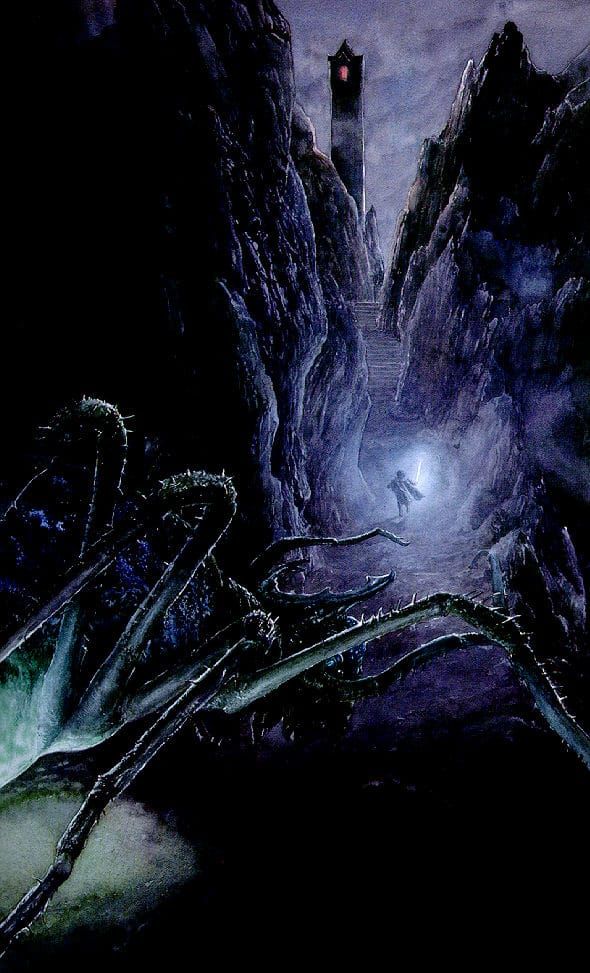
But Tolkien was a devout Catholic, someone who believed in the idea of ontological evil, and while most of the evil creatures in Middle-Earth have been corrupted to be that way – even Sauron – there are those who simply are evil, and perhaps the most effective of those is Shelob. Shelob is a creature of pure appetite, with no apparent capacity for language or reasoning, existing only to eat. She’s one of the oldest things in the story, a child of the giant spider Ungoliant, like one of the children of Echidna and Typhon in Greek myth. And there’s something vaguely Miltonic about the descriptions of her that Tolkien gives us: “she served none but herself, drinking the blood of Elves and Men, bloated and grown fat with endless brooding on her feasts, weaving webs of shadow; for all living things were her food, and her vomit darkness” (414). It’s no wonder that her lair is one of the most unnerving locations in the series, utterly dark and uniquely unsettling.
The Great Dictator
And then there’s Saruman, who is quite a different flavour of evil. He too has been corrupted, but far more recently than Sauron, and so he’s a clearer example of what could happen to a capable and knowledgeable person if they turn their mind to evil. In fact, while the title of Tolkien’s favourite character is up for grabs (though I have a candidate in mind – see below), I think it’s very likely that Saruman might be his least favourite in terms of what he represents. Perhaps the clearest example of that will wait for Return of the King, but beyond the rampant industrialisation and destruction of the natural world, he’s also portrayed as a demagogue, someone whose speech itself has the power to persuade and ultimately corrupt. While this comes about through the literal sound of his voice (one of so many reasons why Christopher Lee made for astonishingly good casting), he’s still easily recognisable as a portrait of the kind of person who stirs up destruction and violence in the real world, playing the injured party despite having himself started the war:
“Much have I desired to see you, mightiest king of western lands, and especially in these latter years, to save you from the unwise and evil counsels that beset you! Is it yet too late? Despite the injuries that have been done to me, in which the men of Rohan, alas! have had some part, still I would save you, and deliver you from the ruin that draws nigh inevitably, if you ride upon this road which you have taken. Indeed I alone can aid you now.” (223)
Note the clever combination of rhetorical strategies here: beginning with flattery, and weaving in the “evil counsellors” trope much beloved of medieval rebels, a way of critiquing the regime without impugning the sacrosanct person of the king, and in this instance appealing in part to the commanders and soldiers of Rohan who aren’t sure if Gandalf can be trusted. He paints himself as magnanimous and forgiving throughout the encounter and offers help, an offer that never fails to come with a hint of a threat of greater sorrow and destruction to come behind it.
But what’s even cleverer about this portrait is what comes next. Twice Saruman is interrupted in his appeals to Théoden, by Gimli and Éomer, and both times he reacts with a flash of temper before recovering himself. But when Théoden rejects him, he is overcome with anger, and can only lash out: “Dotard! What is the house of Eorl but a thatched barn where brigands drink in the reek, and their brats roll on the floor among the dogs?” (226) Instead he appeals over Théoden’s head, as it were, to Gandalf, who easily rejects him. So we can see here first the thin-skinned demagogue, for whom any criticism is an act of rhetorical violence against them – just look at what Nigel Farage does when anyone dares to suggest that a man with a long and well-documented history of fomenting xenophobia (to say nothing of a mounting number of similar claims of historical anti-semitism) might be just a bit racist. Then comes the dismissal, the suggestion that really you’re just too foolish or ignorant to understand, a tactic beloved of a certain flavour of pseudo-intellectual (I was going to cite a specific one, but he seems to have largely vanished from public life and I have no desire to conjure him up again). It’s easy to reach for the WWII context when discussing a book written over the course of the 1940s, but actually Saruman reminds me more of an Oswald Mosley than an actual dictator – an essentially pathetic individual grasping at a power that is beyond him, condemned to be in the shadow of the real overlord. And, like Mosley, his legacy is one of failure, his project falling down around him. Which is both pleasing and important to consider, right now.
The King of the Golden Hall
Théoden is my favourite character in the Peter Jackson films. A lot of this is down to Bernard Hill’s performance, a standout among standouts, where he embodies a sense of weariness in the face of it all, of being afraid that you won’t measure up, but ultimately doing what you have to regardless. In TTT alone he gets two of my favourite moments: breaking down sobbing at his son’s grave (“no parent should have to bury their child” cuts through so strongly for being in such a different register to much of the dialogue, far more direct), and his recital of (a slightly edited version of) Tolkien’s rhyme “where is the horse and the rider” as he contemplates facing down impossible odds. And in RotK he’s central to the ride of the Rohirrim, my favourite moment in the film trilogy, where he leads the riders into battle shouting “Death!” And death is central to all these moments that I’ve mentioned. The films, like the book, are concerned with mortality, with aging and passing away, and Théoden is a big part of that.
Throughout the book, the emphasis is placed on his age. Unlike Bernard Hill’s version, whose initial infirmity is largely a result of Saruman’s influence, Tolkien’s Théoden continues to be considered aged throughout, though he does recover strength and is able to ride into battle. Of all the Men in the story, even Aragorn, Théoden is the most elegiac in his speech, referring frequently to his predecessors and to past glory. He refers to himself as “a lesser son of greater sires” (225), compares his marshal Erkenbrand to his ancestor Helm the Hammerhand, and even after being freed by Gandalf almost immediately laments for his kingdom: “I fear that already you have come too late, only to see the last days of my house. Not long now shall stand the high hall which Brego son of Eorl built.” (141). He believes it likely that he will die in battle against Saruman’s forces, but rides to that battle nonetheless. There’s a sense that, with his son dead, a part of Théoden believes he has lived past his time. He’s regularly paired with Aragorn, the king of the future, where Théoden, like the Elves, is already receding into the past. But, also like the Elves, there’s more for him to do before his time comes.
Showing His Quality
One of Tolkien’s pet topics, one of the ideas he’s clearly seeking to explore throughout the book, is heroism. The most obvious representatives of that are Frodo and Sam, the unlikely heroes at the centre of the story, who find their courage in adversity. Beyond that, there are grand heroic figures who stand tirelessly against evil – Gandalf, Aragorn, Legolas – the kind who populate the epics on which Tolkien was drawing. And then there are the in-between heroes, generally Men, who are grand and capable leaders, but are in some way flawed or weighed down – Théoden and Boromir are perhaps, in different ways, the best examples of this. Aragorn aside, most of the Men in the series are flawed or compromised in some way, though capable of greatness.
There are, I think, two major exceptions to that – three if you include Éowyn, but we’ll come to her with the next volume (short version: I think Tolkien does depict her as flawed). One is Éomer, but he’s not the most fleshed-out character – his only real flaw is a lack of knowledge of the wider world, which comes out in his unwitting slander of Galadriel, to which Gimli takes great offence. The other, though, is Faramir, who I think is, other than the four hobbits, the closest any character in the book comes to Tolkien’s ideal of heroism.
Faramir is a captain of Gondor, and seems to be well-respected by his men, but, unlike his brother, he is not a natural warrior. He seeks to fight against evil, and to defend his people, but as he says himself: “I do not love the bright sword for its sharpness, nor the arrow for its swiftness, nor the warrior for his glory” (346). Like the hobbits, his is a valour borne of necessity, and it seems clear that in more peaceful times he would not be a fighter. As hinted in the last volume, and as will be even clearer in the next, for an epic focused on war LotR largely rejects the idea of valour and martial glory for their own sake [4], and it wouldn’t be a stretch to suggest that Faramir, as is often said of Sam, represents a less violent version of masculinity.
Like Frodo, at heart Faramir is a scholar, an identity beloved of Tolkien (who was, of course, a scholar who had seen war himself). He and his men speak a variant of Elvish among themselves, often a marker of virtue in Tolkien’s writing [5]. He knows about Lothlórien, and is even able to refer to it by its old Elvish name. Unlike his hotheaded brother, he has taken time to consider the Ring and its dangers, and even has the wisdom to guess correctly that Boromir would have fallen for its lure. Indeed, wisdom is an attribute continually associated with Faramir, who also takes the time to “judge justly in a hard matter” (337) – the question of what to do with Frodo and Sam, in which he ultimately opposes his father’s decree. The reader obviously already knows this to be the right choice, but its wisdom is proven even further when we meet Denethor in the next volume.
As I’ve noted before, the identity of the Wise is one that Tolkien reserves for a few notable individuals, particularly Gandalf (to whom Sam explicitly compares Faramir (360)), Elrond and Galadriel. So it’s striking that Faramir is implicitly paralleled with Galadriel. Both are tempted by the One Ring, as a means of safeguarding all that they value, and both refuse it openly – in fact, Faramir seems if anything less tempted by it than Galadriel, although he also refuses to look at it, understanding its power (and is less intimately associated with the origin of the Rings of Power than she is).
In the film, of course, this is changed significantly, to some fans’ ire; Faramir comes closer to being tempted by the Ring, albeit not for personal reasons, and we see his duty and his father’s orders weigh far more heavily on him, particularly in the extended edition (which features one of the few scenes that I think the theatrical edition is arguably weaker for losing, in his flashback scene). This is partly for pacing reasons, with Cirith Ungol and Shelob pushed into the third film to parallel the battle at Minas Tirith, and partly to flesh out Faramir’s character a bit, so he is less the paragon who “would not take this thing, if it lay by the highway” (346). I think he ends up in much the same place, though, and even as a fully paid-up Faramir fan (Fanamir?), I don’t think this creative decision undermines him so much as it underscores the difficulty of his position, setting up his arc in RotK.
Slinker and Stinker
Speaking of the films, perhaps the single hardest element of the book to separate out is Gollum. So striking is Andy Serkis’s performance (to say nothing of the still remarkable digital artistry used to create the character) that it’s next to impossible not to think of him throughout [6]. Tolkien’s Gollum, though, is weirder in certain ways. Notably, his rambling really is just that, especially early on, when he is borderline incomprehensible, before he starts really communicating at all with Frodo and Sam:
Then suddenly his voice and language changed, and he sobbed in his throat, and spoke but not to them. “Leave me alone, gollum. You hurt me. O, my poor hands, gollum. I, we, I don’t want to come back. I can’t find it. I am tired. I, we can’t find it, gollum, gollum, no, nowhere. They’re always awake. Dwarves, Men, and Elves, terrible Elves with bright eyes. I can’t find it. Ach!” (272)
This is recognisable as a sort of traumatic flashback to Gollum’s torture by Sauron, which reminds us of how much he’s suffered even at the point where he seems most threatening. It’s also notable that here, and elsewhere, he uses a variety of pronouns for himself. He alternates between first-person singular (“I”) and plural (“we”) here, and while he generally sticks with the latter, he also reverts to the former at times, with the occasional third-person thrown in: “But Sméagol has used his eyes since then, yes, yes: I’ve used eyes and feet and nose since then. I know other ways. […] Follow Sméagol! He can take you through the marshes” (285). This constant movement between pronouns, and use of his own name, could suggest a kind of identity crisis, in line with the “Slinker” and “Stinker” personae that Sam notices, but there’s also a movement of meaning at times: Frodo notices relatively early on that use of “I” is often a marker of sincerity with Gollum, possibly a throwback to his pre-Gollum days, in line with his re-adoption of the name “Sméagol” (309).
Indeed, our sympathies for Gollum are kept alive carefully through the book, even when he is at his most treacherous. Just before leading the hobbits into Shelob’s lair, he comes upon them asleep together, wrapped up in each other, and has this quite moving moment:
A strange expression passed over his lean hungry face. The gleam faded from his eyes, and they went dim and grey, old and tired. A spasm of pain seemed to twist him, and he turned away, peering back up towards the pass, shaking his head, as if engaged in some interior debate. Then he came back, and slowly putting out a trembling hand, very cautiously he touched Frodo’s knee – but almost the touch was a caress. For a fleeting moment, could one of the sleepers have seen him, they would have thought they beheld an old weary hobbit, shrunken by the years that had carried him far beyond his time, beyond friends and kin, and the fields and streams of youth, an old starved pitiable thing. (403)
It’s not difficult to see why Serkis thought of Gollum as an addict when preparing to play the part, and that’s certainly an easy comparison point, but for Tolkien there’s something more spiritual at play. Gollum is starved in terms of soul more than body, his whole being concentrated on love and desire for something that cannot show him any love, something inherently evil. And in this passage, and others like it, he is compared directly to Frodo (and, more implicitly, to Bilbo after leaving the Shire, when his age is more apparent), as a version of what he could become [7]. Even Sam has some sympathy for Gollum, when it’s not overridden by his protective suspicion; he initially ties the rope around him very loosely (hurting any sapient creature seems to be against his nature), and later calling him “poor wretch” when he believes him to be out of earshot (282).
This “wretch” language, though, points to an aspect of Gollum’s role in the book that I hadn’t considered before, but found myself increasingly uneasy about as I read. When Gollum first appears, he is physically overcome and tied up with a rope that causes him severe pain (although the hobbits don’t realise this at first). After that, he is coerced and persuaded into helping the hobbits, and the rope is taken off, to which he responds “like a whipped cur whose master has patted it” (276), having already been compared to “a little whining dog” (275); in the next chapter he is referred to as being “like an expectant dog by a diner’s chair” (281) and “like a beaten dog” (298) after being “commanded angrily” (ibid), while later, when Frodo threatens him (to save him from the rangers of Ithilien), he is compared to “an erring dog called to heel” (367), a clearly dehumanising pattern of language that is somewhat at odds with the idea of Gollum as a sympathetic individual. Thereafter, he alternates between wheedling obsequiousness and dark plots of revenge as he leads the hobbits on, bound to them by a promise obtained under coercion. Over and over we get references to his pitiful malnourished physical state, though he retains a threatening air. And, of course, he refers to Frodo incessantly as “master.”
What I’m getting at here is that Gollum is treated like something akin to a slave within the narrative. Now I’ll admit this is a harsh reading in some ways, with plenty of mitigation available – for instance, Frodo is the “master” not so much of Gollum, but of the Ring, and so calling him that affirms their shared bond as well as the nature of the promise that ties them together. But it’s hard to get away from, not least as Gollum is regularly referred to as a “black” or “dark” figure (specifically in colouring, not in moral outlook). When Frodo saves Gollum from Faramir and his men, he does so not just out of his general moral courage, but because “the servant has a claim on the master for service, even service in fear” (366). But Gollum is clearly a very different kind of “servant” to Sam, who serves willingly out of devotion and love (which admittedly comes with its own complications). This very much falls into the category of unintended readings, clearly – slavery is not a major part of the world of Middle-Earth, with only fleeting references to it being practiced by the forces of evil [8]. But the way Gollum acts and is described can’t help but recall the attitude of colonisers towards enslaved people, or even a figure like Caliban who represents such attitudes (and Gollum has something of Caliban about him both in his treachery and his animalistic description, though Frodo is certainly kinder than Prospero).
A final note, and honestly I don’t know what to do with this observation, but I couldn’t escape it. There are times where Gollum sounds remarkably like a certain major public figure who also has a bizarre and easily imitable pattern of speech. There’s his habit of using adjectives that don’t quite seem to fit the context (“beautiful sleep” (381)), his aforementioned rambling and strange syntax, and most strikingly, his attribution of his own sentiments to nebulous others (“And what [Gollum] says now many peoples are saying” (307)). Tolkien may be a writer concerned primarily with the past, but it seems he did, somehow, manage to predict the current President of the United States.
Nice Hobbits
Last time, I had a fair bit to say about Frodo, unsurprisingly, and the main points of what I said then remain true. Frodo is tougher and more practical than anyone (including Sam, who thinks of him as too soft-hearted for his own good) realises, ultimately facing down the almost unmatched terror that is Shelob. He remains a scholar, capable of recognising that the rangers of Ithlien are Dúnedain or recalling “the Trees of Silver and Gold” (310)[9], though there are definite gaps in his knowledge, especially geographically, as noted above, notably in regard to Cirith Ungol – the implication is that someone truly versed in lore would recognise the echo of Ungoliant’s name, Shelob’s parent, and understand the nature of the danger that awaits there, which Faramir also fails to do, though he does know that “some dark terror” lives there (373).
And as I also mentioned previously, Frodo’s heroism is of an existential nature. His burden is not just the Ring, but the importance of his quest, and thus of his choices, as he emphasises to Faramir:
“But over the mountains I am bound, by solemn undertaking to the Council, to find a way or perish in the seeking. And if I turn back, refusing the road in its bitter end, where then shall I go among Elves or Men? […] [S]ince [Gandalf] is gone, I must take such paths as I can find. And there is no time for long searching.” (374)
Without getting too caught up in comparison to the films, what stands out here is Frodo’s self-possession, where Elijah Wood’s Frodo seems relatively passive at times. Wood’s performance is a fine one, and Frodo works well as a character in the films, but Tolkien’s Frodo is stronger and more self-directed. Yet he is not immune from the despair that seems at times to be Sauron’s greatest weapon. Upon seeing the armies of Mordor, he is almost overcome: “I am too late. All is lost. I tarried on the way. All is lost. Even if my errand is performed, no one will ever know. There will be no one I can tell. It will be in vain” (394).
Naturally, it is Sam who shakes him out of this, Sam who is not only crucial to Frodo’s journey to find meaning in his actions, but who has his own struggles in this regard. Sam too almost succumbs to despair after Frodo’s apparent death, even briefly contemplating suicide (425). Yet he decides, in true Beckettian fashion, that “I’ve got to go on” (ibid), and while he considers Galadriel, Gollum, Gandalf and the Council in making his decision, ultimately it is premised on himself, as he conducts a lengthy internal debate in his own voice:
“I wish I wasn’t the last,” he groaned. “I wish old Gandalf was here, or somebody. Why am I left all alone to make up my mind? I’m sure to go wrong. And it’s not for me to go taking the Ring, putting myself forward.”
“But you haven’t put yourself forward; you’ve been put forward. And as for not being the right and proper person, why, Mr. Frodo wasn’t, as you might say, nor Mr. Bilbo. They didn’t choose themselves.”
“Ah well, I must make up my own mind. I will make it up. But I’ll be sure to go wrong: that’d be Sam Gamgee all over.” (425-26)
Tolkien makes the curious typographical decision here to close the quotation marks at the ends of paragraphs, indicating that two separate voices are at play here, even though both bear Sam’s speech patterns. So Sam’s internal voice is complex, and perhaps there’s a touch of external influence on it, perhaps from the Valar. Additionally, as Sam recognises, his position is similar to Frodo’s in that both have had a task thrust upon them, to which they must measure up.
And like Frodo, Sam very much does measure up. Not only in taking the Ring, but even in refusing ultimately to abandon Frodo, a decision which, though not the “right” one in terms of the overall quest, is undoubtedly right in terms of Sam’s moral compass, his loyalty overpowering all else. And then there’s his fight with Shelob. In FotR, Frodo jokingly suggested that Sam would be a great warrior in the end, while at the end of TTT, Gorbag assumes that a mighty warrior must have been accompanying Frodo, to Sam’s amusement. And yet there is a degree of truth to both these statements. In fighting Shelob, Sam is compared favourably to “the doughtiest soldier of old Gondor, nor the most savage Orc entrapped” (421), driven by “a fury […] greater than any [Shelob] had known in countless years” (420). Sam, who loves songs and minutes earlier had told Frodo that his own encounter with Shelob would make a fine song (412), takes his place as a warrior of legend, driven by love and loyalty rather than might. Because those are the things that, for Tolkien, constitute true heroism.
“You should be glad, Théoden King,” said Gandalf. “For not only the little life of Men is now endangered, but the life also of those things which you have deemed the matter of legend. You are not without allies, even if you know them not.”
“Yet also I should be sad,” said Théoden. “For however the fortune of war shall go, may it not so end that much that was fair and wonderful may pass for ever out of Middle-Earth?”
“It may,” said Gandalf. “The evil of Sauron cannot be wholly cured, nor made as if it had not been. But to such days we are doomed. Let us now go on with the journey we have begun!” (185)
[1] On the topic of Ent names, another Ent is named “Finglas,” which is extremely funny for a Dublin resident, but presumably not entirely coincidental. While Tolkien wasn’t a fan of Old Irish as a language, the latter syllable “glas,” meaning green in modern Irish, stands out, while “fionn” generally means bright or clear; the placename Finglas (Fionnghlas) dates back to at least the 8th century, and is translated to something along the lines of “bright stream,” reminiscent of the magical waters of Fangorn.
[2] This is not so much the case with The Silmarillion, where Morgoth’s fortress is in the northeast of the map and a number of peoples come from the east at various points, but The Silmarillion, which sees the world in a long-past state, isn’t meant to mapped on to real-world geography in the same way.
[3] Let’s not think too hard about the possible etymology of Shagrat’s name.
[4] Which makes it a shame that so many video games based in Middle-Earth (many of them very good in their own right) have focused on war and conflict so heavily, the recent Tales of the Shire being a rare exception.
[5] Here it also, as Frodo realises, bespeaks their descent from Númenor. Gondor does have a troublingly blood-based class system, where certain individuals are born longer-lived and just generally better than everyone else, which I may talk about with the next book, but then again that’s really just a literalisation of the logic of aristocracy.
[6] Though I maintain, as I have done for two and a half decades now, that “gollum” should be a swallowing sound, not a cat-like coughing.
[7] The film had a deleted scene, which sadly doesn’t exist in any finished form, where Faramir glimpsed Frodo in a Gollum-like state as he clutched at the Ring in a corner.
[8] In general, slaves are referred to as the province of Mordor and Isengard, with Orcs in particular acting as slaves to both Sauron and Saruman, though the practice of enslavement itself seems regarded in the text as less despicable than the works created by the enslaved people. The only possible exception is Faramir’s desire to see Minas Tirith returned to its old glory, “not a mistress of slaves, nay, not even a kind mistress of willing slaves” (346). It’s hard to believe a linguist as accomplished as Tolkien could write such a bizarrely oxymoronic phrase as “willing slaves.”
[9] Though, interestingly, Sam too is at least somewhat conversant with legends of the past, recalling the story of Beren at a crucial moment, and even remembering what became of that particular Silmaril (400), which suggests knowledge beyond that of a single song.