Songs of Love 16: Love and Sex
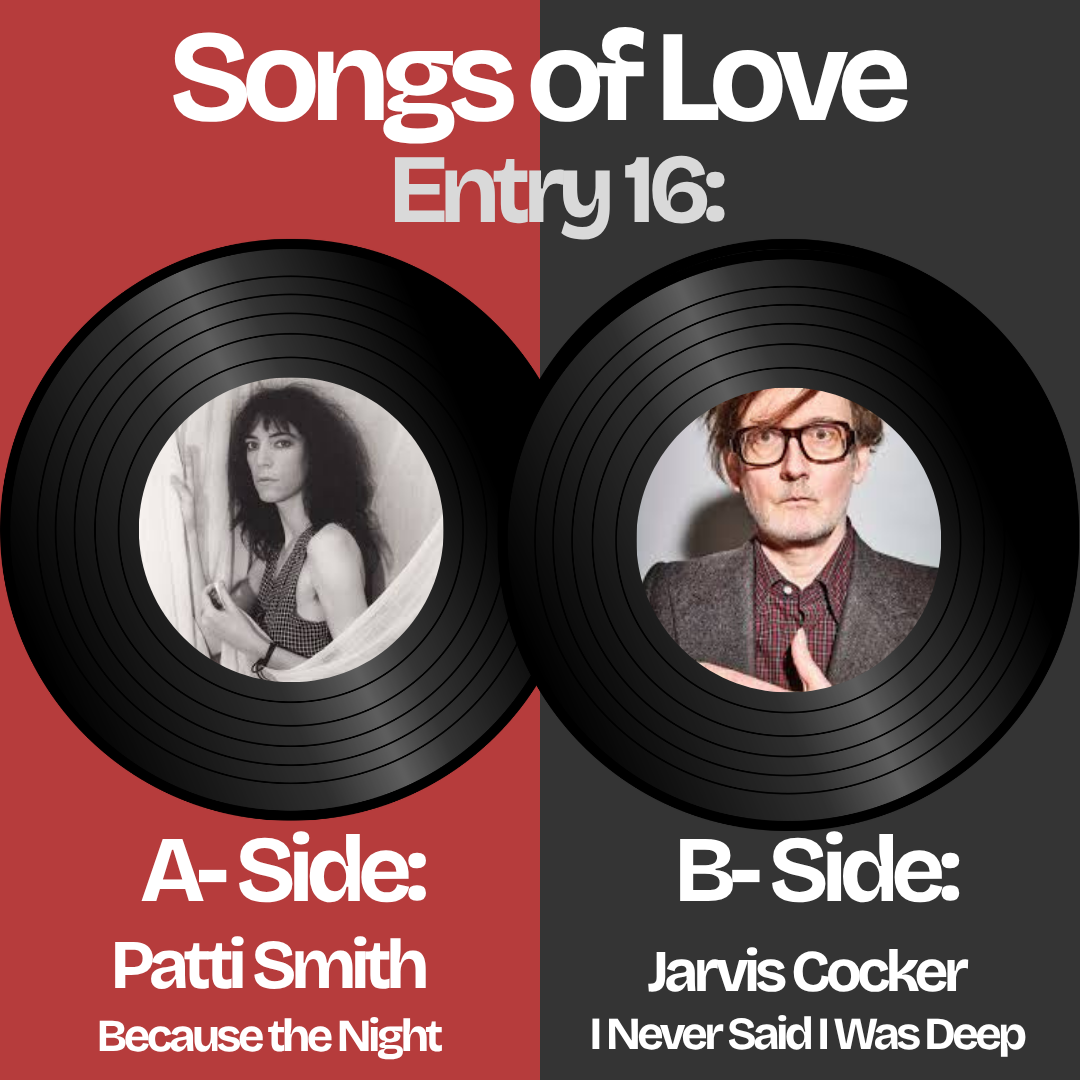
For a project writing about depictions of romantic love, I actually haven’t overtly covered sex very much. This is surprising not only because sex is, for many people, an enormous part of a romantic connection, but also because popular music is in some ways built around sexual appeal, whether between listeners, between audience and performer, or within characters in a song (and of course these things inextricably overlap). And for that matter, there are as many different approaches to and views of sex in popular music as there are for any other aspect of love. Here we have two that are almost diametrically opposed: the A-side covers sex as part of an emotional refuge, while the B-side (which is almost an anti-love song, but is included here because the negation of something is a powerful statement in itself) is about sex as purely mechanical, animalistic instinct. There will be plenty of other songs covered here that deal with sex in one way or another, but it’s at the very centre of these two.
A-Side
Performed by Patti Smith
Written by Patti Smith and Bruce Springsteen
Released 1978
When you’re deeply in love, it’s easy to imagine yourselves as separate from the world (one of many, many ways in which romantic love and religious devotion rhyme). Sometimes this manifests as an exceptionalism (“No it’s not like any other love/This one is different because it’s us,” as a well-known xenophobe once sang), sometimes as a paranoia, a sense that the world is against you, as we saw (possibly with some justification) in ‘The Dark End of the Street.’
Here, perhaps, there’s a little of both. Certainly there’s a sense of shelter, or refuge, to the lovers’ togetherness (“they can’t hurt you now,” the singer assures their lover), but this is very broad. Perhaps the lover is being hunted, perhaps the relationship is taboo (shades, perhaps, of Romeo and Juliet’s one night together), or perhaps they’ve just had a hard day at work. It’s irrelevant, because what matters is the two lovers being together.
This is a song of a deep, burning desire. The singer can’t bear to be alone, needing their partner too badly. Desire, we’re told in the third line, is “hunger,” but also “the fire I breathe.” It’s a deep physical need, then, on two levels – both hunger and breathing. The idea of “fire” might seem destructive, and perhaps it is – there’s certainly a sense here of pain or even sickness, in a burning sensation experienced in the act of breathing - but it’s tied here to a bodily reality. And fire is not just destruction. It’s also heat.
And heat is a concept core to this song in both literal and metaphorical senses. The encounter between the lovers is clearly not a chaste embrace – they’re having some torrid, hungry sex. “Take me now,” the singer urges their lover in the very first words of the song. No easing into the subject, no foreplay, as it were; there’s a fierce need evident from the off. The singer wants to share “the way I feel when I’m in your hands” and later “the way I feel under your command.” For all the need expressed here, there’s a passivity, we might even say (advisedly) a submission that characterises this encounter on the part of the singer.
Indeed, this is a song that deliberately makes love and lust inseparable. One appears to be the other – “love is an angel disguised as lust,” but more importantly, the chorus mixes the lovers together with their lust:
Because the night belongs to lovers
Because the night belongs to lust
Because the night belongs to lovers
Because the night belongs to us
The “lust/us” rhyme in particular is suggestive here. This sexual encounter isn’t just a part or an aspect of the relationship; this is the relationship. Which is not quite the same as saying it’s a purely sexual or purely physical relationship (which is clearly not the case – there’s a deep emotional reservoir at play here, and the need expressed is not “just” physical). Rather, this is a relationship where sex is a core element. It’s how the lovers most clearly display their feelings about each other; it’s how their love is manifested and expressed. Which is, of course, exactly how many people experience sex within the context of a relationship.
This is also, from the title on down, a song that identifies itself with the night, with darkness. Conventionally, darkness stands in for doubt, mystery, even evil in a metaphorical sense. But here, the lovers’ love is intertwined with the night. Night is where they can be together, where they can be themselves, with an implied sense that the morning is a threat – as with ‘Dark End of the Street,’ again, there’s a sense of having to be veiled, making a queer reading of the song quite tempting. They may claim ownership over the night, but there’s also a sense that on some level, they are the night.
Relatedly, there’s an immediacy to the love, and the lust, expressed here, with the word “now” recurring across the verses: “take me now,” “come on now,” “they can’t hurt you now,” and most strikingly, “touch me now.” Like many of the A-Sides we’ve seen, this is a song concerned with the present, almost to the exclusion of all else. While the lovers are together, everything outside of the room, or the bed, ceases to exist. At least for the night, it’s just the two of them, together. In this sexual encounter (or series thereof), an entire loving relationship is manifested.
B-Side
Performed by Jarvis Cocker
Written by Jarvis Cocker
Released 2009
Which is not to say that all sexual encounters are an expression of deep love and affection, of course. And who better to remind us of that than Jarvis Cocker, the master of writing about seedy sex? From the monotonous suburban affairs of ‘Acrylic Afternoons’ through the sex-as-class-war of ‘I Spy’ to the charity shop rutting of ‘Tina,’ it’s one of the key subjects of his work with Pulp, and while his solo work has been a bit more varied in its scope, he’s more than happy to return to one of his favourite themes from time to time.
In fact, this is the polar opposite of the Cocker-authored song previously covered in this project. That was a sweet, pure love song about a relationship written in the stars, with hardly a hint of the carnal (unusually for his work). Here, it’s pure carnality. Not only is there no sense of destiny, of something powerful and lasting and beautiful to contemplate, there’s barely even a flicker of affection. Certainly there’s no indication of something cerebral here, as the singer is at pains to let us know from the very first line: “I love your body ‘cause I’ve lost my mind.” In this particular brand of Cartesian dualism, the body wins out over the mind, which is rendered ineffectual and irrelevant.
It’s a self-aware take from Cocker, someone who’s often been touted (with good reason) as being among the sharper songwriters of his generation, but who’s also often been regarded as someone with very particular concerns (“just another song about single mothers and sex,” as he once sang). But it’s also a kind of character study, of someone who’s utterly brazen in their desires, to a degree that’s actually quite admirable. As he puts it, in perhaps the song’s most memorable lines:
My morality is shabby, my behaviour unacceptable. No, I’m not looking for a relationship, just a willing receptacle. [1]
It’s a well-chosen image, queasy and mundane enough to undercut any sense of roguish charm to the more honest declarations. This song is a coming clean, but more in a shameless mode than a confessional one. This is the rake who makes a virtue of his scandalous nature, but in a way that is at least as much repellent as it is admirable. It’s a sort of self-laceration so severe that it comes all the way around and ends up appearing very much like ego.
Which, oddly enough, means that this is on the less negative side than most B-Sides. We’ll be seeing a lot more sexual misadventure in several entries to come, of the kind that undermines or challenges an emotional connection. But here, the idea of an emotional connection is largely precluded. That’s simply not what’s at play here, and the singer is more than happy to admit it. Whatever else you might say about him, you couldn’t accuse him of dishonesty.
[1] The typesetting here is taken directly from Cocker’s collected lyrics, Mother, Brother, Lover. In the introduction, he admits to “an extreme aversion to the way lyrics are often typeset to resemble poetry,” which is very visible on the lyric sheets for both Pulp and his solo albums.