Songs of Love 23: Love on the Edge of Disaster
Love is, of course, life. In the philosophical sense that we can’t truly live without love, as well as the more literal sense that most of us are (hopefully) conceived and raised through love. And yet love is so often paired with death. The idea of dying for love, or through love, is a common one in all sorts of art – we’ve seen it already in ‘There is a Light That Never Goes Out,’ for instance. Then there’s the rather darker idea of killing the beloved, often through jealousy, as seen in very different ways in ‘Hey Joe’ or ‘Where the Wild Roses Grow.’ And sometimes, this idea of death is broadened out from the lovers to the whole world. The idea of catastrophe shadows the love song at times, not only in the sense of the fear of a breakup, but in the sense that some songs seek to bring the world to an end, as we see in our A-side here. Because love songs, by their nature, make everything big. Even our B-side, which doesn’t deal with the end of the world in any literal sense, finds itself poised on the edge of disaster, full of recrimination and bitterness. Even where the song admits nuance, it can’t escape that sense that everything is falling down around the singer’s ears. Which is, of course, true to life.
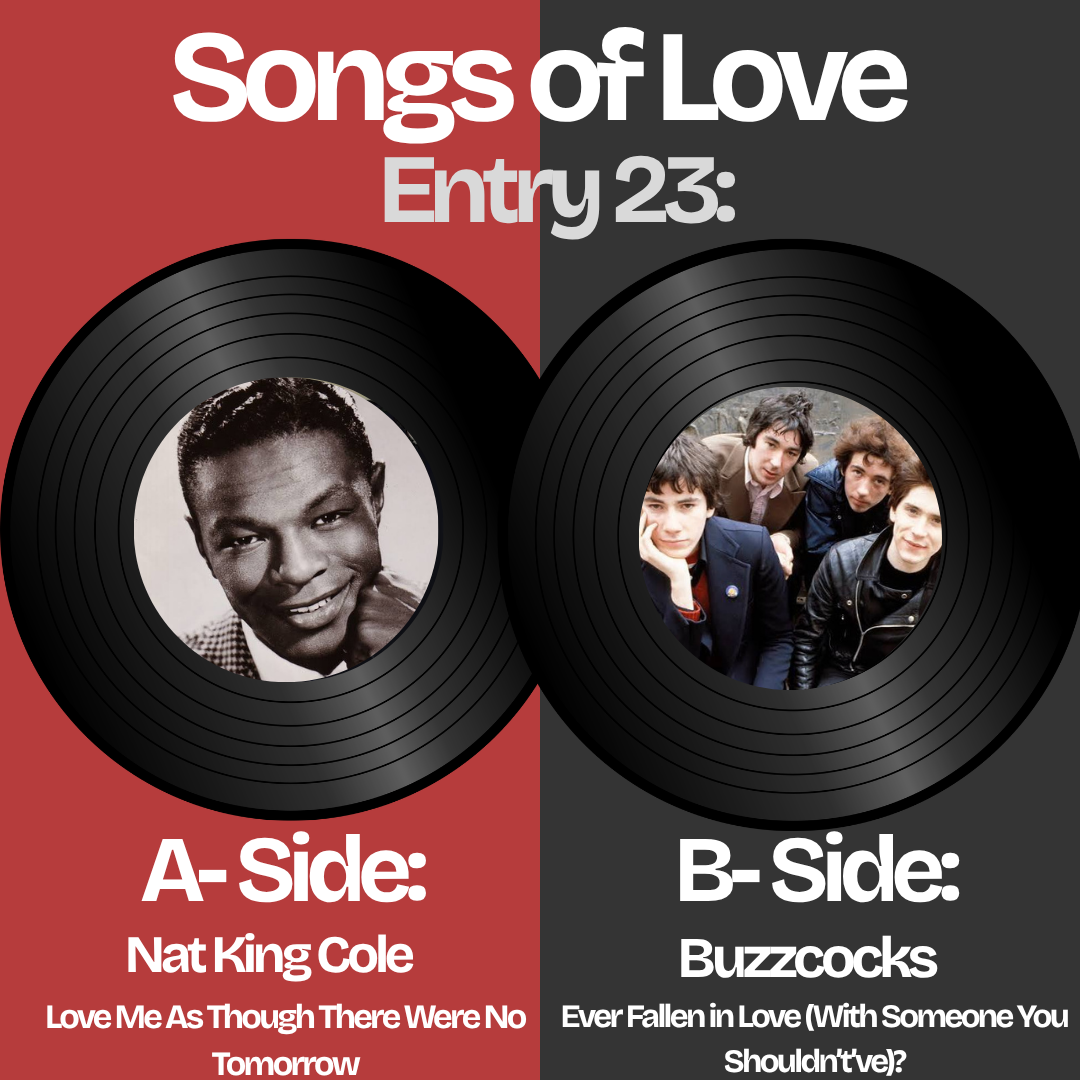
A-Side
Love Me As Though There Were No Tomorrow
Performed by Nat King Cole
Written by Jimmy McHugh and Harold Adamson
Released 1956
If you know this song, I would hazard a guess you encountered it in the same place I did: Obsidian’s phenomenal 2010 post-apocalyptic RPG Fallout New Vegas [1]. Like other games in the series, New Vegas features a soundtrack made up of incongruously breezy songs from the 1940s and 50s, in this case with country and crooner flavours to reflect the setting. And while there are some really fine tracks in there, it was this one more than any other that stopped me in my tracks, its sheer beauty cutting through even as I headshotted mutants and made hard moral choices amid the radioactive wastes.
This is one of those love songs that’s based in idealisation and abstracts, trying to make the impossibly beautiful real. It’s couched in an imperative, a request, perhaps a desperate one: love me, kiss me, make me forget. Nat King Cole makes this a tender extension of the hand, seeking for it to be held, but it’s easy to imagine a version of this song that’s more intense, one that claws desperately, wild-eyed, at the lover. But such a version would likely lose the power that comes here from understatement, similarly to something like ‘It’s All Right with Me,’ where the trauma that seems to underlie the words can be hinted at ominously.
What this song evokes, the very core of it, is a kind of love that suggests the recurring Hiroshima lovers image from Watchmen: a love thrown into sharper relief by the fact that it is shadowed by utter catastrophe. This kind of juxtaposition of human tenderness with destruction is a relatively common artistic move, including in popular music: from the tableau of human connection (and disconnection) of ‘Five Years’ to the lovers facing down the quasi-biblical apocalypse of ‘Straight to You,’ or the nuclear winter foetus holding tight to mother in ‘Breathing.’ Here, though, in contrast to those vivid examples, the catastrophe is really only evoked in abstract, tentative terms – even the title, the whole concept of the song, is an ending that is imagined, “as though there were no tomorrow,” “as though it were now or never.” Perhaps this is because the catastrophe is so overwhelming that it cannot be fully faced. But there’s another possibility, one belied by the song’s sweetness: perhaps it’s being imagined and welcomed into being.
Apocalypse, in the sense of the end of the world, or of history, is conceived in many different ways in various traditions. But one thing they have in common is, in Frank Kermode’s terms, the sense of an ending – generally, that time itself is coming ultimately to a standstill. While this might seem like a frightening possibility, it means the obliteration of all change, that everything is frozen as it is. And for the lovers in this song, like the Watchmen image, it means being together forever – “don’t ever let me go.” By erasing the possibility of a future, an endless present is created, wherein the lovers will always be in each other’s embrace. Hence the singer’s desire to be “take[n] out of this world” – out of this vale of tears, we might say. It’s akin to a desire to be raptured out of the fallen material world.
All of which could be considered somewhat grim in its focus on the otherworldly – wanting the world to end so you can be with your lover forever is simultaneously extremely romantic and incredibly solipsistic. But that’s not all that’s going on here. After all, this apocalypse really is only imagined. The singer will “wake tomorrow,” and what’s more, when they do, their love will be all the stronger, all the more “right,” for the imagined catastrophe they’ve been through. It’s like a kind of role-play, in an odd sort of way, but more the therapeutic kind than the sexual kind. It’s about facing the possibility of there being no future, finding solace in each other, and using that feeling to propel you into the future that does, in fact, exist. It’s just as romantic as, and far more practical than, imagining the possibility of a mutual annihilation.
Like ‘The Party’s Over,’ this is a song originally from a musical – in this case, from what appears to be have an incongruously bawdy (given the nature of this song) musical called Strip for Action, which lasted less than a month of previews in various cities before closing and doesn’t seem to have been performed since. It’s fair to say this song, and others from the musical, have outlasted it by some way, thanks to people like Cole doing versions of it; a relatively common fate for musicals from around the 1940s or 50s.
Which is an important point about any song. Like we talked about a few entries ago, songs are constantly acquiring new contexts. I know this one from a video game released decades after its composers’ and performer’s deaths (indeed, all were dead before the real advent of video games as a medium). Somebody else might know it from an oldies radio station, or just from being a fan of Cole or another similar artist. Vanishingly few people – very possibly nobody at all – would know it from Strip for Action. As music critics and scholars, we often fetishise the idea of the origin point, the place from which the song comes, whether that be in terms of the circumstances of its writing or first performance, or even the geographical and chronological context from which it comes. And while those things are important and can be extremely valuable to explore, they’re not the be-all and end-all. In the case of a song like this, its origin isn’t especially significant at all. It’s transcended that, and found an entirely new life – many entirely new lives, in fact. One for every individual listener.
[1] In fact, much of the information on the song I’ve used for this post, especially for the last two paragraphs, came from the Fallout wiki. Who said video games never did anything for us?
B-Side
Ever Fallen in Love (With Someone You Shouldn’t’ve)?
Performed by Buzzcocks
Written by Pete Shelley
Released 1978
This one has quite a bit in common with some songs we’ve covered recently, as it happens. Like ‘Love Will Tear Us Apart,’ it’s a song that’s been hovering on the horizon for me for a while, that I’ve been vaguely apprehensive about getting to, for similar reasons: like that song, I think this is one of the best singles ever released (in fact, I think I slightly prefer this one). Similar to its near-contemporary and (perfect) cousin ‘Teenage Kicks’[1], another song often regarded as one of the finest singles of all time, it’s a very adolescent idea of love, all big abstract ideas; like ‘I Could Have Lied,’ there’s a sense of self-absorption to it. The title, after all, is a complete rejection of the lover and the whole idea of them, even if it is framed cheekily as a question to them. It’s the paradox of the song, and many songs like it – it seems to be a rejection of the lover, and yet the singer’s obsession is such that even the rejection is directed to the lover, as if it’s impossible to get away from them.
But part of what separates this from a thousand other perfectly good songs on the same theme is its sense of character, as it were. And that can be summed up by a single word from the first line: “You spurn my natural emotions.” This song is coming from the point of view of an adolescent, but not just any teen: one who makes use of words like “spurn” in their heartfelt message to a lover. Someone, in other words, who is comfortable with slightly archaic vocabulary; we might assume someone who reads a fair bit. And especially when combined with Pete Shelley’s slightly nasal delivery, and hint of a Lancashire accent (“and I’m heht”), we get a hint of something, or someone, quite specific amid the big generalised emotions. Which, as always with this sort of thing, makes it hit all the harder.
While we’re on the subject of that first line (another big topic of late, funnily enough), it’s a very good example of something that’s a bit of a Buzzcocks trademark. Try reading it aloud: “you spurn my natural emotions.” The first three words are fine, but when you get to the polysyllabic final words, it gets a bit bogged down. Not especially noticeable in speech, but it should by rights be a bit of a stretch to fit it to a poppy tune. The same thing happens a couple of lines later with the word “commotion” just about jammed into the meter. Even the title is a little awkward – not only longer than you’d expect, thanks to those brackets, but with the double apostrophe of “shouldn’t’ve,” which somehow fails to look like a real word every time I type it. It heightens that sense that this is someone who is being a little wordier than the occasion would demand, not entirely spontaneous, trying to cram words into places they don’t entirely fit. But again Shelley makes it feel entirely natural with his delivery. On the Top of the Pops performance of the song, he alternates between holding the camera’s gaze intently, and glancing away nervously. And that combination of contrasting moods speaks also to how the song works.
Because for all that the title, and the chorus, might suggest a fairly extreme, almost intransigent viewpoint, that’s actually not borne out by the song as a whole. In the second verse, midway through the song, we get: “We won’t be together much longer/Unless we realise that we are the same.” It’s an odd couple of lines, which seem to cut against much of the rest of the song’s aggrieved sense of self-righteousness, but I like to think of it as a sudden outbreak of self-awareness, similar to the final verse of ‘Idiot Wind.’ There’s an identification here between the lovers, a recognition that their troubles are in common. And indeed these lines are preceded by what appears to be a genuine desire to fix the relationship: “I can’t see much of a future/Unless we find out what’s to blame, what a shame.” Those two twinned uses of the word “unless” actually hold out the possibility of something being done to solve all this, albeit without much hope, in contradiction to the chorus’s more generalised blame.
The fact that the song then returns to the chorus, of course, indicates that that should be taken as more the prevailing mood of what’s going on here, as does the subsequent repetition of the first verse. But I still think this second verse is an important part of the emotional tapestry of the song, and part of what elevates it above a thousand similar songs of teenage romantic angst. Its sense of empathy and self-awareness feels like a note (so to speak) of maturity breaking through, a sense of self that is generous rather than egotistical. We might imagine that the singer here doesn’t quite have the emotional range or development to sustain that feeling, and so falls back on the far easier sense of grievance. But that outbreak of maturity matters, and it mirrors the idea of warring feelings that often accompanies the breakdown of a relationship. As we’ve heard already, breaking up is so very hard to do.
[1] Much as I love ‘Teenage Kicks,’ I probably won’t write about it in itself, as I think this song does something broadly similar but is frankly more interesting to analyse, where ‘Teenage Kicks’ is just a very, very good pop song about adolescent desire.