Songs of Love 21: Loving Real People

The idea of songs written about real events has lurked in the background of this project from the off, as a key part of how people think about and relate to love songs, perhaps most notably in the Fleetwood Mac entry. As listeners and critics, we very often want to know what, and more pertinently who, a particular song is about. Whether it be a chronicle of a real, enduring love affair, or a bitter take on an ex’s shortcomings, there’s something undeniably tantalising. Some of this is simply an instinct for gossip, most likely, but when something feels as real and true as many love songs do, we find ourselves fascinated and want to investigate that truth, to feel it more deeply. So here are two songs known widely to be about identifiable real people – the writer/performer’s spouse, in both cases, though the A-Side performer wasn’t yet married. And knowing who and what these songs are about raises all kinds of questions about them and about how we now consider the people they’re about – and indeed, to what extent they really are about those people.
A-Side
Performed by Tom Waits
Written by Tom Waits
Released 1980
What exactly is a “muse?” Not in the mythological sense, but in the sense that we use it today, and have done for centuries[1]. Someone who inspires art, it seems, and is often the subject of it – we might think of Maud Gonne for Yeats, or Petrarch’s Laura, or Dante’s Beatrice. But those examples should immediately teach us to exercise caution. Those were passionate loves, no doubt, but all unrequited and from afar, which means that the woman in all three cases doesn’t have a whole lot of say in what’s written about her [2] (particularly Beatrice, who was dead when Dante wrote much of his verse about her – it’s tempting to think that that’s the ideal state for a muse). Additionally, these very canonical examples draw our attention to the fact that “muse” is almost invariably a gendered term. When was the last time you heard Travis Kelce referred to as Taylor Swift’s “muse?” The implication is always that men make the art, while women inspire it.
Being a muse might mean being immortalised, but it might also mean being reduced to abstraction – what lives forever of you is a two-dimensional version. This is all the more complicated when, as is often the case, the muse and the artist are involved in a romantic relationship. No work of art will ever capture a real person, in all their fullness and vibrancy, but the art can become a distraction precisely for its relative simplicity. It’s easier to deal with an artwork than a real person, as the fictionalised version of Georges Seurat finds in Stephen Sondheim and James Lapine’s Sunday in the Park with George.
But all of that implies that the muse is a sort of passive object, someone about whom and around whom art is made. What if they participate actively in the making of the art?
Tom Waits and Kathleen Brennan met in the late 70s, and quickly developed a romantic relationship, marrying in the year of this song’s release. Since then, Brennan has become Waits’s collaborator, credited as co-writer and producer on much of his work over the last five decades or so. She is credited by many, not least Waits himself, with helping move him towards the more experimental sound that would characterise his music from 1983’s Swordfishtrombones onwards, and he clearly regards her as an indispensable artistic partner, as well as a life one.
In fact, this song is perhaps the last gasp of 1970s barroom crooner Waits before he moves into the wacky world of junkyard Captain Beefheart. So it seems fitting that it would be written, by all accounts, for the person who inspired that shift.
But note that it’s written for, not by. Brennan is a remarkable creative force in her own right, and contributed immeasurably to much of Waits’s best work. But this song predates their creative collaborations, and so it’s a tribute from one partner to another. That’s not in any way to devalue it, just to draw attention to the fact that we haven’t stepped outside the “muse as passive object” paradigm just yet. That will come in much of the rest of Waits’s work, and so once again this marks something of an end point.
So what about the song itself? Well, it’s a surprisingly sweet love song, a genre Waits has always had in him from the start (in lovelorn form on something like the extraordinary ‘Martha’ from his debut album), and that continues to rear its head even once he’s fully swerved into the truly Waitsian borderlands of later albums (‘Downtown Train’ or ‘Hang Down Your Head,’ both from 1985’s Rain Dogs, are easy examples). Aside from the rejected “whores on 8th Avenue,” this is not a crawl through dingy barrooms and down-and-out characters like much of the rest of the Heartattack and Vine album. The world of this song is a brightly-lit carnival, two lovers holding hands as they walk among the stalls and rides, with couplets that wouldn’t be out of place in a Motown song: “My little angel gives me everything/I know someday that she’ll wear my ring.” Waits acknowledged its relatively conventional feel in typically droll fashion in a contemporary interview: “I never thought I would catch myself saying ‘sha la la’ in a song. This is my first experiment with ‘sha la la.’”
And, of course, there’s a slight irony to one of the most straightforward and conventional songs in Waits’s 80s oeuvre being written for the person who is credited, not least by him with inspiring his turn away from that. But that just draws attention to the fact that this song, like every work of art, is not a diary entry, but a discrete work of art. One of the reasons I’m not a fan of overly biographical criticism is that a song – or any work of art, but particularly a song – invariably transcends its origins, and becomes something unique for each listener. It develops an association with a certain moment in their life, or a certain experience, or its lyrics get imprinted onto something of theirs to which they relate.
In fact, ‘Jersey Girl’ gives us a telling example of just that. Bruce Springsteen’s version of the song, which he regularly performs live, is perhaps better known than Waits’s, not least as it seems to fit more easily into his canon. What’s more, Springsteen finds his own meaning in the song – not only does it fit very neatly into his own long tradition of songs specifically about New Jersey, but he regularly dedicates it to his own “Jersey girl,” his wife and bandmate Patti Scialfa [3]. Coincidentally, Springsteen too finds in the song his artistic and life partner. And that’s part of the joy of the song, or really any song. In one sense it’s about Kathleen Brennan. In another, it’s about Patti Scialfa. It could be about any woman, or the idealised image of one. Or it could be about anyone or anything, or the idea of love, or a precious memory that has nothing to do with romance. Songs, even where they emerge out of specific experiences, are free-floating entities that could attach themselves to just about anything. That’s how we find meaning in them.
[1] According to the OED, the first use of “muse” as the chief inspiration for an artist’s or poet’s work dates from 1592, but applying it to a specific individual in the way that is now most common appears to be a later, possibly 19th-century, innovation.
[2] This is perhaps a little more complicated in Gonne’s case, as she and Yeats were close friends who often spoke about his work, and she was a canny self-promoter, though the likes of ‘No Second Troy’ don’t exactly paint her in the best light.
[3] Most obviously in this home duet with Scialfa.
B-Side
Performed by John Cale
Written by John Cale
Released 1975
Like with a novel, a song’s first line has to really create an impression, to draw the listener in and give them a sense of where they are with the song. “Picture yourself in a boat on a river” tells us we’re in a place of voluntary imagination, a visionary quest. When we hear “once upon a time you dressed so fine,” we know we’re in for a whole narrative, likely focused on some kind of fall from grace; likewise “she came from Greece, she had a thirst for knowledge.” With “they paved paradise and put up a parking lot,” Joni Mitchell knew she was onto such a winner in terms of summing up the song’s basic essence that she also made it the song's refrain, the point to which it keeps returning. With all of these and many more, you get to orientate yourself; the song places you somewhere before it takes you on a journey, and while that journey may throw the beginning into different relief, it’s important to have a solid starting position.
And then there’s an opening line like “the bugger in the short sleeves fucked my wife,” which almost overshadows the rest of the song.
Background, then, because really that is a line that demands some explanation. In 1974, the year before this song’s release, Cale discovered the musician Kevin Ayers in bed with his wife before a concert (which is, allegedly, the reason for the odd look they’re exchanging on the cover of the live recording of that concert[1]). This song then, so the story goes, captures Cale’s murderous fantasies resulting from that discovery and the sense of betrayal it engendered.
Straightforward enough, if a little troubling, but I don’t want to get too into moral censure of art here. What concerns me more is the way this story is recorded. Because the Wikipedia articles for both Slow Dazzle, from which this song comes, and the June 1, 1974 live album relate this story very much as I just have, in a sentence or two. Hyperlinks helpfully lead to Cale and Ayers’s own pages for further reading, and Cale’s 1998 autobiography is listed as a source. What is missing is any sustained reference to the third individual in this triad, Cale’s wife, who is not even named in either article. Her identity is, by inference, not all that important here; she’s just something for the two men to argue and perhaps turn to violence over.
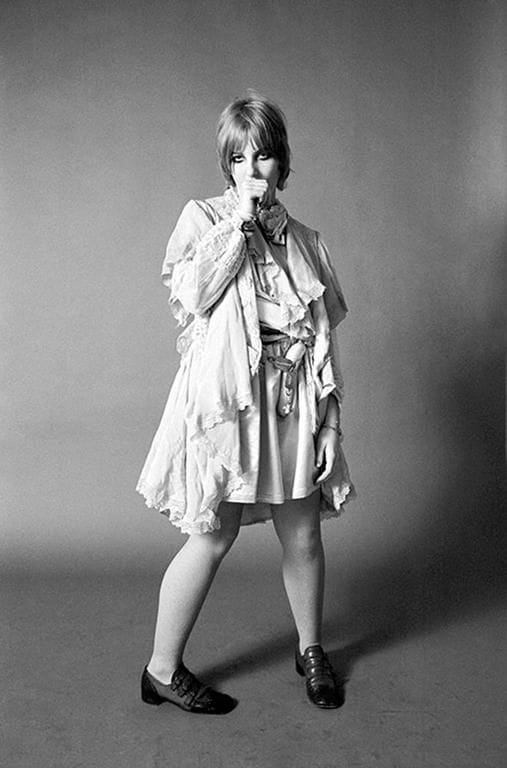
The woman in question is Cale’s second wife, Cynthia Wells. Wells, better known as “Miss Cynderella”, was a well-known “groupie” on the California scene in the late 60s, and a member of the GTOs, the all-girl performance art and music group that coalesced around Frank Zappa. She’s one of those curious figures who flit around the edges of the stories of more famous musicians, like Cale or Zappa, in that not a great deal is known about her. Even sources like Andrew Hickey’s excellent podcast episode about the GTOs only mention her fleetingly. From the limited information out there, she seems to have been born in 1952, making her about 16 around the time of the GTOs’ short-lived career (a similar age to the other members), 19 when she married Cale in 1971, 23 when they divorced in 1975, and 45 when she died in 1997. These few dates comprise most of what we know of her life, and are known only due to her proximity to fame – even her death is only publicly known because her former bandmate Pamela Des Barres (“Miss Pamela”) mentioned it in a book in 2007.
There’s nothing inherently wrong with that, of course – it’s quite likely that she shunned the public eye deliberately, especially after her divorce from Cale. We can only speculate as to why, though there’s a compelling argument that it’s, by definition, none of our business. But it does leave us in an awkward position. Like the other members of the GTOs, Wells seems to have been vivacious and talented, somebody who made a real impression on everyone she met. And now she’s best remembered, if at all, not only as a piece of trivia, but for having sex with two men, and thereby inspiring one of them to write a particularly bitter song. And it’s not like I can disavow that – after all, I wouldn’t be writing about her here if not for the song. But it seems unlikely that it’s how she’d want to be remembered.
Now, I like ‘Guts’ a lot. It’s classic Cale, in both his solo career and his Velvet Underground days, plumbing the depths of human experience to blackly comic effect (in fact there’s an argument that Slow Dazzle is the most Velvets-like of Cale’s solo albums). The song actually moves on from the adultery within a few lines to spend most of its time revelling in the results of a fictionalised Ayers being shot to blackly comic effect (“Guts, guts, got no guts/And stitches don’t help at all”). And Cale, one of the more expressive vocalists in popular music, is in full flow here; as Chris O’Leary says: “[a]fter some near-whispered conspiratorial lines, sounding like a man demanding a ransom on telephone, his voice fills with disgust and loathing, channelling the spirit of Daffy Duck: like PARROT SHIT…PARROT SHIT---PARROT SHIT WAS SHOT!” [2]
But in writing about it, I find myself thinking about Cynthia Wells. A very young woman who got mixed up (voluntarily and to no apparent regret, it should be said) with rock musicians from an even younger age, and found herself married to one for whom the early 70s, though possibly the peak of his creative output, were not a happy time. No wonder she sought to leave the public eye. And yet, thanks in part to this song, she can’t entirely. I have no idea how she felt about sleeping with Kevin Ayers – perhaps she regretted it, perhaps she saw it as a bit of fun. She left no record, and perhaps she never saw the need to. Which means that in writing this song, Cale took sole control of the narrative of that event, as any public figure does when they make a pronouncement, especially an artistic one. And for all that ‘Guts’ is no more solely about Cynthia Wells and Kevin Ayers than ‘Jersey Girl’ is solely about Kathleen Brennan, it’s next to impossible to find any discussion of the song that doesn’t mention them explicitly – after all, that first line seems to demand it.
I’ll write about John Cale again, probably many times. But I’ll likely never write about Cynthia Wells, Miss Cynderella, again directly. That’s not necessarily a bad thing – not everybody wants to be written about. But it does call attention to the essential unfairness of songs like this. Only one side of the story will ever get told now.
[1] Ayers is not in fact wearing short sleeves on the cover of that album, but then one assumes he wasn’t wearing his jacket during sex.
[2] Link here; I’ve linked to O’Leary before, and as previously, this may be behind a paywall. O’Leary too, incidentally, mentions Ayers’s name but not Wells’s.