Songs of Love 14: Love as Experience
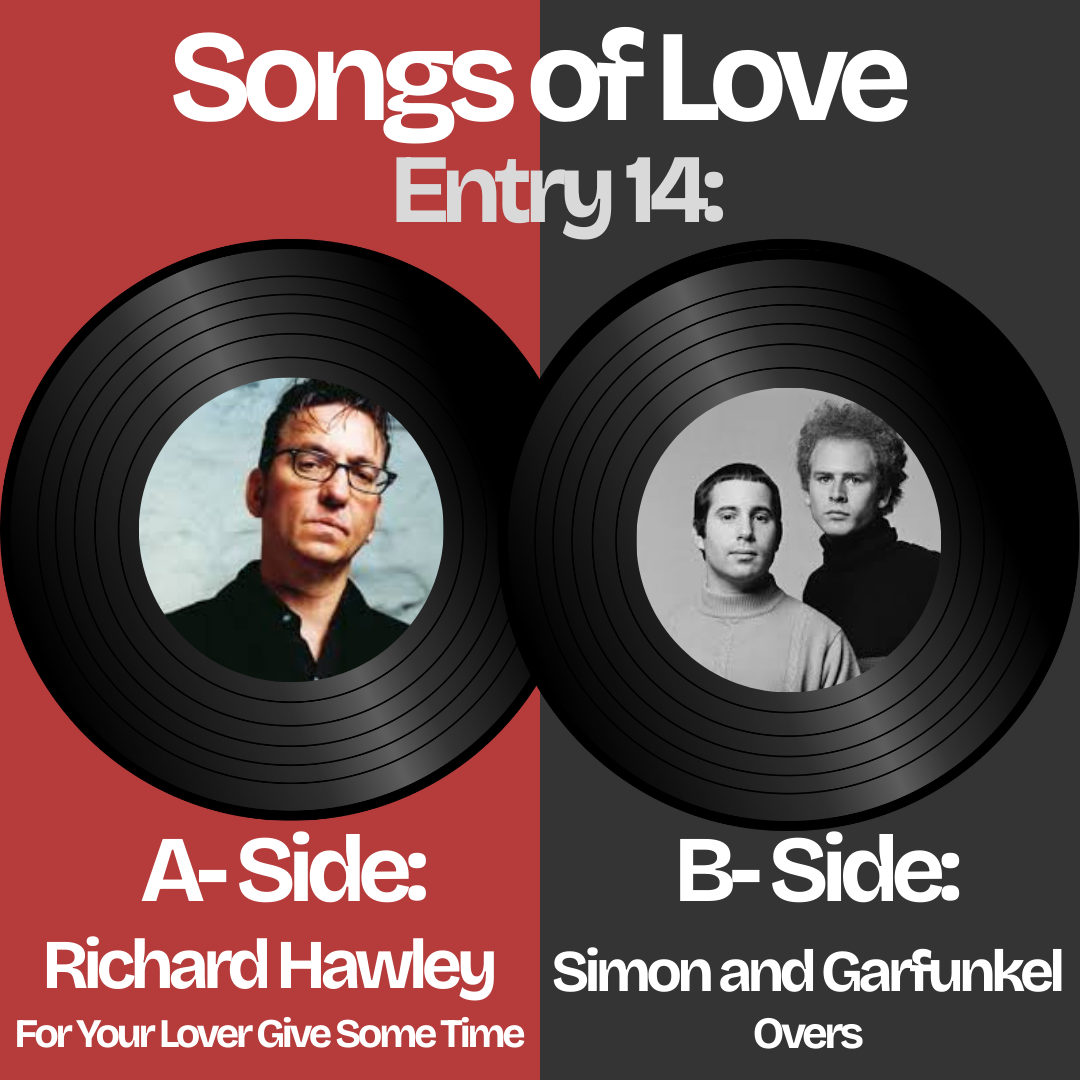
Two songs of experience here, songs that very pointedly deal with the lived experience of a relationship over and above abstracts (indeed, one of them, as we’ll see, is contrasted explicitly by its writer with a song of abstracts). A lot of popular music, certainly since the advent of rock and roll in the ‘50s, is about youth, and correspondingly strong emotions, but these songs are two different versions of what may happen when those emotions run dry, either in youth or later in life. Perhaps they lead to a deeper and more lasting connection (albeit one that requires work) or perhaps there’s nothing at all left in their place. Either way, in sharp contrast to the last entry, we’re in a place of reality, rather than ideals, here.
A-Side
Performed by Richard Hawley
Written by Richard Hawley
Released 2009
Admittedly, it doesn’t sound much like it should be an A-Side, per my categorisation of those as broadly “positive” songs. There’s the sparse arrangement, for a start, calling to mind a dark, empty room. It’s a song of regret, of falling short of what you’d like to be. And Hawley’s mournful baritone doesn’t seem made for songs of joy and new experiences – and as we’ve seen many times, the new is often central to songs I categorise as A-Sides. But then this is not by any means a song of the new. Quite the contrary.
This is very much what we might call a “mature” love song, in contrast to so much of popular music that puts value on youth, inexperience, first encounters. And there are a couple of ways we might take that. One is broadly pessimistic – the idea that love inevitably cools with time, that things that once came easily become difficult, that even the most ardent feelings calcify into routine. And perhaps if I was treating this song as a B-Side, that’s how I’d write about it. But I’m not, because I don’t think that’s what this song is, certainly not how I read it. From the title on down, it’s a song about making the effort, about finding ways to show that you care. And that’s where that maturity comes in, that experience. This is a song that recognises that love doesn’t bloom by itself; it requires effort, and careful tending. Especially after the initial stage of infatuation, love is something that needs to be worked at.
There’s a Nick Cave quote that I often think about with songs like this, in relation to his own ‘And No More Shall We Part,’ another song whose lyrical sentiments seem at odds with its dirgelike tone:
I wanted to write about love as a commitment, as a vow, as a discipline. Not a force that descends upon us from the stars, but something that needed to be worked at, to be practiced. I also wanted to look at the settled middle period of a relationship. Something that has been overlooked in modern music – rock ‘n’ roll being about the beginnings and ends of things.[1]
A quick glance back over most of these entries confirms the truth of that last statement. The vast majority of these songs have been about beginnings or ends, even if viewed from a further vantage point [2]. But this is, similarly, about a middle. It’s settled, yes, but clearly there has also been difficulty. Otherwise, all of that work, to which the singer pledges themself, wouldn’t be necessary. Some of that difficulty has even come from their own lapses, as they’re willing to admit.
Which gets at something else significant: this is also a song of honesty. The phrase “to be honest” occurs early on, a confession about a lapse of concentration that almost ruined a birthday. Throughout, the song comes back to feelings that are buried or unspoken – “how strange our love has grown.” It’s a very interior song, or alternatively a confessional one. It’s easy to imagine this as being a spilling-forth, as it is in the musical based on Hawley’s work Standing at the Sky’s Edge[3]. It is addressed directly to the lover, even calling her by name – “here’s a toast to you, Helene” – suggesting that, like with ‘Last Goodbye,’ here we’re privy to an actual conversation, or at least a monologue addressed directly to someone.
Even the rate of effort involved in the song speaks to that honesty. This singer is briefly tempted by grand romantic gestures (“have your name in rose tattooed across my chest”), but settles for smaller ones. They will give up smoking, drink less (well, “maybe”), and bring home flowers – not ones they’ve bought, but ones taken from the graveyard, which is an appealing (if slightly dubious) piece of honesty. These are small things, compromises – the kinds of things a lasting relationship is built on. They’re not going to stand outside their lover’s window with a tape deck; they’re just going to come home early, to make a conscious effort to spend more time together. It’s a very simple, domestic kind of love, and all the sweeter for that. Even the memory of past happiness is a simple one; sheltering from the rain in the cinema, laughing together[4]. This is a song of love as experienced, not as idealised. It’s a song of hope, and of commitment to being better, more attentive. It is, in a Blakean sense, a song of experience rather than of innocence, and consequently powerful in its level-headed realism.
[1] Quoted in Amy Hanson’s sleeve notes to the collector’s edition of No More Shall We Part, released in 2011. I’ve never found this quote anywhere else, and Cave is quoted extensively through the sleeve notes, so I assume this to be from an interview conducted (presumably by Hanson) expressly for these notes.
[2] As with ‘Something Changed,’ a song by a band with whom Hawley has played extensively, which recalls a beginning from a middle, as it were.
[3] Though crucially, the singer in that (very good) musical stands alone, not addressing the song to anyone; it’s a purely internal monologue, since he can’t express himself in that way.
[4] The cinema vaguely recalls the cover of Hawley’s earlier album Cole’s Corner, which sees Hawley waiting with a bunch of flowers outside a theatre; the album is named after a famous meeting spot for lovers in Sheffield.
B-Side
Performed by Simon and Garfunkel
Written by Paul Simon
Released 1968
Of all the emotions or states of mind that may accompany or characterise a break-up – bitterness, recrimination, jealousy, melancholy, abjection, acceptance – a common one that we haven’t explored yet in any great depth is weariness. A break-up isn’t always a seismic event that catapults someone’s entire life into chaos. Sometimes it’s akin to a vehicle rumbling to a stop, its energy all spent. Maybe someone pulls the brakes, or maybe they wait for the end of the road, visible from a long way away. Either way, there’s nowhere to go.
This is a song of a relationship that’s run its course. Nothing comes naturally any more; the relationship is “just a habit.” There’s a strange kind of bland neutrality to the experience, with all emotion sapped away – “no good times, no bad times.” Gone are the days when the couple laughed together. The best they can muster now is a strained smile as they pass each other – not, notably, seeming to exchange any words as they do so. There’s sense that they’re being hunted down by time, which here takes a malign aspect, akin to destiny or doom, haunting the corners of the room.
This seems to have been something of an interest of Paul Simon’s around this time. The previous Simon and Garfunkel album [1] contained the magnificent ‘The Dangling Conversation,’ which deals with similar subject matter. There, the couple are more apparently congenial, but everything from the title on down alerts us to the stiltedness of their conversation, able only to talk about literature and theatre in lofty, abstract terms, rather than actually connect with each other – the “New York Times/Sitting on the windowsill” of ‘Overs’ seems to recall this. In that song, there’s a sense that things are fundamentally wrong within the relationship – “verses out of rhythm/Couplets out of rhyme.” [2] ‘Overs’ is more fatalistic, and perhaps darker, in the sense that here the end of the relationship seems something inevitable.
Indeed, there’s another connection to the duo’s back catalogue there. In a televised appearance in 1968, Simon characterised ‘Overs’ as a companion piece to another song from the previous album, ‘For Emily, Whenever I May Find Her.’ [3] That song (unusually, sung solely by Art Garfunkel) is a sweet love song about meeting a lover in a dream and then awakening to find her actually present. As the title suggests, it’s very abstract, full of overwhelming sensory detail – “clothed in crinoline/Of smoky burgundy,” “I heard cathedral bells/Tripping down the alleyways,” “we walked on frosted fields/Of juniper and lamplight.” It’s an idealistic song of true love as an unbreakable connection that endures even past the waking world, where ‘Overs’ concerns a love gone sour, past its “best before” date.
And yet there’s a twist in the tale yet. All of this sense of doom and finality suggests that the relationship has reached its natural conclusion, that it’s holding on by a thread. So a break-up must be inevitable, surely. But then come the final lines:
But each time I try on the thought of leaving you
I stop
I stop and think it over
It’s a magnificent piece of writing – the way the word “stop” arrests the momentum of the line, the way the song ends on the word “over” in a different sense from how we’ve been hearing it previously (hence the plural in the title). And it’s also the thing that really complicates this song. For all of the dreary reflection of the whole song, the singer can’t muster the will to actually bring the relationship to a change. And there’s no reason given for this, which suggests that they may not entirely know themself. Perhaps it’s lingering affection, although there’s little enough real sense of that within the song. Perhaps they simply fear change. After all, a habit is always difficult to break.
[1] There are two years between the relevant albums; Parsley Sage Rosemary and Thyme in mid-1966 and Bookends in mid-1968. Some of the sessions for the latter, including for ‘Overs,’ were recorded between June and October 1967, so it seems likely that the song was written some time between the middle of ’66 and ’67.
[2] Coincidentally, like ‘Black,’ ‘Overs’ features very little rhyme, and the rhythm of the vocals is loose and free.
[3] If you’re reading this as a stealth “Simon and Garfunkel’s discography” entry, you’re admittedly not entirely wrong, but you may be shocked to learn that another of their songs will be appearing as an A-Side in the future.