The Fellowship of the Ring Revisited
In 2002, I read The Fellowship of the Ring for the first time. Being a particularly dedicated eleven-year-old, and having seen the film several times by that stage, I read it in less than 12 hours, a feat which continues to stagger me. In the first few months of 2026, I read it for the second time, across a much longer period – the first half slowly across several weeks, the second over a couple of days while recovering from surgery. Apparently my dedication, or possibly my free time, has taken a hit over the last couple of decades.
Naturally, in the intervening 24 years, I’ve changed a lot, as has my relationship to this book, and its sequels (though I also tend to abide by Tolkien’s wishes in thinking of The Lord of the Rings as a single book, as I’ll be doing throughout this). I’ve read, played and watched an awful lot more fantasy, most if not all of it inspired by and responding to this book. I’ve also acquired a little (though only a little) familiarity with the myths and sagas that inspired Tolkien. More directly, I recently read The Silmarillion for the first time, after two decades of meaning to get around to it, and followed it up with Unfinished Tales, so my Middle-Earth lore has ratcheted up several notches in recent months.
Rereading the book with that latter background in particular, the fact that Tolkien had much of that background lore (the fall of Gondolin, the story of Beren and Lúthien, the battles against Morgoth) in mind long before LotR is very clear. Those stories, retold in part at times, form so much of the texture of this one, with the likes of Eärendil and Fëanor referenced regularly. This is a story that takes place against the backdrop of older, greater stories, grand times that are long past, which is key to what it is doing. You don’t have to have read Tolkien’s other works to understand that, but it does help in fleshing out some of what is going on in those references.
And of course, the other thing that’s happened since my first reading is that I’ve watched the Peter Jackson films (two of which weren’t out yet when I first read the book) many, many times. For the most part, I’m not too interested in making comparisons between the films (which, likewise, I think of as a single entity) and the book, which I don’t think are the best or most interesting way to approach either. The films are, if anything, even more important to me than the book, and are brilliant, groundbreaking and profound works of art in their own, largely separate way. Still, they do inform my approach to reading the book – Ian McKellen’s voice and Elijah Wood’s face are in my head at all times. It’s neither a good thing nor a bad thing, but inescapable, and hence worth commenting on.
There are, though, a good number of things that have struck me on my rereading of FotR, on a general level, which have either surprised me or reinforced ideas I already had about the book. Here are a few of the most significant.
(All page number references are to the 1999 HarperCollins edition.)
Genre and Tone
When I first read LotR, I read it simply as an adventure story, full of danger and battles and the kinds of things that appeal to an eleven-year-old in that way. And it works very, very well on that level: the broad appeal of the films is proof enough of that. Tolkien wrote often of how he was attempting to craft a story to entertain, primarily, and he very clearly succeeded in that. But LotR’s entertainment is of a very different kind to The Hobbit’s breezy children’s story, and this is perhaps where all that background I mentioned is most obvious. Above all, LotR is absolutely obsessed with the past, and with what has been lost.
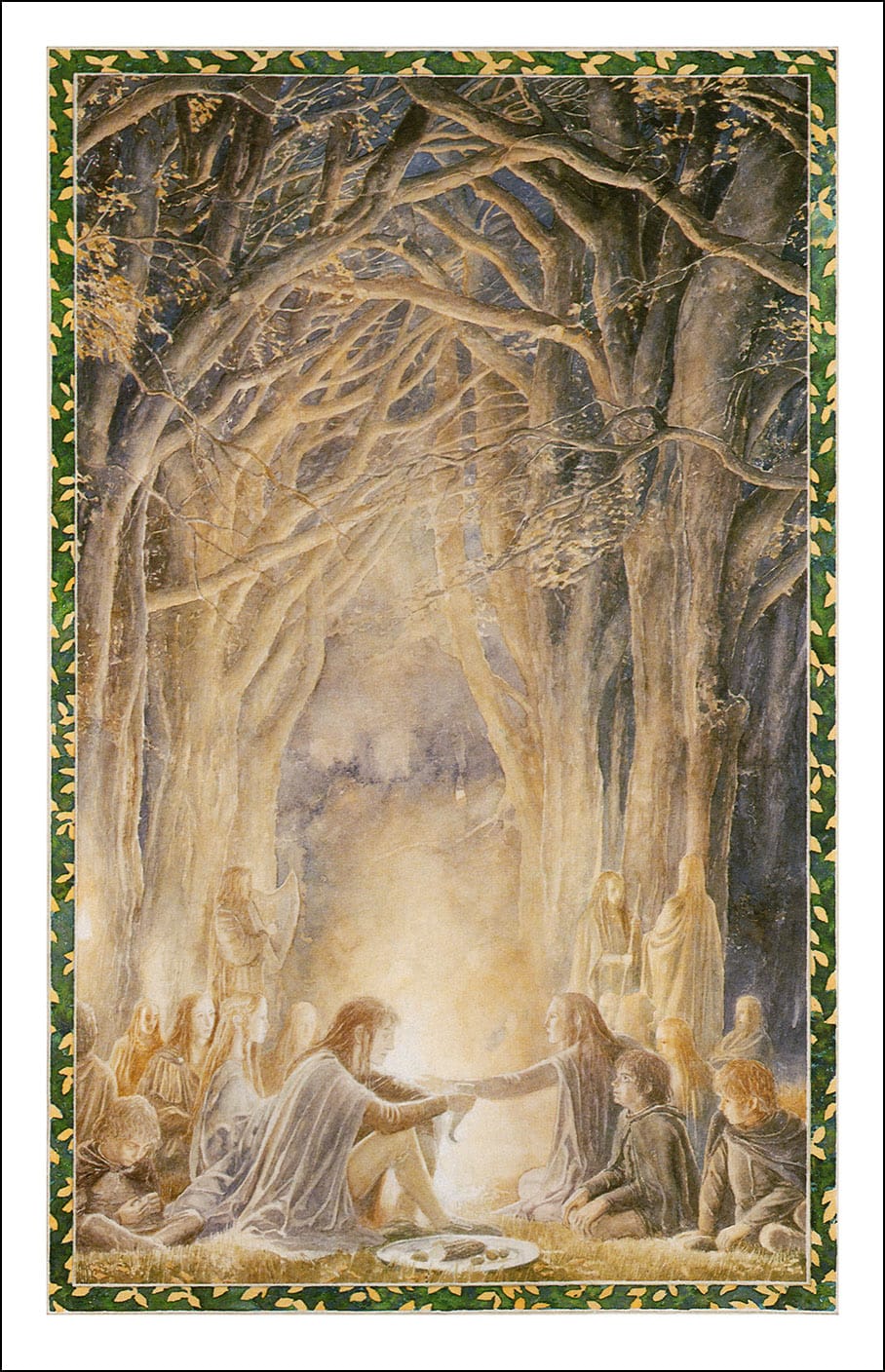
History in LotR is ever-present – in songs and tales, but also in the direct reminiscences of characters like Elrond or Galadriel. But even for those characters, its presence is little more than a reminder of what no longer exists. As Gimli says after leaving Lothlórien, which he already knows will haunt him forever: “Memory is not what the heart desires” (497). This is partly why the elves of Middle-Earth already seem faintly unreal as the story begins: they are of the past, and live partially in it – we’re told more than once that elves experience dreams and memories much more vividly than other people, one of the many ways in which they are inherently distanced from the future of Middle-Earth.
But even for characters like Aragorn or Frodo, the sense that the past can never be revisited is constant. This is particularly true of Lothlórien, a place whose glory is maintained by a power that will end when the Ring is destroyed[1], and which is by inference a glimpse of the glorious past – again and again we’re reminded that the Fellowship is entering it in winter, which is literally true in the timeline of the book, but also a clear metaphor for its decline. And yet Lórien itself is fleeting, and doomed; Tolkien tells us specifically that Aragorn “came there never again as living man” (462) and that “To that fair land Frodo never came again” (497). But even aside from this living past, from Weathertop to Moria to Amon Hen, the characters constantly encounter ruins, places that were once seats of power but now hold little trace of their former glory. History can even be actively dangerous, as in the unquiet dead of the Barrow-Downs, or the Balrog of Moria, an ancient creature of millennia past stirred up to haunt the present. The famous second chapter of the book is entitled “The Shadow of the Past,” which could serve as a subtitle for the whole book – the entire quest takes place shadowed and haunted by the past.
Even more than the settings, though, the most obvious place we see Middle-Earth’s history is in the songs, of which there are usually a couple per chapter, on average, and which can take up several pages. Where once I skimmed over these, now I find myself enjoying not only the way they flesh out the world, but are a constant part of the characters’ experience. Characters in LotR are constantly calling for songs, or even composing them. Even Sam, ostensibly the least learned of the Fellowship, sings more than one of his own invention. His are closer to comic folk songs than the ballads of days gone by composed and sung by the likes of Bilbo or Aragorn, but they have a place alongside those. For all the elegiac quality of much of the book, there’s often a sense of life going on too – and very often, it’s one of the hobbits, especially Sam, who provides that.
What is less apparent in FotR, but I’m interested to trace in the other two volumes, is one of the key themes of the book, and one of the most remarked-upon (and debated) aspects of it: war, and its costs. In some ways, I’ve found myself oddly reminded of another of my favourite novels of the mid-20th century: Evelyn Waugh’s Brideshead Revisited, another book by a devout Catholic about a world being lost amid a global conflict, and another book marked by an odd mix of radicalism and conservatism in a way that helps define the limits of those unhelpful terms. No doubt there’ll be much more to say on this topic after the latter two volumes, which are far more directly concerned with the waging of war.
The Land
That Middle-Earth is in some sense the “main character” of LotR is a frequent and trite observation, and while I wouldn’t say it’s entirely a true one, what is notable is how characterful the landscape is. There is (infamously) a great deal of description of landscape, and of different kinds of landscapes, in this book, but more importantly, the land seems at times to have its own will. The character of Treebeard obviously has a bearing on this, but even before we come to him in The Two Towers, the hobbits have almost been eaten by a tree in the Old Forest, saved only by the intervention of the friendly but chaotic Tom Bombadil[2], himself seemingly a kind of natural force. And after that, the Fellowship’s attempt to cross the mountain Caradhras is thwarted by the weather. Gimli ascribes this to the will of Caradhras itself, and while the film’s explanation that it’s Saruman working against them makes sense, the fact that Tolkien finishes the relevant chapter “Caradhras had defeated them” (386) rather suggests that Gimli’s theory should be taken seriously.
The land of LotR is in important ways unknowable. The reader is given maps, drawn by Christopher Tolkien, but the characters rarely have access to them. There is a good deal of focus on finding the way to a particular destination – first the hobbits finding their way to Bree; then travelling first to Weathertop and then Rivendell with Aragorn; then the Fellowship’s journey south from Rivendell, including their abortive attempt at Caradhras; their journey through Moria, guided by Gandalf’s memory; and, after sailing south from Lothlórien, their dilemma over whether to travel east directly to Mordor or west to Gondor, which ultimately splits them. Through all of this, the reality of the wilderness, and its dangers, is emphasised many times over, whether that danger comes from enemies hidden in the wilderness, or the land itself. This focus on wilderness and navigation is (as with so many things about LotR) very evident in, for instance, early editions of D&D, which were more focused than recent ones on the practicalities of finding one’s way, and likewise relied on the assumption that the world outside of settlements is generally mysterious and potentially dangerous.
Which perhaps accounts for why the characters are not especially well travelled. Hobbits rarely leave the Shire and have a low opinion of those who do, but in this they are not particularly unusual in Middle-Earth. Boromir, for instance, has been throughout Gondor and spent some time in Rohan, but seems never to have travelled outside of those lands before his journey to Rivendell. Gimli knows the lands through which the Fellowship travel only by reputation. Even Legolas, who is at least several centuries old, has never visited Lothlórien and seems not to have left Mirkwood much. The only exceptions to this are Gandalf – who is associated constantly with wandering by people throughout Middle-Earth – and Aragorn, who lives in the wilderness. But even these two are never entirely comfortable in their journey, debating between them which path to take from Rivendell. After Gandalf’s death in Moria, Aragorn struggles to know which way to take the Fellowship, partially due to his wider struggle around his identity as king of Gonder, but also for practical reasons. Indeed, Aragorn seems filled with doubt frequently in the book, especially in the latter chapters, which is quite a contrast with the stoical kingly hero he’s often thought of as – another thing to keep an eye on as I continue to reread, especially as I have a suspicion that that doubt will fade over time.
Elves
Tolkien’s elves have a reputation of being serene, sombre and otherworldly – remote, unmoved figures who seem not entirely of the world. And there is a good deal of truth to this, especially with regard to Elrond and Galadriel, the key elven figures we meet, or even Glorfindel, who bursts onto the scene like a superhero to rescue Frodo at the end of Book One. But especially after reading The Silmarillion, in which the elves are guided far more by passion and seem broadly more human in various ways, I found myself seeing all the ways in which they defy this idea of serenity.
The key one is that elves are frequently described as laughing, and being merry (a favourite word of Tolkien’s; no wonder he named a character after it). Sometimes this laughter is incomprehensible to the other characters, and has something of the otherworldly quality of stories of the fey, with all the attendant unease. But more often, everyone is included in the merrymaking, in the laughter and singing. Bilbo seems to have become a key component of life in Rivendell, and his songs are greeted with great cheer (which he believes, self-deprecatingly, to be indulgent), and the elves whom Sam and Frodo meet early in Book One, despite being on their way out of Middle-Earth, are delighted to see them and provide them with a feast on the road. Even Legolas laughs a fair amount, in stark contrast to Orlando Bloom’s Serious Background Face, though less so as the company’s journey goes on and becomes grimmer; Legolas seems to become more like the other members of the Fellowship as time goes on, particularly Aragorn and Gimli, as though being drawn from his elven plane into the realm of mortals.
I’m not sure how much this impression will change over the course of the other volumes, since apart from Legolas we don’t see many other elves. But that’s important in itself, of course – the elves are frontloaded, because they are part of the past of Middle-Earth that is fading. All that will remain is the stories.
Magic
Fantasy loves a good magic system. Whether it’s spell slots, or MP, or magic circles, or manipulating the inherent energy of things, some kind of explanation for how the magic things are happening is almost de rigueur. Tolkien, though, can’t be having with any of that. For him, magic is, well, magic. Even Gandalf doesn’t seem to quite know the limits of his power, suggesting that he only understands it by experience. There’s an odd paradox here: on the one hand, magic in LotR is inherently mysterious and unknowable. On the other hand, it is itself knowledge.
The word “magic” is used infrequently in the book [3], and the more learned characters seem not to fully understand it. As Galadriel describes her mirror to Sam:
This is what your folk would call magic, I believe; though I do not understand clearly what they mean; and they seem to use the same word of the deceits of the Enemy. But this, if you will, is the magic of Galadriel. [475]
There’s a sense here of a fantasy version of Clarke’s Law: “magic” is, for hobbits and others, a way of describing what they don’t understand, the products of superior knowledge of the world. As Sam says just before this, of Lothlórien: “if there’s any magic about, it’s right deep down, where I can’t lay my hands on it, in a manner of speaking” [473]. Rather than being flashy and obvious, it’s deep and inherent.
To a modern eye, this seems a curious approach in a book where, two chapters before, a wizard has smashed an ancient bridge with his staff to plunge a shadow demon into a chasm. But, as with the landscape, it’s in keeping with Tolkien’s approach. Whether due to his Catholicism, his medievalism, or any other influence you’d care to name, Tolkien is deeply invested in mystery as a structuring principle. The ways of the world are fundamentally unknowable. Gandalf’s powers, or Saruman’s, or Sauron’s for that matter, are indefinable. The eagles cannot fly the Fellowship to Mordor because they are fundamentally other, of the world and yet not of it. The Ring has power that we are told about but can never see. Language seems to have power, with spells wrought of runes, but there is no clear distinction between ordinary words and magic ones. Like the hobbits, we’re lost in a world we cannot understand, and our guides have other priorities than explaining every detail to us.
Samwise the Brave
There’s a popular idea that Sam is the “true” hero of LotR, especially by the time of Return of the King. I don’t agree with this, for multiple reasons: I have a higher opinion of Frodo than many people who espouse this idea seem to (more of which anon), but more pertinently, I don’t think there is a single hero – in fact, I think this is critical to understand about the book. Not for nothing is the first volume named after a group of individuals, and at no point does Frodo travel alone (though admittedly Sam does, briefly). The idea of a collective heroism is crucial; Sauron is to be resisted and defeated by the union of the peoples of Middle-Earth, and any attempt to use the Ring to amplify the power of a single individual would be fruitless, either falling under Sauron’s dominion or else raising up another Dark Lord. Either way, the idea of individual dominion and power is an ontological evil, which may or may not sit oddly alongside the book’s focus on nobility and royalty (something to keep an eye on along Aragorn’s arc).
But that, of course, brings me back to Sam, commonly regarded as the one “commoner” in the Fellowship[4]. And that status with regard to Frodo is emphasised over and over: Sam is constantly carrying burdens for Frodo, or worrying about him, or attempting to smooth his path in one way or another, taking little if any time for himself. It seems an inherently unfair dynamic, and one which might reasonably be thought to denigrate Sam. And yet the other thing that’s constantly emphasised about Sam, even early on, is his dignity and his intelligence. Sam has a real insight, and is frequently proven right in his misgivings and concerns: most significantly, he is the only member of the Fellowship to realise that Frodo intends to strike out on his own at the end of the first volume.
In fact, Sam possesses a genuine wisdom, another favourite word and trait of Tolkien’s, but one with a degree of nuance to it. Many times in the book there are references to the Wise, which seems to be a token of grandeur among other things – it refers to characters like Gandalf or Elrond or Galadriel whom we see as genuinely wise and well-intentioned, but it could also refer to those like Saruman or Denethor who are knowledgeable, but whose wisdom is displaced by deeper flaws. But wisdom is also shown by the less celebrated; all four hobbits possess it to varying degrees and at various times (yes, even Pippin), but Sam most of all. Aragorn refers to him “speak[ing] more wisely than any of us” (530), and this is not just situational – even his final words of the volume, suggesting that he and Frodo “may” see the rest of the Fellowship again, prove prophetic, a victory for the kind of hope and optimism that is treasured throughout the book.
Indeed, numerous characters find themselves surprised and impressed by Sam over the course of the first volume. As Frodo says, himself somewhat prophetically: “‘He’ll end up by becoming a wizard – or a warrior!’” to which Sam replies “‘I hope not. I don’t want to be neither’” (274). Like Frodo, Sam takes up his burdens unwillingly, but never shirks them. It is not merely his forthrightness or his insight, nor even his heart, that are impressive, but even his knowledge; the elves of Lothlórien are taken with his understanding of rope-making, and lament that they do not have the time to teach him their own art. Galadriel’s gift to him is particularly significant – rather than a weapon or jewel, she gives him some soil from her own garden, to bless his own. In doing so, she recognises his love of growing things, calling him “little gardener and lover of trees” (493), another trait clearly beloved of both Tolkien and the elves, and one which elevates Sam by his devotion to it.
Frodo the Tool?
Frodo frustrated me when I was younger. I was far from alone in this opinion; my older sister, who read the books just after me, developed the habit of referring to him as “Frodo the Tool,” due to his perceived uselessness (an odd nickname, come to think of it – a tool is by definition something useful). He’s not an obvious hero, nor, crucially, does he ever develop into one – rather than a Luke Skywalker who finds his heroism and develops into a larger than life figure, Frodo is always unsure and tormented. Which is not to say that he doesn’t have courage – his entire journey is premised on courage, and he has his moments of facing down evil, rescuing his friends from the Barrow-Downs and even attempting to fight the Nazgûl. But he’s never a fighter, in a martial sense at least. Rather, he’s a scholar.
And that is an aspect of Frodo that I’d entirely forgotten, or overlooked, and one that’s not often discussed, it seems to me. Like his adoptive father Bilbo, Frodo is interested in history and languages. Just about everyone in LotR loves a good song, but Frodo is one of a few who is every bit as at home with a book; like Bilbo, he will ultimately write one [5]. What interests me most, though, is that while Frodo is a scholar, he’s not a brilliant one. Due to a lack of access, his grasp of the Elvish languages is halting; he can barely introduce himself (Gildor’s reference to him as a “scholar in the Ancient Tongue” (107) seems more like a kind gesture than anything). He is interested in the world around him, but more so than Sam, one gets the impression that Frodo would be happier to sit in Rivendell reading about Lothlórien and the Argonath, rather than needing to experience them in person. He is more connected than most hobbits to the world of the elves and the deeper meanings of the world – he calls upon the Valar without really understanding how or why at Weathertop – but unlike Gandalf or (to a lesser extent) Aragorn, he is not someone who understands intuitively the currents at work in the world.
And yet, despite all of this, despite his unwillingness, he goes out and walks the world, and is ultimately prepared to do so alone if he must. He’s an unlikely hero, but one possessed of an astonishing will, his chief virtue and the thing which protects him (mostly) from the Ring’s influence. He is weighed down by the weight of his decisions and the fate that has come to him, and yet he ploughs on relentlessly. Oddly, I find myself wondering if Beckett ever read LotR. It seems phenomenally unlikely (although probably more likely than him giving Andre the Giant a lift to school, and hey, look), and yet I can’t help but feel he’d recognise something in Frodo’s existential brand of heroism. Surely few fictional characters have embodied “I can’t go on. I’ll go on” more than Frodo? I’m interested to see if my impression of him changes – after all, he’s yet to really Go Through It in my reading of the book at present.
At time of writing, I’m 50 or so pages into the next volume (which I will have to refer to as TTT, a vaguely unpleasant abbreviation somehow), and I’m intrigued to see how the split format of that volume changes my impressions – no Frodo or Sam at all until about page 250, for instance. How does Fangorn fit into what I have to say about landscape? Does Sam’s suspicion around Gollum prove his insight, or suggest a lack of empathy? Already I suspect I’ll have some things to say about how orcs are depicted, a topic on which I’ll likely do some research before wading in. I may have more to say about the film in that instance, given that the second film is my favourite of the trilogy, but who knows. More than anything, and distinctly unlike Frodo, I’m glad I embarked on this journey, a strange mixture of nostalgia and novelty – very fitting for Tolkien.
[1] Which is a fascinating point in itself – the preservation of the past, though apparently a good thing, is inherently tied to evil. You don’t have to work too hard here to find a warning about the dangers of nostalgia – after all, it was the elves, in their desire to maintain and preserve, who helped create the rings of power in the first place. For all the lamenting of what’s past, and all the preindustrial conservatism of much of the story, Tolkien’s view of nostalgia is quite a nuanced one.
[2] Since he’s one of the more divisive aspects of the book, a quick note on my experience of the Bombadil chapters. I can’t say I found them the most engaging part of the book, and yet – now that I’m no longer reading to find out what happens – I also can’t say I was bored by them. I admire the sheer strangeness of Bombadil and Goldberry, and the degree to which they are removed from the existential struggles of the book, slowing it right down for a couple of chapters. It’s a brave move, and one which risks undermining the foundations of the story, but not for the first or last time, Tolkien’s ambition gets away with it.
[3] According to the search engine Search Tolkien, only 13 times in the book itself (not including the prologue), almost all of them in FotR, and usually used by the hobbits.
[4] Merry and Pippin come from notable noble families, Boromir and Legolas are the sons of rulers, Gimli’s father is a notable and wealthy dwarf, Aragorn is royalty, and Frodo is Sam’s employer. Gandalf is an ageless pseudo-angelic entity, and hence more or less outside of such social structures.
[5] Yet another thing to keep an eye on: the way in which LotR is constantly aware of itself as a story. The idea that the Ringbearer’s story will be a tale told through generations if the quest succeeds crops up numerous times, and (if memory serves) we even see the beginnings of that in the final chapters of RotK.