Songs of Love: Introduction
The love song is the basic unit of the song, we might even say the default form. In the same way that the novel has become the dominant prose form since the 18th century, the love song dominates the airwaves. Listen to a given radio station for an hour, regardless of genre, and it’s likely that what you hear will be predominantly love songs of one form or another. Even dance songs which largely lack lyrics frequently revolve around the idea of desire. Falling in love, being in love, and having your heart broken are, if not universal, at least such commonplace human experiences that they have whole genres, whole forms dedicated to them. And yet we continue to find new ways to think about and approach them. Which is exactly what I want to look at in this ongoing project.
We can say, extremely broadly, that there are two basic types of love song. There’s the “in love” song, documenting a relationship which is beginning, or about to begin, or well underway, in which love blossoms and joy and serenity are the order of the day. And there’s the “break-up” song, about a relationship that’s ending, or clearly going to end, or already ended, in which pain and bitterness tend to dominate. There are, of course, a thousand exceptions to these two types that will have sprung to mind, because art does not typically have the good manners to fall into neat categories. There are songs of obsession, songs of lust, songs of possessiveness and jealousy, songs of studied disdain or indifference, songs of adultery, songs of fortitude in the absence of love, and, of course, that close cousin to the love song, the hate song. We will see all of these types and many more in the course of this project. For the sake of documentation, however, I have chosen to stick with two broad types, similar to but distinct from the two types mentioned previously – “positive” love songs, in which the love affair (past, present or future) is a source of joy and happiness, broadly speaking; and “negative” love songs, in which the love affair, or love itself, brings misery and pain. By no means are these categories entirely distinct, but more often than not, where a song is great, it is because it speaks to one or other of these types.
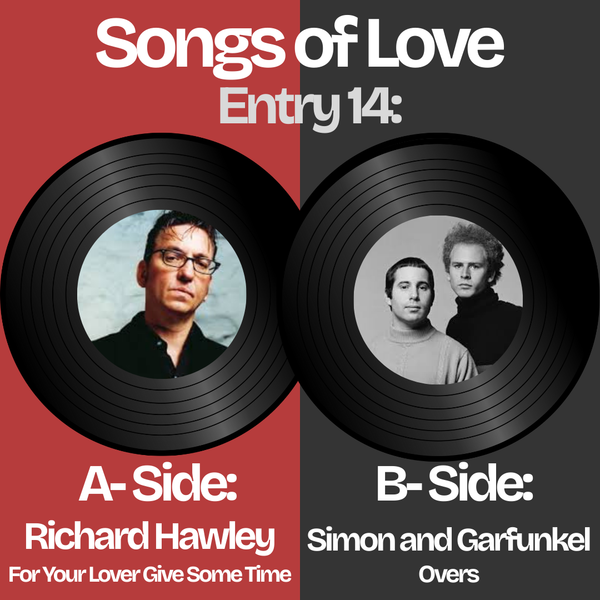
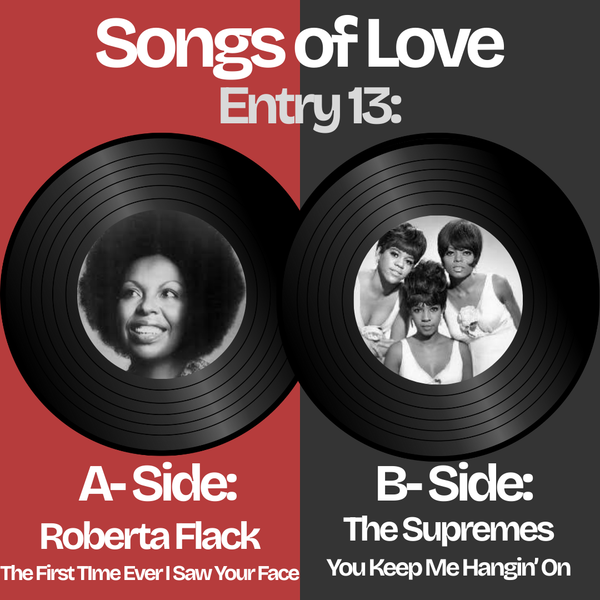
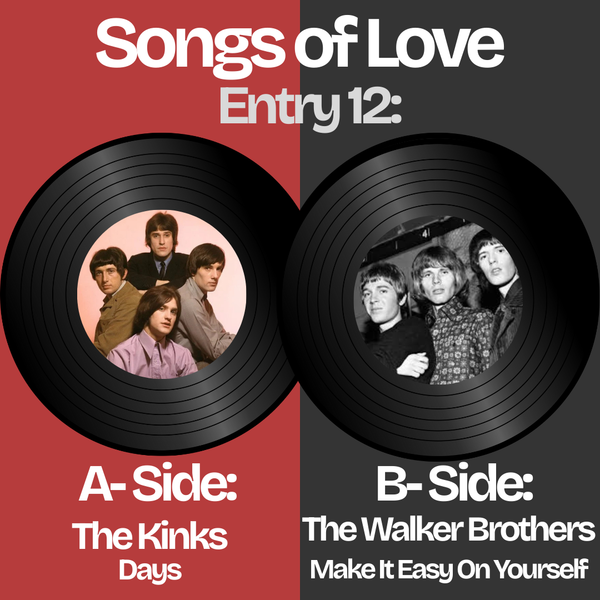
For each entry for this project, I will tackle one of each of these types, which will be labelled “A-Side” (the positive song) and “B-Side” (the negative one). These have been paired by a combination of random chance and choice, via Spotify’s shuffle function, my contemporary version of the Gysin/Burroughs/Bowie cut-up technique. At times, these songs will speak very directly to each other; more often than not, they will pick up minor aspects of each other – a feeling or image or stage of life approached from different angles. In general, these connections will be left implicit, because this is so often the joy of art; picking up on stray thoughts and connections. And, of course, my readers will undoubtedly pick up on many, many such connections that have passed me by entirely.
One minor rule of sorts is that I try to keep the spread as wide as possible: to this end, no artists will be repeated within either the “A-side” or “B-side” category (with one very specific exception, within a single B-side entry, coming up quite early). Some feature in both, and some personnel feature more than once (Paul McCartney, for instance, will be appearing in two A-sides early on – one a Beatles song, the other a solo song), but in general, you can expect to see a good spread. Sometimes, such as in the first entry, I have paired artists based on genre, but more often the aforementioned shuffle has thrown up two quite different artists/songs in tandem, which to my mind is no bad thing. One of the things I want to do here is to look at connections and dialogues across decades and genres, which is another reason to want as wide a spread as possible. It is also worth saying that I have not applied the same criteria to songwriters – you can expect to see the likes of Burt Bacharach showing up quite frequently.
As to why I’m doing this, it’s simple enough, really: I’m fascinated by love songs. The sheer breadth of what they can cover is extraordinary, as is the fact that they combine the particular and the universal in the way that lyric poetry aims for – how many of us have recognised ourselves or our circumstances in a love song? Some artists, such as the Manic Street Preachers in their early Situationist sloganeering days, have disdained love songs as simple and straightforward, but in fact they’re anything but; not only do songwriters who deal in the vicissitudes of love from Leonard Cohen to Taylor Swift find all kinds of nuances and niches, but even what seem like the most unabashed classical love songs by writers like Irving Berlin or Rodgers and Hammerstein often turn out, on closer inspection, to have more going on beneath the surface than was immediately apparent. They speak directly to a facet of human experience that is, by nature, turbulent and overwhelming, and so any love song worth its salt must tap into that.
Like a lot of what I do, this is an appeal to the value of the popular. I bring a quasi-academic eye because that’s my background, but I try to avoid pretension, or claiming these songs to be something they’re not. Art is, by its nature, subjective; a given reader will likely dislike some of the songs I cover. For that matter, I don’t love them all myself, though I do find something of interest or value in all of them. At base, though, I want to make a case that all of these songs, and the love song in general, are inherently worthwhile and worthy of study and consideration. There's nothing throwaway about songs that express our deepest emotions.