2025 Cultural Highlights
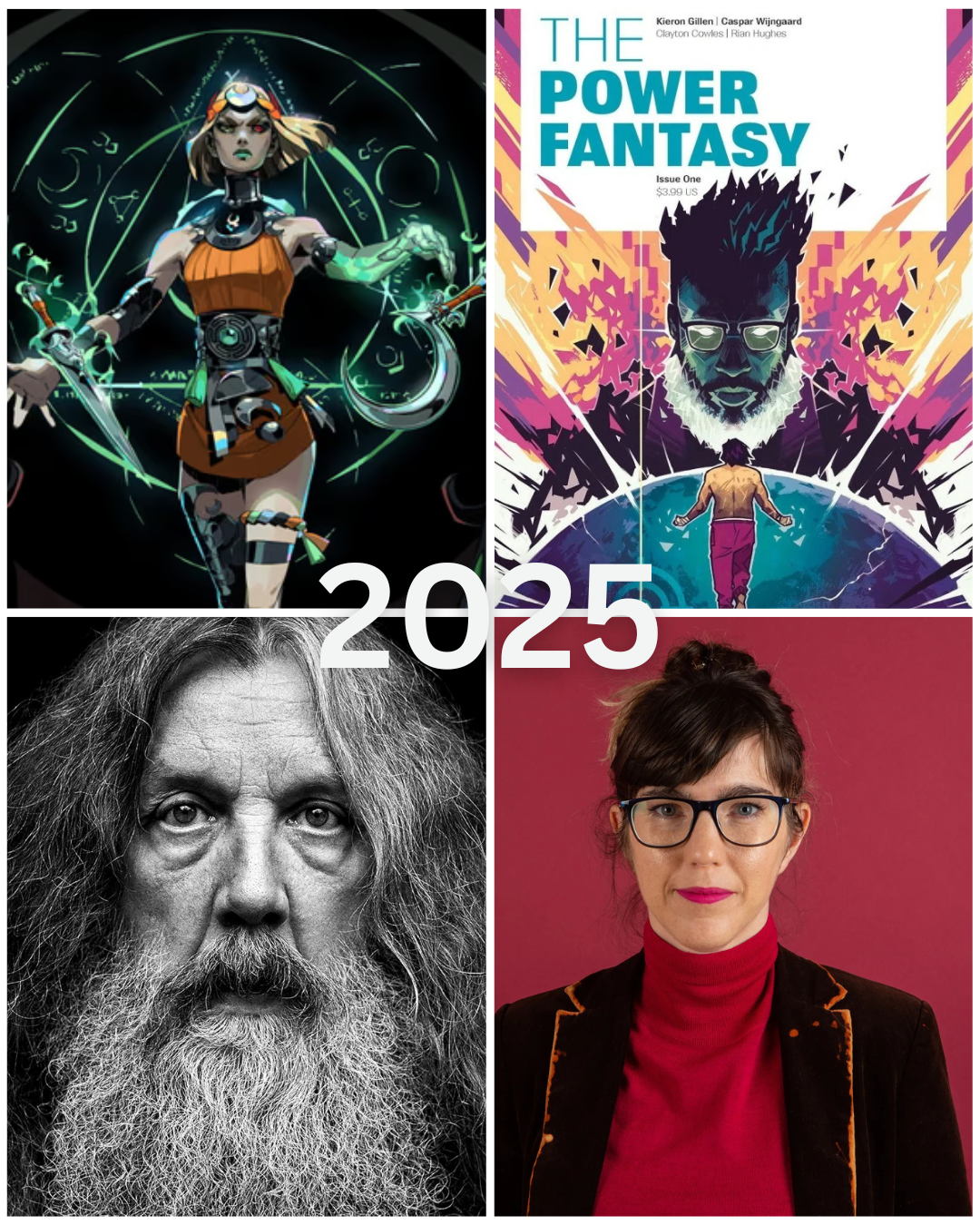
Two things I love are lists and spreading the word of cultural phenomena that I enjoy. So every year I like to combine those two into one beautiful whole. Let’s celebrate 2025 with all it brought us (well, me).
Top 5 Games That I’ve Played This Year
1. Hades 2
It was almost inevitable, really. Hades was (in common, it seems, with most people who’ve played it) one of my favourite games of the last decade, and so all its sequel really needed to do was more of the same. Not that I expected Supergiant, one of the most consistently inventive indie studios around, to rest on their laurel crowns, and they certainly didn’t. I don’t need to say too much about this one, because I’ve already said it all, at length. Suffice to say that my expectations were extremely high, and they were surpassed.
2. Clair Obscur: Expedition 33
Again, I’ve had a bit to say about this one already (but note spoilers). Perhaps the most impactful game I’ve played this year, for its gorgeous landscapes, its phenomenal voice acting, and most of all, its extraordinary writing. It’s a game of real emotional intelligence, with a lot to say about grief and art. Clearly, I’m not alone; lots of people have written and spoken about the impact the game’s had on them, and it seems to have been nominated for every possible award (a sentence which I wrote some weeks ago and has now aged poorly, but oh well). Nevertheless, it’s the kind of game with which you experience a uniquely personal relationship, and I cherish that fondly.
As an addendum to all of this, the game has recently been dominating headlines with the revelation that the developers used generative AI at early stages in the game’s development to construct placeholder assets. I had to think about whether that disqualified the game from this list (as it did from various awards now, although I gather that was more a matter of disclosure than the actual use). Eventually I decided it didn’t, because this is so clearly a work of human artistry to its core and there doesn’t seem to be anything remotely AI-generated in the final product, but that’s not to say this kind of thing shouldn’t be discussed and called out where necessary.
3. Metaphor Re. Fantaszio
I’m a big Persona fan. I’m a big fan of high fantasy, especially when it’s all about grand politics and battling ideologies. So it’s not a shock that the combination of those two things would be right up my alley. Metaphor tells a clever, expansive story. Its allegories are not exactly subtle, but they are broad; like the X-Men, it’s about prejudice and power in general, more so than in any specific instance. But it's also about utopianism, and the power of fantasy and of imagination. Couple that with some great music – a highlight of Shoji Meguro’s already storied career – a quirky but coherent visual design philosophy, and some nice variations on the Persona/Shin Megami Tensei battle system, and it's a recipe for a fun and thought-provoking journey.
4. Crusader Kings 3
As all of the above suggests, I love games as a storytelling medium. They’re unrivalled for immersion (except perhaps by some forms of theatre), and the degree to which player agency shapes their experience of the story provides an almost endless number of possibilities for storytelling, whether that be the choice-based stories of many RPGs (e.g. Baldur’s Gate 3, my favourite game of two years ago) or the subtle environmental storytelling of something like Elden Ring (my favourite game that I played last year, and which I’ve recently gotten sucked back into), which requires a good deal of effort on the part of the player. All of which might seem like an odd way to introduce a strategy game, but part of the brilliance of CK3 is that it is, among other things, an emergent storytelling engine. This is true of Paradox’s other grand strategy games; I love the alternate histories that emerge from something like Europa Universalis IV. But with CK3, this is all personalised, and centred around characters. Suddenly, your strategic decisions take on a different tone – what’s to be done about your feckless son who stands to inherit? Or your formerly loyal brother whose new dukedom makes him a rival? It’s a game that constantly throws up surprises, and I love it for that.
5. Trails in the Sky 1st Chapter
Trails is one of my favourite series, and one that I’m constantly banging the drum for, making it all the sweeter that we fans have been eating well lately. In fact, there’ve been two new Trails games in the last twelve months: Trails Through Daybreak 2, and this remake of the very first game. I had difficulty choosing between the two, but ultimately plumped for this one, largely because it’s a very faithful remake of a great game. If anything, I have issues with it being too faithful at times – some dialogue stacks up oddly against later developments in the series, but honestly, that’s something only an obsessive fan like me is going to notice. The gameplay is a nice balance between honouring the original and incorporating later advances in the series; where the original’s dungeons could be a bit of a slog, for instance, the remake never drags. Plus, as any fan knows, Olivier is worth the price of admission by himself, especially when voiced by Matt Mercer.
(Honourable mentions: Resident Evil 4 Remake, another very good example of how a faithful remake can also feel new and fresh; Like A Dragon: Pirate Yakuza in Hawaii, which in typical Like a Dragon fashion manages to be as wacky as the title suggests while also telling an engaging and coherent story; and while I played it first last year, as mentioned above, I have put dozens of hours into Elden Ring in the last few weeks, so it probably needs a mention.)
Top 5 Books That I’ve Read This Year (Fiction)
1. The Great When by Alan Moore
Alan Moore is perhaps my favourite living writer, so this is hardly a shock. And yet, this book is a bit of a departure for him. Intended as the first in a five-part series, this is probably his most readable piece of prose fiction to date. Which is to say, it’s a psychogeographic magical realist take on London and its attendant mythology, haunted by Aleister Crowley and William Blake. But it does lack the formal experimentation of his magnum opus Jerusalem, focusing instead on Moore’s gifts of characterisation and dialogue (which are, it must be said, extremely evident in his other books as well). Moore fans will enjoy touches like a very different take on Jack the Ripper from that explored in From Hell, and if you’re new to his prose, this is now perhaps the best place to start.
2. Middlemarch by George Eliot
The first of two successive entries on this list that have been sitting on my shelf looking forbidding for many years. At well over 700 pages, Middlemarch is a daunting tome, and took me a few months to plough through, but I never found myself discouraged by the scale of the task. I think that’s because, like the best realist novels, it’s a lively read, full of humanity and wit. The characters are well-drawn and largely sympathetic, yet driven by vice, prejudice and fear (apart from Will Ladislaw, the blandest man to ever haunt a work of fiction). More than that, though, it’s a great picture of a community, where everyone is inescapably wrapped up in each other’s business and nobody can ever quite strike out alone. Victorian realism is far from my favourite genre or time period, but I enjoyed this at least immensely.
3. The Silmarillion by J.R.R. Tolkien
It took me twenty-odd years, but I finally got to it. And like Middlemarch, perhaps even more so, what surprised me most is how readable it is. Tolkien’s medievalist background is on full display here, with not only the scale of the mythology but also much of the language recalling Norse and Old English epics (or rather, pre-contemporary translations of them). The depth of Tolkien’s lifelong creation never fails to astound – I moved on from this to Unfinished Tales, which is in some ways even more interesting with its more visible editorial hand by Christopher Tolkien, whose task of sorting out his father’s scattered work was no less gargantuan. But this is also, at heart, a really good story, and one which lends yet greater interest to one of my favourite stories of all time. I’m gearing myself up for my first Lord of the Rings reread in over two decades at some point soon. Wish me luck.
4. The City and its Uncertain Walls by Haruki Murakami
Another of my favourite living writers, and another piece of magical realism to boot. Unlike with Moore, this is probably not Murakami’s most accessible work, but it is a very solid one, full of the matter-of-fact yet dreamlike prose for which he’s known. Like many of his novels, it’s concerned with alternate worlds and their relationship to the real world, in a way that is less conceptually ambitious than Kafka on the Shore or Killing Commendatore, but rigorously drawn. The novel reaches back to the beginning of his career; in this case, an early novella with which, he claims in the epilogue, he was never quite happy. There’s a sense here of a career coming full circle; there’s no indication that this is to be Murakami’s last novel, thankfully, but if it were to turn out that way, it would make a fitting conclusion.
5. City of Last Chances by Adrian Tchaikovsky
This is my first Tchaikovsky book, though his (very memorable) name has been inescapable in fantasy and sci-fi circles in recent years. In something of a theme for this list, it’s a wonderful portrait of a world; while its characters are well-drawn, the main source of interest is their various interactions, and how those add up to the titular city. Its POV structure is fairly standard in many fantasy books these days, but this one is more interesting than most for its objectivity; each chapter is introduced with a brief sketch of the POV characters and their situation, and several chapters skip between chapters to give a “mosaic” sense of wider events fitting together. It’s the first in a series, and I’m looking forward to tracking down the others soon.
(Honourable mentions: Fleischerei by Saoirse Ní Chiaragáin, a beautifully messed-up story of obsession and self-harm (which, full disclaimer, is written by one of my oldest friends); One Last Stop by Casey McQuiston, a rare foray into contemporary romance for me, but one for which I was well rewarded with a witty and moving read; I also reread Lolita this year, which obviously remains a masterpiece, but I’m only counting first-time reads.)
Top 6 Books That I’ve Read This Year (Non-Fiction)
(It’s six because I completely forgot about one until after I’d written the list, and then decided I couldn’t leave that one off and didn’t want to get rid of any of the others in its favour. Hey, this kind of thing is arbitrary by its nature anyway.)
1. Notes to Self by Emilie Pine
Yes, I’m extremely late to this one, I’m aware. It created a lot of buzz and won every award going a few years ago, but I’ve somehow failed to get around to it until now. Fair to say it was worth the wait, though; a series of bracingly honest personal essays written with heart and a surprising degree of humour. I found myself, for personal reasons, particularly impressed by the way Pine uses her academic career both as background and at times to inform the ways the essays work (it’s critical to at least one of them, and her writing style – while far more personal than any academic writing – emerges clearly from a kind of confessional essay which isn’t too far from the late 20th-century drama in which she specialises).
2. The Message by Ta-Nehisi Coates
A book so important it caused a restructure of CBS News. I’m being slightly facetious (not least because the host of that infamous interview has actually been promoted), but it’s a clear indicator of the kind of atmosphere around this book (and indeed discourse more generally in the US), which dares to suggest that Palestinians may not, in fact, be treated entirely fairly in Israel. Written before the October 7th attacks, it’s about prejudice and everyday bigotry rather than armed conflict, and the Palestine section follows essays on similar topics based around trips to Senegal and South Carolina. Coates is one of my favourite living writers of non-fiction (both the book itself and the blurb place him pointedly in the tradition of James Baldwin), and this is typically reflective, exploring the role of essays and journalism in shaping the contemporary world.
3. Catch a Wave: The Rise, Fall and Redemption of The Beach Boys’ Brian Wilson by Peter Ames Carlin
2025 was, among many other things, the year I finally “got” Brian Wilson. Not the Beach Boys, who aren’t exactly a difficult band to like, but Wilson as an artist, in all his strange complexity. That he died this year was largely a coincidence, but did help to sharpen my commitment to delve into his life and career. My main source for this was the ever-brilliant podcast A History of Rock Music in 500 Songs by Andrew Hickey, whose final Beach Boys episode was released this year, but feeling there’s no substitute for a good biography, I got this as a recommendation from Hickey. It’s sadly out of date now, having been updated in the mid-2010s, but this just means it gets to end on the redemptive, positive note implied by the title. The author is the kind of exhaustive fan that Wilson’s work tends to attract, but has a good eye for the man’s undeniable flaws, even if he does generally come across (as in most accounts, unless you’re Mike Love) as more sinned against than sinning. No doubt there’s be more Wilson biographies in the next 12 months or so covering his last years, but it’s hard to see this one being bettered in a general sense.
4. Bury My Heart at Wounded Knee by Dee Brown
As I understand it, this is very, very far from being the most up to date historiography of the 19th century genocides of Native American peoples, having been, having been originally published in 1970, and no doubt there are all kinds of details in it that are factually wrong or otherwise problematic. That said, it’s easy to see why it was so revolutionary. Two things in particular stood out to me; the first being its effectiveness as a narrative. It’s an extended tragedy which plays out over decades, whose key characters are brought vividly to life throughout, not least by the extraordinary photographs reproduced within. The second is its perspective; Brown, in seeking to refocus the “how the west was won” story, chooses to use terminology that would have been common among some of the people he describes. So the various American presidents are “Great Fathers;” months are given descriptive names rather than January, February etc. It's the sort of thing that could easily become patronising or tokenistic, but because it’s in tune with the book’s wider aims, it works, for me at least.
5. The Grass Ceiling by Eimear Ryan
Something strange and unexpected has happened to me in recent years: after being a lifelong refusenik, I’ve found myself getting into sports. Primarily rugby, but I do find myself watching more football and (to a lesser extent) GAA than before, and taking a real interest in them. And perhaps it’s partly the novelty of being a late bloomer as far as these interests goes, but I find myself not making a huge distinction between men’s and women’s sports (other than the obvious ones in terms of player salaries etc.). So I very much enjoyed this account by a committed camogie player, of the role the sport has played in her life, its place in her community and, most notably, the struggle for recognition of women’s sports more generally. Even as an outsider to this particular sport, I found myself engaging with the sheer passion for it that emanates from the page. In a year when (for instance) the Women’s Rugby World Cup smashed all available records for the women’s code (and came tantalisingly close to a few for the men’s as well), it felt a timely read.
6. Shakespeare is Hard, But So Is Life by Fintan O’Toole
Well, we’ve had music and sport already, so if we’re going down the list of “Ciarán’s interests,” education policy had to show up at some point. The title of this book is, in some ways, a little misleading – while it’s very much in favour of the idea of Shakespeare as complex and sometimes difficult, and that that is something to celebrate, it’s also about the idea that for many years we’ve been teaching his plays wrong. Following on from the Romantics and Victorians, we’ve been seeing his plays, especially the tragedies, as character studies, rather than action centred around a particular place, time and community. It’s a strong argument, cemented by in-depth readings of the four big tragedies (which happen also to be the four that cycle on the Leaving Cert in Ireland); I’d perhaps have liked more of the general argument at the expensive of the individual readings, but O’Toole is a gifted critic of literature and drama, and his point is very much taken.
(Honourable mentions: I Love You Byeeee by Adam Buxton, a very welcome follow-up to his previous Ramblebook which simultaneously blends his brand of offbeat comedy with reflective and moving memoir; Obsessed by Johnny Sexton, a must-read for any rugby fan and a typically honest look at the psychology of high-level sport; Homer and His Iliad by Robin Lane Fox, which I’ve yet to finish (which is why it didn’t make the list) but is very engaging, and full of bizarre details like an offhand mention of the author following Alexander’s example by running around the (presumed) walls of Troy naked.)
Top 5 Comic Series of the Year
1. The Power Fantasy by Kieron Gillen and Caspar Wijngaard
This is one of those comics you feel compelled to accost people on the street about, demanding that they read it (and by “you,” obviously I mean me). It’s a fascinating take on the idea of superpowers (though not, notably, superheroes), an idea pushed to several conceptual limits throughout. It’s frequently compared to Watchmen for its combination of conceptual and psychological complexity, as well as its “deconstruction” of superpowered antics, and while I think it’s doing something quite different to Watchmen, it’s a rare comic that deserves the comparison and stands up to it. If it even comes close to sticking the landing, it’ll be a high point of Gillen’s already storied career.
2. The Ultimates by Deniz Camp and Juan Frigeri
The new Ultimate line has been firing on all cylinders, for the most part, in this last year and a half or so. I’ve been loving Ultimate Spider-Man’s (Jonathan Hickman and various artists) take on a more mature Peter Parker and his family, and Ultimate X-Men’s (Peach Momoko) horror manga antics, but for me this is the crowning achievement of the line. It’s a fascinating take on the Avengers (or a similar group) as a resistance group; Luke Cage as a prison rioter has been a particular highlight. The shift in recent issues towards the Ultimates as a global grassroots movement of education and resistance in particular has been a brilliant move, one of those plot elements that points towards new ways of using superheroes. The series is coming to an end in the next few months, its real-time ticking clock (a brilliant formal move, incidentally) about to reach its conclusion, and I’m simultaneously excited to see how it all blows up, and very sorry to see it go.
3. The (Im)Mortal Thor by Al Ewing, Jan Bazaldua and Pasqual Ferry
If anything, it’s surprising that it’s taken this long for Al Ewing to get to Thor. As a writer, he’s drawn constantly to magic, and hence to symbols and stories, and he’s been able to bring those interests in full force here. The Immortal Thor was a grand narrative, framed from the beginning as a tragedy and modelled very consciously on Norse sagas, full of heroism and grand gestures (plus no small amount of meta-commentary on the comics industry, not least in the blisteringly satirical fake Roxxon issue). The Mortal Thor, as the series has become in the last few months, carries that forward, but with a much more grounded feel, especially in Pasqual Ferry’s art, which is remarkably unafraid to show the consequences of a large man swinging a massive hammer into people. I have no idea where this series could be going, but I’m very much along for the ride.
4. Fantastic Four by Ryan North and various artists
As with Ewing and Thor, it’s hard to think of a better mix of artist and characters than North and the FF. While I’m partial to the odd darker storyline (usually premised in “Reed Richards does something monumentally stupid”), the FF tend to work best with a lighter tone, emphasising their familial bonds. North is great at this, especially in his ear for comedic dialogue drawn from his origins as a webcomics writer (and as a long-term fan of Dinosaur Comics, I couldn’t be more pleased to see his success these days). He’s also remarkably good at handling the technobabble, drawing attention to both Reed and Sue’s academic backgrounds, and handling real scientific, psychological and sociological concepts deftly. Many issues to date have been clever, standalone sci-fi stories, often focused on a particular character, and North has done brilliantly in giving the requisite attention to each member of the FF, not to mention their children and Ben’s wife Alicia (who has been a highlight of the series). And, not incidentally, North writes Doom better than almost anyone, carefully balancing his ridiculous pomposity with an air of real menace rooted in genuine intelligence. Which is not unimportant, given…
5. One World Under Doom by Ryan North and R.B. Silva
These kinds of big event books have a mixed history. Many centre around gimmicky changes to the status quo (vampires! Asgard on earth! Mark Millar writing the entire universe out of character!) which require books to pause their ongoing storylines for a few months of themed runaround. The best are about telling us something about this universe and its characters on an individual basis; Judgement Day from a few years ago is a highlight of both the wider Marvel line and my favourite ever era of X-Men. Thankfully, this one is very much in the latter category, centred around a take on Doom which brings his pride and ambition to almost unprecedented levels, but ends with a focus on his most humanising aspect. Along the way, it allows for some interesting moral debates in its associated books, and its nine-issue length means the story really gets the requisite room to breathe – so much so that one issue can revolve entirely around a sit-down TV debate between Doom and Reed Richards. This is the flip-side to that lighter FF tone I mentioned previously, and North handles both very well indeed.
(Honourable mentions, as well as the other Ultimates comics mentioned, have to go to Saladin Ahmed’s Daredevil, a run I was very sorry to see end; Hickman and [artist]’s Imperial, which could have done with a few more issues to breathe but was bursting with typical Hickman-esque ambition; Gillen and Stephanie Hans’s continuation Die: Loaded, which has really just started but seems every bit as haunting and atmospheric as the first)
A few other cultural highlights:
- I didn’t feel I’d seen enough films this year to make a decent list, but highlights have included Ryan Coogler’s Sinners and Robert Eggers’ Nosferatu. Big year for vampires, apparently.
- Andor was superb, but if you’re reading this you probably already know that.
- Doctor Who was a very mixed bag in 2025 (including The War Between the Land and the Sea, which started promising but ended up disappointing, very much like most Silurians/Sea Devils stories since 1970), but there were some real bright spots; ‘Lux’ and ‘The Story and the Engine’ were both among the strongest episodes of this (quite short) era.
- My podcast listening was dominated by the aforementioned A History of Rock Music in 500 Songs and various rugby podcasts. The former I’d recommend to just about anyone, as I’ve spent the last two years obsessively evangelising it, while the latter are a bit more specialised.
- As always, I watched a fair amount of actual play TTRPG content online, particularly the Mystery Quest and Chaotic Neutral channels, both of which are always lively and varied. I also tentatively got back into Critical Role after stalling 50 episodes into campaign 3, so we’ll see how that goes.
As for 2026? I’ve already started in on my Christmas reading (Andrew Porter’s Heart on my Sleeve is well worth a read for anyone interested in sports psychology, and I’m midway through Shon Faye’s interesting and affecting Love in Exile), and there’s plenty to look forward to. A new Trails game and a remake of Yakuza 3 in the first two months, as well as a new Fire Emblem at some point; I’m intrigued by Nolan’s Odyssey, as I’ve been looking for a solid cinematic take on mythology for some time; The Power Fantasy is almost certainly going to end this year, as is the Ultimates series, and much as I’ll miss them, the conclusions should be worth looking forward to. And then, as with every year, there are all the films, books, games, comics etc. that I haven’t heard of yet that will intrigue and delight over the next 12 months.
Happy new year to all readers, and do let me know what you’ve enjoyed in the last year, and what you’re looking forward to in the next.